In the late nineteenth and early twentieth centuries, European settlers from diverse backgrounds transformed Ontario. By 1881, German speakers made up almost ten per cent of the province's population and the German language was spoken in businesses, public schools, churches, and homes. German speakers in Ontario – children, parents, teachers, and religious groups – used their everyday practices and community institutions to claim a space for bilingualism and religious diversity within Canadian society.
In The Boundaries of Ethnicity Benjamin Bryce considers what it meant to be German in Ontario between 1880 and 1930. He explores how the children of immigrants acquired and negotiated the German language and how religious communities relied on language to reinforce social networks. For the Germans who make up the core of this study, the distinction between insiders and outsiders was often unclear. Boundaries were crossed as often as they were respected. German ethnicity in this period was fluid, and increasingly interventionist government policies and the dynamics of generational change also shaped the boundaries of ethnicity.
German speakers, together with immigrants from other countries and Canadians of different ethnic backgrounds, created a framework that defined relationships between the state, the public sphere, ethnic spaces, family, and religion in Canada that would persist through the twentieth century. The Boundaries of Ethnicity uncovers some of the origins of Canadian multiculturalism and government attempts to manage this diversity.
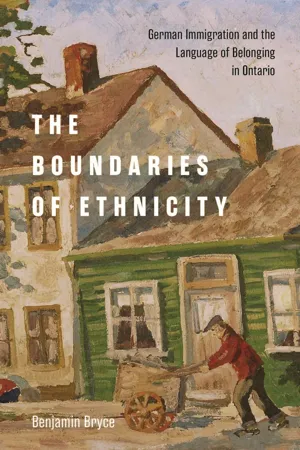
eBook - ePub
The Boundaries of Ethnicity
German Immigration and the Language of Belonging in Ontario
- English
- ePUB (mobile friendly)
- Available on iOS & Android
eBook - ePub
The Boundaries of Ethnicity
German Immigration and the Language of Belonging in Ontario
About this book
Information
Publisher
McGill-Queen's University PressYear
2022Print ISBN
9780228013952
9780228013945
eBook ISBN
9780228014898
Table of contents
- Cover Page
- Title Page
- Copyright
- Dedication
- Contents
- Figures and Tables
- Acknowledgments
- A Note on the Cover Image
- Introduction: The Boundaries of Ethnicity
- One / The State and Ethnicity
- Two / Making Ethnic Spaces
- Three / Ethnic Practice
- Conclusion: Citizenship, Ethnicity, and Pluralism
- Notes
- Bibliography
- Index
Trusted by 375,005 students
Access to over 1.5 million titles for a fair monthly price.
Study more efficiently using our study tools.
Frequently asked questions
Yes, you can cancel anytime from the Subscription tab in your account settings on the Perlego website. Your subscription will stay active until the end of your current billing period. Learn how to cancel your subscription
No, books cannot be downloaded as external files, such as PDFs, for use outside of Perlego. However, you can download books within the Perlego app for offline reading on mobile or tablet. Learn how to download books offline
Perlego offers two plans: Essential and Complete
- Essential is ideal for learners and professionals who enjoy exploring a wide range of subjects. Access the Essential Library with 800,000+ trusted titles and best-sellers across business, personal growth, and the humanities. Includes unlimited reading time and Standard Read Aloud voice.
- Complete: Perfect for advanced learners and researchers needing full, unrestricted access. Unlock 1.5M+ books across hundreds of subjects, including academic and specialized titles. The Complete Plan also includes advanced features like Premium Read Aloud and Research Assistant.
We are an online textbook subscription service, where you can get access to an entire online library for less than the price of a single book per month. With over 1.5 million books across 990+ topics, we’ve got you covered! Learn about our mission
Look out for the read-aloud symbol on your next book to see if you can listen to it. The read-aloud tool reads text aloud for you, highlighting the text as it is being read. You can pause it, speed it up and slow it down. Learn more about Read Aloud
Yes! You can use the Perlego app on both iOS and Android devices to read anytime, anywhere — even offline. Perfect for commutes or when you’re on the go.
Please note we cannot support devices running on iOS 13 and Android 7 or earlier. Learn more about using the app
Please note we cannot support devices running on iOS 13 and Android 7 or earlier. Learn more about using the app
Yes, you can access The Boundaries of Ethnicity by Benjamin Bryce in PDF and/or ePUB format, as well as other popular books in History & North American History. We have over 1.5 million books available in our catalogue for you to explore.