Many people think that profound disability presents us with a real problem, often because it seems difficult to connect with someone who does not seem to think or act like us. Positioning profound disability in this way immediately sets up a 'them' and 'us', where the person with profound disability becomes the problematic 'other'. Attempts to bridge the 'them' and 'us' risk reducing everyone to the same where disability is not taken seriously.
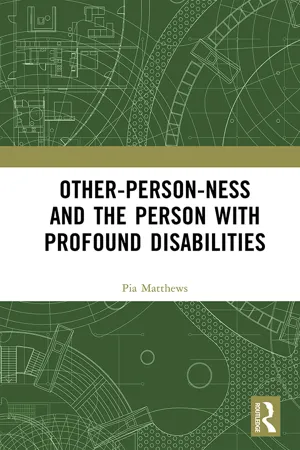
In contrast to a 'them' and 'us', and negative connotations of the other found in the existentialist philosophies of writers like Sartre and Beauvoir, Pia Matthews argues for a return to a positive view of the other. One positive approach to the other, based on an ethics of relationship as championed by Levinas, seems to mitigate the other-ness of profound disability. However, this still makes the person with profound disability dependent on the ethical concern of the more powerful other. Instead, this book argues for return to a personalist philosophy of being offered by Mounier, Marcel, and Wojty?a, and deepened by participation, belonging, and the possibility of contributing to the good of all. This deepened philosophy of being gives a more solid foundation for people who are especially at the mercy of others.
It will be of interest to all scholars and students of disability studies, philosophy and anthropology.
- 182 pages
- English
- ePUB (mobile friendly)
- Available on iOS & Android
eBook - ePub
Other-person-ness and the Person with Profound Disabilities
About this book
Information
Table of contents
- Cover
- Half Title
- Title Page
- Copyright Page
- Table of Contents
- 1. Other-person-ness and the person with profound disabilities
- 2. Emmanuel Mounier and the turn to the other in philosophy
- 3. Normalcy and the social construct of disability: Against the other according to Jean Paul Sartre and Simone de Beauvoir
- 4. Disabled others in relationships: The presence and the call of the other heard by Martin Buber and Emmanuel Levinas
- 5. In vulnerability and brokenness: Gabriel Marcel and being other
- 6. Inclusion, belonging and participation: God, being and other with Karol Wojtyła
- 7. Celebrating other-person-ness of the person with profound disability
- Index
Trusted by 375,005 students
Access to over 1.5 million titles for a fair monthly price.
Study more efficiently using our study tools.
Frequently asked questions
Yes, you can cancel anytime from the Subscription tab in your account settings on the Perlego website. Your subscription will stay active until the end of your current billing period. Learn how to cancel your subscription
No, books cannot be downloaded as external files, such as PDFs, for use outside of Perlego. However, you can download books within the Perlego app for offline reading on mobile or tablet. Learn how to download books offline
Perlego offers two plans: Essential and Complete
- Essential is ideal for learners and professionals who enjoy exploring a wide range of subjects. Access the Essential Library with 800,000+ trusted titles and best-sellers across business, personal growth, and the humanities. Includes unlimited reading time and Standard Read Aloud voice.
- Complete: Perfect for advanced learners and researchers needing full, unrestricted access. Unlock 1.5M+ books across hundreds of subjects, including academic and specialized titles. The Complete Plan also includes advanced features like Premium Read Aloud and Research Assistant.
We are an online textbook subscription service, where you can get access to an entire online library for less than the price of a single book per month. With over 1.5 million books across 990+ topics, we’ve got you covered! Learn about our mission
Look out for the read-aloud symbol on your next book to see if you can listen to it. The read-aloud tool reads text aloud for you, highlighting the text as it is being read. You can pause it, speed it up and slow it down. Learn more about Read Aloud
Yes! You can use the Perlego app on both iOS and Android devices to read anytime, anywhere — even offline. Perfect for commutes or when you’re on the go.
Please note we cannot support devices running on iOS 13 and Android 7 or earlier. Learn more about using the app
Please note we cannot support devices running on iOS 13 and Android 7 or earlier. Learn more about using the app
Yes, you can access Other-person-ness and the Person with Profound Disabilities by Pia Matthews in PDF and/or ePUB format, as well as other popular books in Social Sciences & Mind & Body in Philosophy. We have over 1.5 million books available in our catalogue for you to explore.