"Thoroughly 'reader friendly' in organization and presentation . . . an ideal introduction to the creation and rise of the Ptolemaic era of Egypt." —
Midwest Book Review
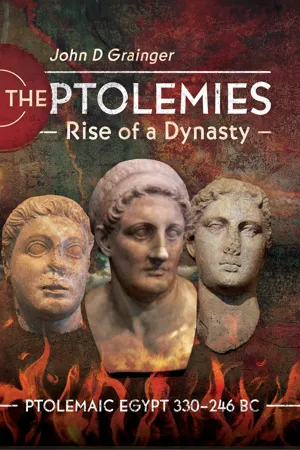
In this first volume of his trilogy on the Ptolemies, John Grainger explains how Ptolemy I established the dynasty's power in Egypt in the wake of Alexander the Great's death. Egypt had been independent for most of the fourth century BC, but was reconquered by the Persian Empire in the 340s. This is essential background for Ptolemaic history, since it meant that Alexander was welcomed as a liberator and, after the tyranny of Kleomenes, so was Ptolemy.
This was the essential basis of Ptolemy's power. He conciliated the Egyptians, but reinforced his military strength with Greek settlers, mainly retired or available soldiers. He built the city of Alexandria, but to his own requirements, not those planned by Alexander. The empire outside Egypt was acquired, perhaps for defense, perhaps by sheer greed. Ptolemy took over Cyrenaica (with difficulty), Cyprus, and Syria/Palestine. These had to be defended against his rivals, hence the development of his navy, and the Syrian Wars.
The succession was carefully managed, but not directly hereditary (Ptolemy II wasn't the eldest son), and the new king was very different. He fought repeated wars in Syria, built up his navy in the Aegean to the greatest seen in the ancient world, and extended his empire into the lands of the Red Sea, Sudan, and Ethiopia. He taxed the Egyptians mercilessly to fund all these activities. Yet few of his wars were successful, and he stored up trouble for his successors. This volume by a historian of the period delves into these events in a clear, compelling style.
- 320 pages
- English
- ePUB (mobile friendly)
- Available on iOS & Android
eBook - ePub
About this book
Information
Subtopic
Egyptian Ancient HistoryIndex
HistoryTable of contents
- Cover
- Halftitle
- Title
- Copyright
- Contents
- Maps
- Introduction
- Chapter 1 Ptolemy’s First Years
- Chapter 2 Egypt’s Defender
- Chapter 3 City, Family and Settlers
- Chapter 4 Securing Syria
- Chapter 5 Ptolemy’s Empire Revived
- Chapter 6 Ptolemy II’s First Decade
- Chapter 7 Governing Egypt
- Chapter 8 Arsinoe II
- Chapter 9 The First Syrian War
- Chapter 10 The Empire – The Nearby Mainland
- Chapter 11 The Empire – The Islands, the Asian Coasts, and the West
- Chapter 12 Expeditions to the South
- Chapter 13 The Chremonidean War
- Chapter 14 The Second Syrian War
- Chapter 15 Preparations for a New War
- Genealogical Tables
- Notes and References
- Bibliography
- Plate
Trusted by 375,005 students
Access to over 1.5 million titles for a fair monthly price.
Study more efficiently using our study tools.
Frequently asked questions
Yes, you can cancel anytime from the Subscription tab in your account settings on the Perlego website. Your subscription will stay active until the end of your current billing period. Learn how to cancel your subscription
No, books cannot be downloaded as external files, such as PDFs, for use outside of Perlego. However, you can download books within the Perlego app for offline reading on mobile or tablet. Learn how to download books offline
Perlego offers two plans: Essential and Complete
- Essential is ideal for learners and professionals who enjoy exploring a wide range of subjects. Access the Essential Library with 800,000+ trusted titles and best-sellers across business, personal growth, and the humanities. Includes unlimited reading time and Standard Read Aloud voice.
- Complete: Perfect for advanced learners and researchers needing full, unrestricted access. Unlock 1.5M+ books across hundreds of subjects, including academic and specialized titles. The Complete Plan also includes advanced features like Premium Read Aloud and Research Assistant.
We are an online textbook subscription service, where you can get access to an entire online library for less than the price of a single book per month. With over 1.5 million books across 990+ topics, we’ve got you covered! Learn about our mission
Look out for the read-aloud symbol on your next book to see if you can listen to it. The read-aloud tool reads text aloud for you, highlighting the text as it is being read. You can pause it, speed it up and slow it down. Learn more about Read Aloud
Yes! You can use the Perlego app on both iOS and Android devices to read anytime, anywhere — even offline. Perfect for commutes or when you’re on the go.
Please note we cannot support devices running on iOS 13 and Android 7 or earlier. Learn more about using the app
Please note we cannot support devices running on iOS 13 and Android 7 or earlier. Learn more about using the app
Yes, you can access The Ptolemies, Rise of a Dynasty by John D. Grainger in PDF and/or ePUB format, as well as other popular books in History & Egyptian Ancient History. We have over 1.5 million books available in our catalogue for you to explore.