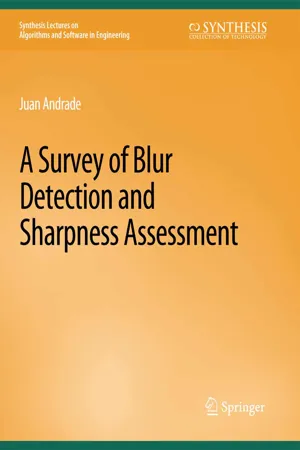
A Survey of Blur Detection and Sharpness Assessment Methods
eBook - PDF

A Survey of Blur Detection and Sharpness Assessment Methods

  1. English
  2. PDF
  3. Available on iOS & Android
eBook - PDF

A Survey of Blur Detection and Sharpness Assessment Methods

About this book

Blurring is almost an omnipresent effect on natural images. The main causes of blurring in images include: (a) the existence of objects at different depths within the scene which is known as defocus blur; (b) blurring due to motion either of objects in the scene or the imaging device; and (c) blurring due to atmospheric turbulence.

Automatic estimation of spatially varying sharpness/blurriness has several applications including depth estimation, image quality assessment, information retrieval, image restoration, among others.

There are some cases in which blur is intentionally introduced or enhanced; for example, in artistic photography and cinematography in which blur is intentionally introduced to emphasize a certain image region. Bokeh is a technique that introduces defocus blur with aesthetic purposes. Additionally, in trending applications like augmented and virtual reality usually, blur is introduced in order to provide/enhance depth perception.

Digital images and videos are produced every day in astonishing amounts and the demand for higher quality is constantly rising which creates a need for advanced image quality assessment. Additionally, image quality assessment is important for the performance of image processing algorithms. It has been determined that image noise and artifacts can affect the performance of algorithms such as face detection and recognition, image saliency detection, and video target tracking. Therefore, image quality assessment (IQA) has been a topic of intense research in the fields of image processing and computer vision. Since humans are the end consumers of multimedia signals, subjective quality metrics provide the most reliable results; however, their cost in addition to time requirements makes them unfeasible for practical applications. Thus, objective quality metrics are usually preferred.

Frequently asked questions

Yes, you can cancel anytime from the Subscription tab in your account settings on the Perlego website. Your subscription will stay active until the end of your current billing period. Learn how to cancel your subscription.
No, books cannot be downloaded as external files, such as PDFs, for use outside of Perlego. However, you can download books within the Perlego app for offline reading on mobile or tablet. Learn more here.
Perlego offers two plans: Essential and Complete
  • Essential is ideal for learners and professionals who enjoy exploring a wide range of subjects. Access the Essential Library with 800,000+ trusted titles and best-sellers across business, personal growth, and the humanities. Includes unlimited reading time and Standard Read Aloud voice.
  • Complete: Perfect for advanced learners and researchers needing full, unrestricted access. Unlock 1.4M+ books across hundreds of subjects, including academic and specialized titles. The Complete Plan also includes advanced features like Premium Read Aloud and Research Assistant.
Both plans are available with monthly, semester, or annual billing cycles.
We are an online textbook subscription service, where you can get access to an entire online library for less than the price of a single book per month. With over 1 million books across 1000+ topics, we’ve got you covered! Learn more here.
Look out for the read-aloud symbol on your next book to see if you can listen to it. The read-aloud tool reads text aloud for you, highlighting the text as it is being read. You can pause it, speed it up and slow it down. Learn more here.
Yes! You can use the Perlego app on both iOS or Android devices to read anytime, anywhere — even offline. Perfect for commutes or when you’re on the go.
Please note we cannot support devices running on iOS 13 and Android 7 or earlier. Learn more about using the app.
Yes, you can access A Survey of Blur Detection and Sharpness Assessment Methods by Juan Andrade in PDF and/or ePUB format, as well as other popular books in Technology & Engineering & Signals & Signal Processing. We have over one million books available in our catalogue for you to explore.

Table of contents

  1. Cover
  2. Copyright Page
  3. Title Page
  4. Dedication
  5. Contents
  6. Preface
  7. Acknowledgments
  8. Introduction
  9. Out-of-Focus Blur
  10. Image Quality Assessment
  11. No-Reference Image Assessment
  12. Summary and Future Directions
  13. Bibliography
  14. Author's Biography