eBook - PDF
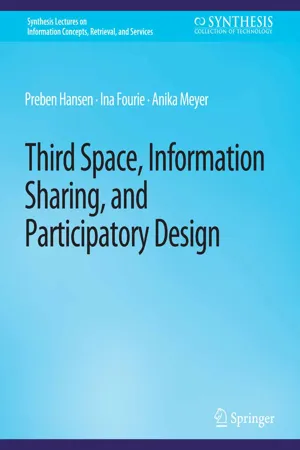
Third Space, Information Sharing, and Participatory Design
- 151 pages
- English
- PDF
- Available on iOS & Android
eBook - PDF
Third Space, Information Sharing, and Participatory Design
About this book
Society faces many challenges in workplaces, everyday life situations, and education contexts. Within information behavior research, there are often calls to bridge inclusiveness and for greater collaboration, with user-centered design approaches and, more specifically, participatory design practices. Collaboration and participation are essential in addressing contemporary societal challenges, designing creative information objects and processes, as well as developing spaces for learning, and information and research interventions. The intention is to improve access to information and the benefits to be gained from that. This also applies to bridging the digital divide and for embracing artificial intelligence. With regard to research and practices within information behavior, it is crucial to consider that all users should be involved. Many information activities (i.e., activities falling under the umbrella terms of information behavior and information practices) manifest through participation, and thus, methods such as participatory design may help unfold both information behavior and practices as well as the creation of information objects, new models, and theories. Information sharing is one of its core activities. For participatory design with its value set of democratic, inclusive, and open participation towards innovative practices in a diversity of contexts, it is essential to understand how information activities such as sharing manifest itself. For information behavior studies it is essential to deepen understanding of how information sharing manifests in order to improve access to information and the use of information. Third Space is a physical, virtual, cognitive, and conceptual space where participants may negotiate, reflect, and form new knowledge and worldviews working toward creative, practical and applicable solutions, finding innovative, appropriate research methods, interpreting findings, proposing new theories, recommending next steps, and evendesigning solutions such as new information objects or services. Information sharing in participatory design manifests in tandem with many other information interaction activities and especially information and cognitive processing. Although there are practices of individual information sharing and information encountering, information sharing mostly relates to collaborative information behavior practices, creativity, and collective decision-making. Our purpose with this book is to enable students, researchers, and practitioners within a multi-disciplinary research field, including information studies and Human–Computer Interaction approaches, to gain a deeper understanding of how the core activity of information sharing in participatory design, in which Third Space may be a platform for information interaction, is taking place when using methods utilized in participatory design to address contemporary societal challenges. This could also apply for information behavior studies using participatory design as methodology. We elaborate interpretations of core concepts such as participatory design, Third Space, information sharing, and collaborative information behavior, before discussing participatory design methods and processes in more depth. We also touch on information behavior, information practice, and other important concepts. Third Space, information sharing, and information interaction are discussed in some detail. A framework, with Third Space as a core intersecting zone, platform, and adaptive and creative space to study information sharing and other information behavior and interactions are suggested. As a tool to envision information behavior and suggest future practices, participatory design serves as a set of methods and tools in which new interpretations of the design of information behavior studies and eventually new information objects are being initiated involving multiple stakeholders in future information landscapes. For this purpose, we argue thatThird Space can be used as an intersection zone to study information sharing and other information activities, but more importantly it can serve as a Third Space Information Behavior (TSIB) study framework where participatory design methodology and processes are applied to information behavior research studies and applications such as information objects, systems, and services with recognition of the importance of situated awareness.
Information
Table of contents
- Cover
- Copyright Page
- Title Page
- Contents
- List of Figures
- List of Tables
- Preface
- Acknowledgments
- Abbreviations
- Introduction: Contemporary Challenges Faced in the Emerging Information Context
- Foundation and Components
- Participatory Design as an Approach for Participation
- Third Space
- Information Sharing and Other Information Activities
- Third Space as an Intersection Zone for Information Behavior Studies
- Conclusion and the Way Forward
- Appendix A: General Guideline for Conducting a Participatory Design Workshop Called Future Workshop
- Bibliography
- Authors’ Biographies
Trusted by 375,005 students
Access to over 1.5 million titles for a fair monthly price.
Study more efficiently using our study tools.
Frequently asked questions
Yes, you can cancel anytime from the Subscription tab in your account settings on the Perlego website. Your subscription will stay active until the end of your current billing period. Learn how to cancel your subscription
No, books cannot be downloaded as external files, such as PDFs, for use outside of Perlego. However, you can download books within the Perlego app for offline reading on mobile or tablet. Learn how to download books offline
We are an online textbook subscription service, where you can get access to an entire online library for less than the price of a single book per month. With over 1.5 million books across 990+ topics, we’ve got you covered! Learn about our mission
Look out for the read-aloud symbol on your next book to see if you can listen to it. The read-aloud tool reads text aloud for you, highlighting the text as it is being read. You can pause it, speed it up and slow it down. Learn more about Read Aloud
Yes! You can use the Perlego app on both iOS and Android devices to read anytime, anywhere — even offline. Perfect for commutes or when you’re on the go.
Please note we cannot support devices running on iOS 13 and Android 7 or earlier. Learn more about using the app
Please note we cannot support devices running on iOS 13 and Android 7 or earlier. Learn more about using the app
Yes, you can access Third Space, Information Sharing, and Participatory Design by Preben Hansen,Ina Fourie,Anika Meyer in PDF and/or ePUB format, as well as other popular books in Computer Science & Computer Networking. We have over 1.5 million books available in our catalogue for you to explore.