- 102 pages
- English
- PDF
- Available on iOS & Android
eBook - PDF
About this book
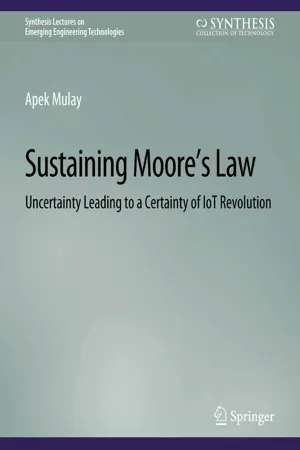
In 1965, Intel co-founder Gordon Moore, in ""Cramming more components onto Integrated Circuits"" in Electronics Magazine (April 19, 1965), made the observation that, in the history of computing hardware, the number of transistors on integrated circuits doubles approximately every two years. Since its inception in 1965 until recent times, this law has been used in the semiconductor industry to guide investments for long-term planning as well as to set targets for research and development. These investments have helped in a productive utilization of wealth, which created more employment opportunities for semiconductor industry professionals. In this way, the development of Moore's Law has helped sustain the progress of today's knowledge-based economy. While Moore's Law has, on one hand, helped drive investments toward technological and economic growth, thereby benefiting the consumers with more powerful electronic gadgets, Moore's Law has indirectly also helped to fuel other innovationsin the global economy. However, the Law of diminishing returns is now questioning the sustainability of further evolution of Moore's Law and its ability to sustain the progress of today's knowledge based economy. The lack of liquidity in the global economy is truly bringing the entire industry to a standstill and the dark clouds of an economic depression are hovering over the global economy. What factors have been ignored by the global semiconductor industry leading to a demise of Moore's Law? Do the existing business models prevalent in the semiconductor industry pose any problems? Have supply chains made that progress unsustainable? In today's globalized world, have businesses been able to sustain national interests while driving the progress of Moore's Law? Could the semiconductor industry help the entire global economy move toward a radiance of the new crimson dawn, beyond the veil of the darkest night by sustaining the progress of Moore's Law? The entire semiconductor industry isnow clamoring for a fresh approach to overcome existing barriers to the progress of Moore's Law, and this book delivers just that. Moore's Law can easily continue for the foreseeable future if the chip manufacturing industry becomes sustainable by having a balanced economy. The sustainable progress of Moore's Law advocates the ""heresy"" of transforming the current economic orthodoxy of monopoly capitalism into free-market capitalism. The next big thing that everybody is looking forward to after mobile revolution is the ""Internet of Things"" (IoT) revolution. While some analysts forecast that the IoT market would achieve 5.4 billion connections worldwide by 2020, the poor consumer purchasing power in global economy makes this forecast truly questionable. Sustaining Moore's Law presents a blueprint for sustaining the progress of Moore's Law to bring about IoT Revolution in the global economy.
Information
Subtopic
MatérielTable of contents
- Cover
- Copyright Page
- Title Page
- Contents
- Foreword
- Preface
- Acknowledgments
- 1 Impacts of Moore’s Law on Human Progress
- 2 From an Unsustainable to a Sustainable Progress of Moore’s Law
- 3 Impacts of Semiconductor Business Models on U.S. National Interests
- 4 Impacts of Semiconductor Business Models on Sustainability
- 5 Macroeconomic Cycles and Business Models for the Progress of Moore’s Law
- 6 Would Economics End Moore’s Law?
- 7 Design of Supply Chains for the Success of the Internet of ings (IoT)
- 8 The Macroeconomics of 450 mm Wafers
- 9 Moore’s Law Beyond 50
- 10 Macroeconomics of Semiconductor Manufacturing for Emerging Economies
- 11 The Internet of Things (IoT) Revolution
- 12 An Engagement with Semiconductor Industry Thought Leaders about the Future of the Semiconductor Industry
- Author’s Biography
Trusted by 375,005 students
Access to over 1.5 million titles for a fair monthly price.
Study more efficiently using our study tools.
Frequently asked questions
Yes, you can cancel anytime from the Subscription tab in your account settings on the Perlego website. Your subscription will stay active until the end of your current billing period. Learn how to cancel your subscription
No, books cannot be downloaded as external files, such as PDFs, for use outside of Perlego. However, you can download books within the Perlego app for offline reading on mobile or tablet. Learn how to download books offline
Perlego offers two plans: Essential and Complete
- Essential is ideal for learners and professionals who enjoy exploring a wide range of subjects. Access the Essential Library with 800,000+ trusted titles and best-sellers across business, personal growth, and the humanities. Includes unlimited reading time and Standard Read Aloud voice.
- Complete: Perfect for advanced learners and researchers needing full, unrestricted access. Unlock 1.5M+ books across hundreds of subjects, including academic and specialized titles. The Complete Plan also includes advanced features like Premium Read Aloud and Research Assistant.
We are an online textbook subscription service, where you can get access to an entire online library for less than the price of a single book per month. With over 1.5 million books across 990+ topics, we’ve got you covered! Learn about our mission
Look out for the read-aloud symbol on your next book to see if you can listen to it. The read-aloud tool reads text aloud for you, highlighting the text as it is being read. You can pause it, speed it up and slow it down. Learn more about Read Aloud
Yes! You can use the Perlego app on both iOS and Android devices to read anytime, anywhere — even offline. Perfect for commutes or when you’re on the go.
Please note we cannot support devices running on iOS 13 and Android 7 or earlier. Learn more about using the app
Please note we cannot support devices running on iOS 13 and Android 7 or earlier. Learn more about using the app
Yes, you can access Sustaining Moore’s Law by Apek Mulay in PDF and/or ePUB format, as well as other popular books in Technologie et ingénierie & Matériel. We have over 1.5 million books available in our catalogue for you to explore.