eBook - PDF
Data Exploration Using Example-Based Methods
- 151 pages
- English
- PDF
- Available on iOS & Android
eBook - PDF
Data Exploration Using Example-Based Methods
About this book
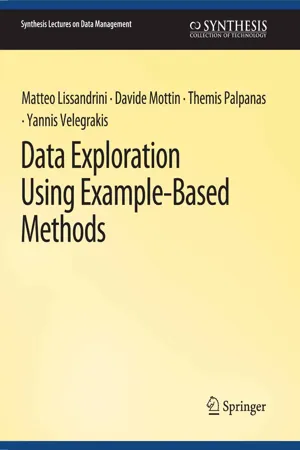
Data usually comes in a plethora of formats and dimensions, rendering the exploration and information extraction processes challenging. Thus, being able to perform exploratory analyses in the data with the intent of having an immediate glimpse on some of the data properties is becoming crucial. Exploratory analyses should be simple enough to avoid complicate declarative languages (such as SQL) and mechanisms, and at the same time retain the flexibility and expressiveness of such languages. Recently, we have witnessed a rediscovery of the so-called example-based methods, in which the user, or the analyst, circumvents query languages by using examples as input. An example is a representative of the intended results, or in other words, an item from the result set. Example-based methods exploit inherent characteristics of the data to infer the results that the user has in mind, but may not able to (easily) express. They can be useful in cases where a user is looking for information in an unfamiliar dataset, when the task is particularly challenging like finding duplicate items, or simply when they are exploring the data. In this book, we present an excursus over the main methods for exploratory analysis, with a particular focus on example-based methods. We show how that different data types require different techniques, and present algorithms that are specifically designed for relational, textual, and graph data. The book presents also the challenges and the new frontiers of machine learning in online settings which recently attracted the attention of the database community. The lecture concludes with a vision for further research and applications in this area.
Information
Table of contents
- Cover
- Copyright Page
- Title Page
- Contents
- Preface
- Acknowledgments
- Introduction
- Example-Based Approaches
- Open Research Directions
- Bibliography
- Authors' Biographies
Trusted by 375,005 students
Access to over 1.5 million titles for a fair monthly price.
Study more efficiently using our study tools.
Frequently asked questions
Yes, you can cancel anytime from the Subscription tab in your account settings on the Perlego website. Your subscription will stay active until the end of your current billing period. Learn how to cancel your subscription
No, books cannot be downloaded as external files, such as PDFs, for use outside of Perlego. However, you can download books within the Perlego app for offline reading on mobile or tablet. Learn how to download books offline
Perlego offers two plans: Essential and Complete
- Essential is ideal for learners and professionals who enjoy exploring a wide range of subjects. Access the Essential Library with 800,000+ trusted titles and best-sellers across business, personal growth, and the humanities. Includes unlimited reading time and Standard Read Aloud voice.
- Complete: Perfect for advanced learners and researchers needing full, unrestricted access. Unlock 1.5M+ books across hundreds of subjects, including academic and specialized titles. The Complete Plan also includes advanced features like Premium Read Aloud and Research Assistant.
We are an online textbook subscription service, where you can get access to an entire online library for less than the price of a single book per month. With over 1.5 million books across 990+ topics, we’ve got you covered! Learn about our mission
Look out for the read-aloud symbol on your next book to see if you can listen to it. The read-aloud tool reads text aloud for you, highlighting the text as it is being read. You can pause it, speed it up and slow it down. Learn more about Read Aloud
Yes! You can use the Perlego app on both iOS and Android devices to read anytime, anywhere — even offline. Perfect for commutes or when you’re on the go.
Please note we cannot support devices running on iOS 13 and Android 7 or earlier. Learn more about using the app
Please note we cannot support devices running on iOS 13 and Android 7 or earlier. Learn more about using the app
Yes, you can access Data Exploration Using Example-Based Methods by Matteo Lissandrini,Davide Mottin,Themis Palpanas,Yannis Velegrakis in PDF and/or ePUB format, as well as other popular books in Computer Science & Computer Networking. We have over 1.5 million books available in our catalogue for you to explore.