eBook - PDF
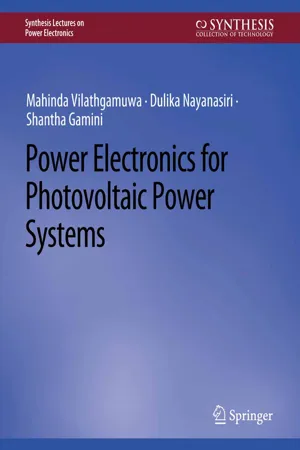
Power Electronics for Photovoltaic Power Systems
- 129 pages
- English
- PDF
- Available on iOS & Android
eBook - PDF
Power Electronics for Photovoltaic Power Systems
About this book
The world energy demand has been increasing in a rapid manner with the increase of population and rising standard of living. The world population has nearly doubled in the last 40 years from 3.7 billion people to the present 7 billion people. It is anticipated that world population will grow towards 8 billion around 2030. Furthermore, the conventional fossil fuel supplies become unsustainable as the energy demand in emerging big economies such as China and India would rise tremendously where the China will increase its energy demand by 75% and India by 100% in the next 25 years. With dwindling natural resources, many countries throughout the world have increasingly invested in renewable resources such as photovoltaics (PV) and wind. The world has seen immense growth in global photovoltaic power generation over the last few decades. For example, in Australia, renewable resources represented nearly 15% of total power generation in 2013. Among renewable resources, solar and wind account for 38% of generation. In near future, energy in the domestic and industrial sector will become ""ubiquitous"" where consumers would have multiple sources to get their energy. Another such prediction is that co-location of solar and electrical storage will see a rapid growth in global domestic and industrial sectors; conventional power companies, which dominate the electricity market, will face increasing challenges in maintaining their incumbent business models. The efficiency, reliability and cost-effectiveness of the power converters used to interface PV panels to the mains grid and other types of off-grid loads are of major concern in the process of system design. This book describes state-of-the-art power electronic converter topologies used in various PV power conversion schemes. This book aims to provide a reader with a wide variety of topologies applied in different circumstances so that the reader would be able to make an educated choice for a given application.
Information
Table of contents
- Cover
- Copyright Page
- Title Page
- Contents
- 1 PV Power Conversion Systems
- 2 Centralized PV Power Conversion Systems
- 3 Distributed PV Power Conversion Systems
- 4 Active Power Decoupling in Single-Phase Micro Inverters
- 5 Energy Storage Interfacing
- References
- Authors’ Biographies
Trusted by 375,005 students
Access to over 1.5 million titles for a fair monthly price.
Study more efficiently using our study tools.
Frequently asked questions
Yes, you can cancel anytime from the Subscription tab in your account settings on the Perlego website. Your subscription will stay active until the end of your current billing period. Learn how to cancel your subscription
No, books cannot be downloaded as external files, such as PDFs, for use outside of Perlego. However, you can download books within the Perlego app for offline reading on mobile or tablet. Learn how to download books offline
Perlego offers two plans: Essential and Complete
- Essential is ideal for learners and professionals who enjoy exploring a wide range of subjects. Access the Essential Library with 800,000+ trusted titles and best-sellers across business, personal growth, and the humanities. Includes unlimited reading time and Standard Read Aloud voice.
- Complete: Perfect for advanced learners and researchers needing full, unrestricted access. Unlock 1.5M+ books across hundreds of subjects, including academic and specialized titles. The Complete Plan also includes advanced features like Premium Read Aloud and Research Assistant.
We are an online textbook subscription service, where you can get access to an entire online library for less than the price of a single book per month. With over 1.5 million books across 990+ topics, we’ve got you covered! Learn about our mission
Look out for the read-aloud symbol on your next book to see if you can listen to it. The read-aloud tool reads text aloud for you, highlighting the text as it is being read. You can pause it, speed it up and slow it down. Learn more about Read Aloud
Yes! You can use the Perlego app on both iOS and Android devices to read anytime, anywhere — even offline. Perfect for commutes or when you’re on the go.
Please note we cannot support devices running on iOS 13 and Android 7 or earlier. Learn more about using the app
Please note we cannot support devices running on iOS 13 and Android 7 or earlier. Learn more about using the app
Yes, you can access Power Electronics for Photovoltaic Power Systems by Mahinda Vilathgamuwa,Dulika Nayanasiri,Shantha Gamini in PDF and/or ePUB format, as well as other popular books in Technology & Engineering & Electrical Engineering & Telecommunications. We have over 1.5 million books available in our catalogue for you to explore.