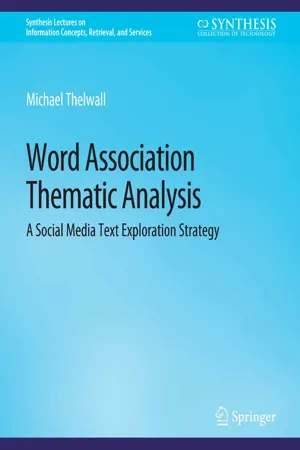
Many research projects involve analyzing sets of texts from the social web or elsewhere to get insights into issues, opinions, interests, news discussions, or communication styles. For example, many studies have investigated reactions to Covid-19 social distancing restrictions, conspiracy theories, and anti-vaccine sentiment on social media. This book describes word association thematic analysis, a mixed methods strategy to identify themes within a collection of social web or other texts. It identifies these themes in the differences between subsets of the texts, including female vs. male vs. nonbinary, older vs. newer, country A vs. country B, positive vs. negative sentiment, high scoring vs. low scoring, or subtopic A vs. subtopic B. It can also be used to identify the differences between a topic-focused collection of texts and a reference collection. The method starts by automatically finding words that are statistically significantly more common in one subset than another, thenidentifies the context of these words and groups them into themes. It is supported by the free Windows-based software Mozdeh for data collection or importing and for the quantitative analysis stages. This book explains the word association thematic analysis method, with examples, and gives practical advice for using it. It is primarily intended for social media researchers and students, although the method is applicable to any collection of short texts.
eBook - PDF
Word Association Thematic Analysis
A Social Media Text Exploration Strategy
- 120 pages
- English
- PDF
- Available on iOS & Android
eBook - PDF
About this book
Information
Table of contents
- Cover
- Copyright Page
- Title Page
- Contents
- Acknowledgments
- Introduction
- Data Collection with Mozdeh
- Word Association Detection: Term Identification
- Word Association Contextualization: Term Meaning and Context
- Word Association Thematic Analysis: Theme Detection
- Word Association Thematic Analysis Examples
- Comparison Between WATA and Other Methods
- Ethics
- Project Planning
- 3.7 Summary
- References
- Author Biography
Trusted by 375,005 students
Access to over 1.5 million titles for a fair monthly price.
Study more efficiently using our study tools.
Frequently asked questions
Yes, you can cancel anytime from the Subscription tab in your account settings on the Perlego website. Your subscription will stay active until the end of your current billing period. Learn how to cancel your subscription
No, books cannot be downloaded as external files, such as PDFs, for use outside of Perlego. However, you can download books within the Perlego app for offline reading on mobile or tablet. Learn how to download books offline
Perlego offers two plans: Essential and Complete
- Essential is ideal for learners and professionals who enjoy exploring a wide range of subjects. Access the Essential Library with 800,000+ trusted titles and best-sellers across business, personal growth, and the humanities. Includes unlimited reading time and Standard Read Aloud voice.
- Complete: Perfect for advanced learners and researchers needing full, unrestricted access. Unlock 1.5M+ books across hundreds of subjects, including academic and specialized titles. The Complete Plan also includes advanced features like Premium Read Aloud and Research Assistant.
We are an online textbook subscription service, where you can get access to an entire online library for less than the price of a single book per month. With over 1.5 million books across 990+ topics, we’ve got you covered! Learn about our mission
Look out for the read-aloud symbol on your next book to see if you can listen to it. The read-aloud tool reads text aloud for you, highlighting the text as it is being read. You can pause it, speed it up and slow it down. Learn more about Read Aloud
Yes! You can use the Perlego app on both iOS and Android devices to read anytime, anywhere — even offline. Perfect for commutes or when you’re on the go.
Please note we cannot support devices running on iOS 13 and Android 7 or earlier. Learn more about using the app
Please note we cannot support devices running on iOS 13 and Android 7 or earlier. Learn more about using the app
Yes, you can access Word Association Thematic Analysis by Michael Thelwall in PDF and/or ePUB format, as well as other popular books in Computer Science & Computer Networking. We have over 1.5 million books available in our catalogue for you to explore.