eBook - PDF
Representing and Reasoning with Qualitative Preferences
Tools and Applications
- 144 pages
- English
- PDF
- Available on iOS & Android
eBook - PDF
Representing and Reasoning with Qualitative Preferences
Tools and Applications
About this book
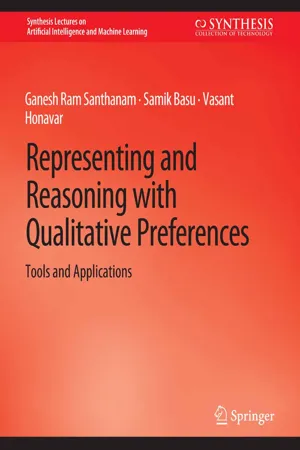
This book provides a tutorial introduction to modern techniques for representing and reasoning about qualitative preferences with respect to a set of alternatives. The syntax and semantics of several languages for representing preference languages, including CP-nets, TCP-nets, CI-nets, and CP-theories, are reviewed. Some key problems in reasoning about preferences are introduced, including determining whether one alternative is preferred to another, or whether they are equivalent, with respect to a given set of preferences. These tasks can be reduced to model checking in temporal logic. Specifically, an induced preference graph that represents a given set of preferences can be efficiently encoded using a Kripke Structure for Computational Tree Logic (CTL). One can translate preference queries with respect to a set of preferences into an equivalent set of formulae in CTL, such that the CTL formula is satisfied whenever the preference query holds. This allows us to use a model checker toreason about preferences, i.e., answer preference queries, and to obtain a justification as to why a preference query is satisfied (or not) with respect to a set of preferences. This book defines the notions of the equivalence of two sets of preferences, including what it means for one set of preferences to subsume another, and shows how to answer preferential equivalence and subsumption queries using model checking. Furthermore, this book demontrates how to generate alternatives ordered by preference, along with providing ways to deal with inconsistent preference specifications. A description of CRISNER—an open source software implementation of the model checking approach to qualitative preference reasoning in CP-nets, TCP-nets, and CP-theories is included, as well as examples illustrating its use.
Information
Table of contents
- Cover
- Copyright Page
- Title Page
- Dedication
- Contents
- Acknowledgments
- Qualitative Preferences
- Qualitative Preference Languages
- Model Checking and Computation Tree Logic
- Dominance Testing via Model Checking
- Verifying Preference Equivalence and Subsumption
- Ordering Alternatives With Respect to Preference
- CRISNER: A Practically Efficient Reasoner for Qualitative Preferences
- Postscript
- SMV Model Listings
- Bibliography
- Authors' Biographies
Trusted by 375,005 students
Access to over 1.5 million titles for a fair monthly price.
Study more efficiently using our study tools.
Frequently asked questions
Yes, you can cancel anytime from the Subscription tab in your account settings on the Perlego website. Your subscription will stay active until the end of your current billing period. Learn how to cancel your subscription
No, books cannot be downloaded as external files, such as PDFs, for use outside of Perlego. However, you can download books within the Perlego app for offline reading on mobile or tablet. Learn how to download books offline
Perlego offers two plans: Essential and Complete
- Essential is ideal for learners and professionals who enjoy exploring a wide range of subjects. Access the Essential Library with 800,000+ trusted titles and best-sellers across business, personal growth, and the humanities. Includes unlimited reading time and Standard Read Aloud voice.
- Complete: Perfect for advanced learners and researchers needing full, unrestricted access. Unlock 1.5M+ books across hundreds of subjects, including academic and specialized titles. The Complete Plan also includes advanced features like Premium Read Aloud and Research Assistant.
We are an online textbook subscription service, where you can get access to an entire online library for less than the price of a single book per month. With over 1.5 million books across 990+ topics, we’ve got you covered! Learn about our mission
Look out for the read-aloud symbol on your next book to see if you can listen to it. The read-aloud tool reads text aloud for you, highlighting the text as it is being read. You can pause it, speed it up and slow it down. Learn more about Read Aloud
Yes! You can use the Perlego app on both iOS and Android devices to read anytime, anywhere — even offline. Perfect for commutes or when you’re on the go.
Please note we cannot support devices running on iOS 13 and Android 7 or earlier. Learn more about using the app
Please note we cannot support devices running on iOS 13 and Android 7 or earlier. Learn more about using the app
Yes, you can access Representing and Reasoning with Qualitative Preferences by Ganesh Ram Santhanam,Samik Basu,Vasant Honavar,Ganesh Ram Liu,Samik Cheng in PDF and/or ePUB format, as well as other popular books in Computer Science & Artificial Intelligence (AI) & Semantics. We have over 1.5 million books available in our catalogue for you to explore.