- 172 pages
- English
- PDF
- Available on iOS & Android
eBook - PDF
PSpice for Circuit Theory and Electronic Devices
About this book
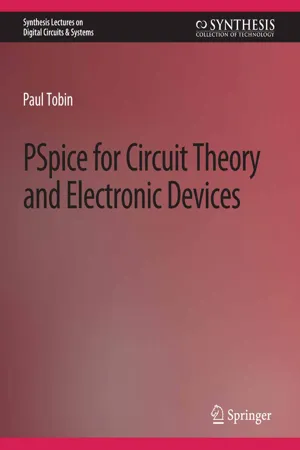
PSpice for Circuit Theory and Electronic Devices is one of a series of five PSpice books and introduces the latest Cadence Orcad PSpice version 10.5 by simulating a range of DC and AC exercises. It is aimed primarily at those wishing to get up to speed with this version but will be of use to high school students, undergraduate students, and of course, lecturers. Circuit theorems are applied to a range of circuits and the calculations by hand after analysis are then compared to the simulated results. The Laplace transform and the s-plane are used to analyze CR and LR circuits where transient signals are involved. Here, the Probe output graphs demonstrate what a great learning tool PSpice is by providing the reader with a visual verification of any theoretical calculations. Series and parallel-tuned resonant circuits are investigated where the difficult concepts of dynamic impedance and selectivity are best understood by sweeping different circuit parameters through a range of values. Obtaining semiconductor device characteristics as a laboratory exercise has fallen out of favour of late, but nevertheless, is still a useful exercise for understanding or modelling semiconductor devices. Inverting and non-inverting operational amplifiers characteristics such as gain-bandwidth are investigated and we will see the dependency of bandwidth on the gain using the performance analysis facility. Power amplifiers are examined where PSpice/Probe demonstrates very nicely the problems of cross-over distortion and other problems associated with power transistors. We examine power supplies and the problems of regulation, ground bounce, and power factor correction. Lastly, we look at MOSFET device characteristics and show how these devices are used to form basic CMOS logic gates such as NAND and NOR gates.
Information
Subtopic
HardwareTable of contents
- Cover
- Copyright Page
- Title Page
- Dedication
- Contents
- Preface
- Acknowledgments
- 1. Introduction to PSpice and Ohm’s Law
- 2. TheDC Circuit and Kirchhoff’s Laws
- 3. Transient Circuits and Laplace Transforms
- 4. Transfer Functions and System Parameters
- 5. AC Circuits and Circuit Theorems
- 6. Series and Parallel-tuned Resonance
- 7. Semiconductor Devices and Characteristics
- 8. Operational Amplifier Characteristics
- Index
- Author Biography
Trusted by 375,005 students
Access to over 1.5 million titles for a fair monthly price.
Study more efficiently using our study tools.
Frequently asked questions
Yes, you can cancel anytime from the Subscription tab in your account settings on the Perlego website. Your subscription will stay active until the end of your current billing period. Learn how to cancel your subscription
No, books cannot be downloaded as external files, such as PDFs, for use outside of Perlego. However, you can download books within the Perlego app for offline reading on mobile or tablet. Learn how to download books offline
Perlego offers two plans: Essential and Complete
- Essential is ideal for learners and professionals who enjoy exploring a wide range of subjects. Access the Essential Library with 800,000+ trusted titles and best-sellers across business, personal growth, and the humanities. Includes unlimited reading time and Standard Read Aloud voice.
- Complete: Perfect for advanced learners and researchers needing full, unrestricted access. Unlock 1.5M+ books across hundreds of subjects, including academic and specialized titles. The Complete Plan also includes advanced features like Premium Read Aloud and Research Assistant.
We are an online textbook subscription service, where you can get access to an entire online library for less than the price of a single book per month. With over 1.5 million books across 990+ topics, we’ve got you covered! Learn about our mission
Look out for the read-aloud symbol on your next book to see if you can listen to it. The read-aloud tool reads text aloud for you, highlighting the text as it is being read. You can pause it, speed it up and slow it down. Learn more about Read Aloud
Yes! You can use the Perlego app on both iOS and Android devices to read anytime, anywhere — even offline. Perfect for commutes or when you’re on the go.
Please note we cannot support devices running on iOS 13 and Android 7 or earlier. Learn more about using the app
Please note we cannot support devices running on iOS 13 and Android 7 or earlier. Learn more about using the app
Yes, you can access PSpice for Circuit Theory and Electronic Devices by Paul Tobin in PDF and/or ePUB format, as well as other popular books in Tecnología e ingeniería & Hardware. We have over 1.5 million books available in our catalogue for you to explore.