- 136 pages
- English
- PDF
- Available on iOS & Android
eBook - PDF
Articulation and Intelligibility
About this book
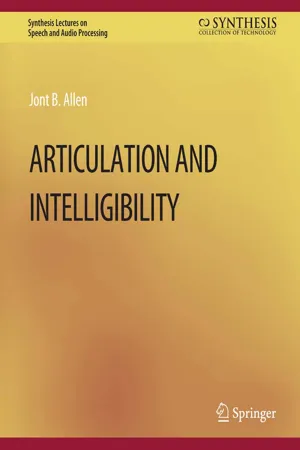
Immediately following the Second World War, between 1947 and 1955, several classic papers quantified the fundamentals of human speech information processing and recognition. In 1947 French and Steinberg published their classic study on the articulation index. In 1948 Claude Shannon published his famous work on the theory of information. In 1950 Fletcher and Galt published their theory of the articulation index, a theory that Fletcher had worked on for 30 years, which integrated his classic works on loudness and speech perception with models of speech intelligibility. In 1951 George Miller then wrote the first book Language and Communication, analyzing human speech communication with Claude Shannon's just published theory of information. Finally in 1955 George Miller published the first extensive analysis of phone decoding, in the form of confusion matrices, as a function of the speech-to-noise ratio. This work extended the Bell Labs' speech articulation studies with ideas from Shannon's Information theory. Both Miller and Fletcher showed that speech, as a code, is incredibly robust to mangling distortions of filtering and noise. Regrettably much of this early work was forgotten. While the key science of information theory blossomed, other than the work of George Miller, it was rarely applied to aural speech research. The robustness of speech, which is the most amazing thing about the speech code, has rarely been studied. It is my belief (i.e., assumption) that we can analyze speech intelligibility with the scientific method. The quantitative analysis of speech intelligibility requires both science and art. The scientific component requires an error analysis of spoken communication, which depends critically on the use of statistics, information theory, and psychophysical methods. The artistic component depends on knowing how to restrict the problem in such a way that progress may be made. It is critical to tease out the relevant from the irrelevant and dig for the key issues. This will focus us on the decoding of nonsense phonemes with no visual component, which have been mangled by filtering and noise. This monograph is a summary and theory of human speech recognition. It builds on and integrates the work of Fletcher, Miller, and Shannon. The long-term goal is to develop a quantitative theory for predicting the recognition of speech sounds. In Chapter 2 the theory is developed for maximum entropy (MaxEnt) speech sounds, also called nonsense speech. In Chapter 3, context is factored in. The book is largely reflective, and quantitative, with a secondary goal of providing an historical context, along with the many deep insights found in these early works.
Information
Table of contents
- Cover
- Copyright Page
- Title Page
- Contents
- Preface
- Acknowledgment
- Introduction
- Articulation
- Intelligibility
- Discussion with Historical Context
- References
- The Author
Trusted by 375,005 students
Access to over 1.5 million titles for a fair monthly price.
Study more efficiently using our study tools.
Frequently asked questions
Yes, you can cancel anytime from the Subscription tab in your account settings on the Perlego website. Your subscription will stay active until the end of your current billing period. Learn how to cancel your subscription
No, books cannot be downloaded as external files, such as PDFs, for use outside of Perlego. However, you can download books within the Perlego app for offline reading on mobile or tablet. Learn how to download books offline
Perlego offers two plans: Essential and Complete
- Essential is ideal for learners and professionals who enjoy exploring a wide range of subjects. Access the Essential Library with 800,000+ trusted titles and best-sellers across business, personal growth, and the humanities. Includes unlimited reading time and Standard Read Aloud voice.
- Complete: Perfect for advanced learners and researchers needing full, unrestricted access. Unlock 1.5M+ books across hundreds of subjects, including academic and specialized titles. The Complete Plan also includes advanced features like Premium Read Aloud and Research Assistant.
We are an online textbook subscription service, where you can get access to an entire online library for less than the price of a single book per month. With over 1.5 million books across 990+ topics, we’ve got you covered! Learn about our mission
Look out for the read-aloud symbol on your next book to see if you can listen to it. The read-aloud tool reads text aloud for you, highlighting the text as it is being read. You can pause it, speed it up and slow it down. Learn more about Read Aloud
Yes! You can use the Perlego app on both iOS and Android devices to read anytime, anywhere — even offline. Perfect for commutes or when you’re on the go.
Please note we cannot support devices running on iOS 13 and Android 7 or earlier. Learn more about using the app
Please note we cannot support devices running on iOS 13 and Android 7 or earlier. Learn more about using the app
Yes, you can access Articulation and Intelligibility by Jont B. Allen in PDF and/or ePUB format, as well as other popular books in Technology & Engineering & Acoustical Engineering. We have over 1.5 million books available in our catalogue for you to explore.