- 129 pages
- English
- PDF
- Available on iOS & Android
eBook - PDF
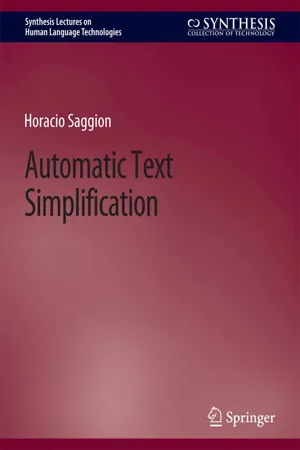
Automatic Text Simplification
About this book
Thanks to the availability of texts on the Web in recent years, increased knowledge and information have been made available to broader audiences. However, the way in which a text is written—its vocabulary, its syntax—can be difficult to read and understand for many people, especially those with poor literacy, cognitive or linguistic impairment, or those with limited knowledge of the language of the text. Texts containing uncommon words or long and complicated sentences can be difficult to read and understand by people as well as difficult to analyze by machines. Automatic text simplification is the process of transforming a text into another text which, ideally conveying the same message, will be easier to read and understand by a broader audience. The process usually involves the replacement of difficult or unknown phrases with simpler equivalents and the transformation of long and syntactically complex sentences into shorter and less complex ones. Automatic text simplification, a research topic which started 20 years ago, now has taken on a central role in natural language processing research not only because of the interesting challenges it posesses but also because of its social implications. This book presents past and current research in text simplification, exploring key issues including automatic readability assessment, lexical simplification, and syntactic simplification. It also provides a detailed account of machine learning techniques currently used in simplification, describes full systems designed for specific languages and target audiences, and offers available resources for research and development together with text simplification evaluation techniques.
Information
Table of contents
- Cover Page
- Copyright Page
- Title Page
- Contents
- Acknowledgments
- Introduction
- Readability and Text Simplification
- Lexical Simplification
- Syntactic Simplification
- Learning to Simplify
- Full Text Simplification Systems
- Applications of Automatic Text Simplification
- Text Simplification Resources and Evaluation
- Conclusion
- Bibliography
- Author’s Biography
Trusted by 375,005 students
Access to over 1.5 million titles for a fair monthly price.
Study more efficiently using our study tools.
Frequently asked questions
Yes, you can cancel anytime from the Subscription tab in your account settings on the Perlego website. Your subscription will stay active until the end of your current billing period. Learn how to cancel your subscription
No, books cannot be downloaded as external files, such as PDFs, for use outside of Perlego. However, you can download books within the Perlego app for offline reading on mobile or tablet. Learn how to download books offline
Perlego offers two plans: Essential and Complete
- Essential is ideal for learners and professionals who enjoy exploring a wide range of subjects. Access the Essential Library with 800,000+ trusted titles and best-sellers across business, personal growth, and the humanities. Includes unlimited reading time and Standard Read Aloud voice.
- Complete: Perfect for advanced learners and researchers needing full, unrestricted access. Unlock 1.5M+ books across hundreds of subjects, including academic and specialized titles. The Complete Plan also includes advanced features like Premium Read Aloud and Research Assistant.
We are an online textbook subscription service, where you can get access to an entire online library for less than the price of a single book per month. With over 1.5 million books across 990+ topics, we’ve got you covered! Learn about our mission
Look out for the read-aloud symbol on your next book to see if you can listen to it. The read-aloud tool reads text aloud for you, highlighting the text as it is being read. You can pause it, speed it up and slow it down. Learn more about Read Aloud
Yes! You can use the Perlego app on both iOS and Android devices to read anytime, anywhere — even offline. Perfect for commutes or when you’re on the go.
Please note we cannot support devices running on iOS 13 and Android 7 or earlier. Learn more about using the app
Please note we cannot support devices running on iOS 13 and Android 7 or earlier. Learn more about using the app
Yes, you can access Automatic Text Simplification by Horacio Saggion in PDF and/or ePUB format, as well as other popular books in Computer Science & Artificial Intelligence (AI) & Semantics. We have over 1.5 million books available in our catalogue for you to explore.