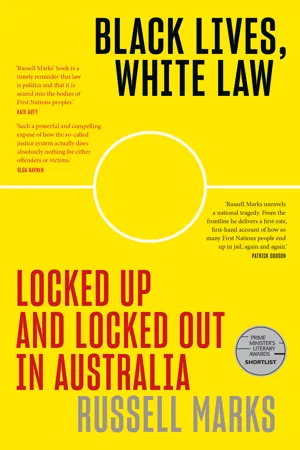
Black Lives, White Law
eBook - ePub

Black Lives, White Law

Locked Up and Locked Out in Australia

  1. 368 pages
  2. English
  3. ePUB (mobile friendly)
  4. Available on iOS & Android
eBook - ePub

Black Lives, White Law

Locked Up and Locked Out in Australia

About this book

How and why Australia's legal system fails Aboriginal and Torres Strait Islander people

'Russell Marks unravels a national tragedy. From the front line he delivers a first-rate, firsthand account of how so many First Nations people end up in jail, again and again.' --Patrick Dodson, Labor Senator for Western Australia

Indigenous Australians are the most incarcerated people on the planet. Indigenous men are fifteen times more likely to be locked up than their non-Indigenous counterparts; Indigenous women are twenty-one times more likely.

Featuring vivid case studies and drawing on a deep sense of history, Black Lives, White Law explores Australia's extraordinary record of locking up First Nations people. It examines Australia's system of criminal justice -- the web of laws and courts and police and prisons -- and how that system interacts with First Nations people and communities. How is it that so many are locked up? Why have imprisonment rates increased in recent years? Is this situation fair? Almost everyone agrees that it's not. And yet it keeps getting worse.

In this groundbreaking book, Russell Marks investigates Australia's incarceration epidemic. What would happen if the institutions of Australian justice received the same scrutiny to which they routinely subject Indigenous Australians?

'How should we tell the story of Indigenous incarceration in Australia? Only part of it is in the numbers. And we can't get very far by looking at the crimes that see Indigenous offenders punished by courts and sentenced to prison … To really grapple with the problem of Indigenous incarceration requires us to accept the possibility that there might be another way. That the current state of affairs -- where entire families sometimes spend time behind bars -- is not inevitable.' --Russell Marks

Shortlisted, Australian Political Book of the Year 2023
Shortlisted, Prime Minister's Literary Awards 2023

'This passionate, timely book shines a critical light on First Nations' incarceration rates in Australia, bringing history into the present with a sense of urgency and purpose... Powerfully interventionist while avoiding polemic, this book reminds us that frontier violence has a present as well as a past.' --Judges' comments, Prime Minister's Literary Awards

Frequently asked questions

Yes, you can cancel anytime from the Subscription tab in your account settings on the Perlego website. Your subscription will stay active until the end of your current billing period. Learn how to cancel your subscription.
At the moment all of our mobile-responsive ePub books are available to download via the app. Most of our PDFs are also available to download and we're working on making the final remaining ones downloadable now. Learn more here.
Perlego offers two plans: Essential and Complete
  • Essential is ideal for learners and professionals who enjoy exploring a wide range of subjects. Access the Essential Library with 800,000+ trusted titles and best-sellers across business, personal growth, and the humanities. Includes unlimited reading time and Standard Read Aloud voice.
  • Complete: Perfect for advanced learners and researchers needing full, unrestricted access. Unlock 1.4M+ books across hundreds of subjects, including academic and specialized titles. The Complete Plan also includes advanced features like Premium Read Aloud and Research Assistant.
Both plans are available with monthly, semester, or annual billing cycles.
We are an online textbook subscription service, where you can get access to an entire online library for less than the price of a single book per month. With over 1 million books across 1000+ topics, we’ve got you covered! Learn more here.
Look out for the read-aloud symbol on your next book to see if you can listen to it. The read-aloud tool reads text aloud for you, highlighting the text as it is being read. You can pause it, speed it up and slow it down. Learn more here.
Yes! You can use the Perlego app on both iOS or Android devices to read anytime, anywhere — even offline. Perfect for commutes or when you’re on the go.
Please note we cannot support devices running on iOS 13 and Android 7 or earlier. Learn more about using the app.
Yes, you can access Black Lives, White Law by Russell Marks in PDF and/or ePUB format, as well as other popular books in Law & Legal History. We have over one million books available in our catalogue for you to explore.

Information

Topic
Law
Index
Law

Table of contents

  1. Cover Page
  2. Title Page
  3. Copyright
  4. Contents
  5. Introduction: The mass incarceration crisis
  6. 1. Settlers: How the criminal law came to Australia
  7. 2. Sovereignty: How Aboriginal law disappeared as if by magic
  8. 3. Solutions: How settlers ‘solved’ their First Nations problem in different ways at different times
  9. 4. Winds of Change: How the First Nations tried to get settler institutions to listen
  10. 5. Bending: How the settler criminal justice system began to make accommodations
  11. 6. Backlash: How the implications of self-determination unsettled settlers
  12. 7. Saviours: How settler courts and governments ‘saved’ First Nations women and children from First Nations cultures – and then locked them up anyway
  13. 8. Incarceration: How settler justice threw up its hands and decided prison was the only answer after all
  14. 9. Debate: How settlers could not agree on which story to tell about Indigenous incarceration
  15. 10. Women: How protection isn’t working much better this time around for First Nations women
  16. 11. Children: How the settler justice system protects and rehabilitates Indigenous kids
  17. 12. Justice: Who calls it a justice system anyway?
  18. 13. The Defenders: Why Aboriginal and Torres Strait Islander Legal Services are so important, and how they fail
  19. 14. A New Beginning: Why Settler Australia needs to acknowledge it created the problem and doesn’t have the answers
  20. Acknowledgements
  21. Notes
  22. Index
  23. Back Cover