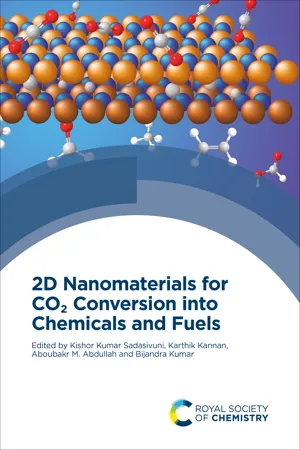
Since the discovery of graphene, two-dimensional nanomaterials including Transition metal dichalcogenides (TMDCs), Hexagonal Boron Nitride (hBN), non-layered compounds, black phosphorous, and Xenes with large lateral dimensions, have emerged as promising candidates for heterogenous electrocatalysis owing to their exceptional physical, chemical, and electronic properties. The tremendous opportunities of using 2D nanomaterials in electrochemical CO2 reduction arises from their unique properties and vast number of applications. Covering the fundamentals, properties, and applications, all aspects of 2D nanomaterial composites within carbon dioxide conversion are discussed. The industrial scale-up and new challenges that exist in the field of electrochemical reduction of carbon dioxide will also be presented. With chapters written by internationally recognized researchers, this state-of-the-art overview will serve the growing interest amongst academic and industrial researchers in understanding 2D nanomaterials composites, their hidden interfaces and nanoscale dispersion of the metal oxide with nanocomposites for specific uses in carbon dioxide conversion to chemicals for fuel applications. This book will be of interest to graduate students and researchers in materials science, energy, and environmental science, as well as those in industry.
eBook - ePub
2D Nanomaterials for CO2 Conversion into Chemicals and Fuels
- 149 pages
- English
- ePUB (mobile friendly)
- Available on iOS & Android
eBook - ePub
2D Nanomaterials for CO2 Conversion into Chemicals and Fuels
About this book
Information
Publisher
Royal Society of ChemistryYear
2022Print ISBN
9781839163111
9781839163111
eBook ISBN
9781839165559
Table of contents
- Cover
- Half Title
- Title
- Copyright
- Preface
- Acknowledgements
- Contents
- Chapter 1 A Fundamental Approach Towards Carbon Dioxide Conversion to Chemicals and Fuels: Current Trends for CO2 Utilization Technologies 1
- Chapter 2 Synthesis and Characterization of Two Dimensional Materials 36
- Chapter 3 Synthesis of Two-dimensional Hybrid Materials, Unique Properties, and Challenges 64
- Chapter 4 CO2 Conversion to Chemicals and Fuel Cells Using Renewable Energy Sources 126
- Chapter 5 Two-dimensional Metal Oxide Nanomaterials for Electrochemical Conversion of CO2 Into Energy-rich Chemicals 171
- Chapter 6 Two-dimensional Based Hybrid Materials for CO2-to-fuels Electrochemical Conversion CO2 Process 196
- Chapter 7 Two-dimensional Nanomaterials Design and Reactor Engineering of Different Methods for CO2 Electrochemical Conversion Process 211
- Chapter 8 Photoelectrochemical CO2 Conversion Through the Utilization of Non-oxide Two-dimensional Nanomaterials 230
- Chapter 9 Photocatalytic Conversion of CO2 Into Energy-rich Chemicals by Two-dimensional Nanomaterials 244
- Chapter 10 Two-dimensional Based Hybrid Materials for Photocatalytic Conversion of CO2 Into Hydrocarbon Fuels 270
- Chapter 11 Catalytic Thermal Conversion of CO2 to Fuels Using Two-dimensional Nanomaterials 301
- Chapter 12 Oxidative Dehydrogenation of Ethane to Ethylene Over Two-dimensional Nanomaterial Catalysts Using CO2 320
- Chapter 13 A Comparative Study of 0D, 1D, and 2D Nanocatalysts Towards CO2 Conversion 341
- Chapter 14 CO2 Capture and Conversion Using Different Renewable Sources 374
- Chapter 15 CO2 Capture by Functionalized Two-dimensional Nanomaterials 392
- Chapter 16 Conversion of CO2 into Energy-dense Chemicals and the Commercialization Using Two-dimensional Nanomaterials as Catalysts 409
- Subject Index
Trusted by 375,005 students
Access to over 1.5 million titles for a fair monthly price.
Study more efficiently using our study tools.
Frequently asked questions
Yes, you can cancel anytime from the Subscription tab in your account settings on the Perlego website. Your subscription will stay active until the end of your current billing period. Learn how to cancel your subscription
No, books cannot be downloaded as external files, such as PDFs, for use outside of Perlego. However, you can download books within the Perlego app for offline reading on mobile or tablet. Learn how to download books offline
Perlego offers two plans: Essential and Complete
- Essential is ideal for learners and professionals who enjoy exploring a wide range of subjects. Access the Essential Library with 800,000+ trusted titles and best-sellers across business, personal growth, and the humanities. Includes unlimited reading time and Standard Read Aloud voice.
- Complete: Perfect for advanced learners and researchers needing full, unrestricted access. Unlock 1.5M+ books across hundreds of subjects, including academic and specialized titles. The Complete Plan also includes advanced features like Premium Read Aloud and Research Assistant.
We are an online textbook subscription service, where you can get access to an entire online library for less than the price of a single book per month. With over 1.5 million books across 990+ topics, we’ve got you covered! Learn about our mission
Look out for the read-aloud symbol on your next book to see if you can listen to it. The read-aloud tool reads text aloud for you, highlighting the text as it is being read. You can pause it, speed it up and slow it down. Learn more about Read Aloud
Yes! You can use the Perlego app on both iOS and Android devices to read anytime, anywhere — even offline. Perfect for commutes or when you’re on the go.
Please note we cannot support devices running on iOS 13 and Android 7 or earlier. Learn more about using the app
Please note we cannot support devices running on iOS 13 and Android 7 or earlier. Learn more about using the app
Yes, you can access 2D Nanomaterials for CO2 Conversion into Chemicals and Fuels by Kishor Kumar Sadasivuni, Karthik Kannan, Aboubakr M Abdullah, Bijandra Kumar, Kishor Kumar Sadasivuni,Karthik Kannan,Aboubakr M Abdullah,Bijandra Kumar in PDF and/or ePUB format, as well as other popular books in Physical Sciences & Environmental Science. We have over 1.5 million books available in our catalogue for you to explore.