eBook - ePub
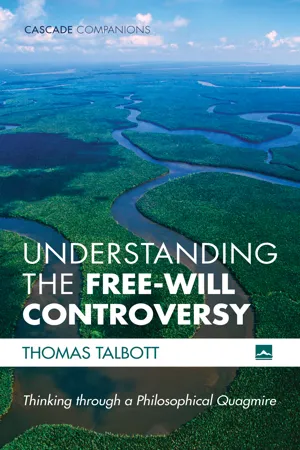
Understanding the Free-Will Controversy
Thinking through a Philosophical Quagmire
- 140 pages
- English
- ePUB (mobile friendly)
- Available on iOS & Android
eBook - ePub
About this book
What is free will and do humans possess it? While these questions appear simple they have tied some of our greatest minds in knots over the millennia. This little book seeks to clarify for an audience of educated non-specialists some of the issues that often arise in philosophical disputes over the existence and the nature of human free will. Beyond that, it proposes a particular solution to the puzzles.
Many philosophers have argued that free will is incompatible with determinism, and many have also argued that it is incompatible with indeterminism. So, is free will simply an incoherent concept? Talbott argues that the best way out of this quagmire requires that we come to appreciate why certain conditions essential to our emergence as free moral agents--conditions such as indeterminism, ignorance, and a context of ambiguity and misperception--are themselves obstacles to a fully realized freedom. For a fully realized freedom requires that, as minimally rational individuals, we have learned some important lessons for ourselves; and once these lessons have been learned, some of our freest choices may be such that we could not have chosen otherwise because so choosing would then seem to us utterly unthinkable and irrational.
Information
Topic
PhilosophySubtopic
Philosophical EssaysTable of contents
- Title Page
- Introduction
- Chapter 1: A Philosophical Quagmire
- Chapter 2: The Consequence Argument against Compatibilism
- Chapter 3: Indeterminism and Random Chance
- Chapter 4: Rationality and the Nature of Moral Freedom
- Chapter 5: The Temptations of Fatalism
- Chapter 6: Divine Foreknowledge, Divine Providence, and Human Freedom
- Summary and Conclusion
- Suggestions for Further Reading
- Bibliography of Works Cited
Trusted by 375,005 students
Access to over 1.5 million titles for a fair monthly price.
Study more efficiently using our study tools.
Frequently asked questions
Yes, you can cancel anytime from the Subscription tab in your account settings on the Perlego website. Your subscription will stay active until the end of your current billing period. Learn how to cancel your subscription
No, books cannot be downloaded as external files, such as PDFs, for use outside of Perlego. However, you can download books within the Perlego app for offline reading on mobile or tablet. Learn how to download books offline
Perlego offers two plans: Essential and Complete
- Essential is ideal for learners and professionals who enjoy exploring a wide range of subjects. Access the Essential Library with 800,000+ trusted titles and best-sellers across business, personal growth, and the humanities. Includes unlimited reading time and Standard Read Aloud voice.
- Complete: Perfect for advanced learners and researchers needing full, unrestricted access. Unlock 1.5M+ books across hundreds of subjects, including academic and specialized titles. The Complete Plan also includes advanced features like Premium Read Aloud and Research Assistant.
We are an online textbook subscription service, where you can get access to an entire online library for less than the price of a single book per month. With over 1.5 million books across 990+ topics, we’ve got you covered! Learn about our mission
Look out for the read-aloud symbol on your next book to see if you can listen to it. The read-aloud tool reads text aloud for you, highlighting the text as it is being read. You can pause it, speed it up and slow it down. Learn more about Read Aloud
Yes! You can use the Perlego app on both iOS and Android devices to read anytime, anywhere — even offline. Perfect for commutes or when you’re on the go.
Please note we cannot support devices running on iOS 13 and Android 7 or earlier. Learn more about using the app
Please note we cannot support devices running on iOS 13 and Android 7 or earlier. Learn more about using the app
Yes, you can access Understanding the Free-Will Controversy by Thomas Talbott in PDF and/or ePUB format, as well as other popular books in Philosophy & Philosophical Essays. We have over 1.5 million books available in our catalogue for you to explore.