This book addresses present-day landscapes, ecosystem functioning and biodiversity as legacies of the past. It implements an interdisciplinary approach to understand how natural or human-impacted ecological systems have changed over time.
Historical Ecology combines theory, methods, regional case studies and syntheses to provide a complete up-to-date overview of historical ecology. Beginning with the crucial role of time and inference from observed patterns, the book critically reviews the main methodological approaches, including monitoring of permanent plots, analysis of old maps, repeat photography, remote sensing, soil analysis, charcoal analysis, botanical indicators, and combinations of these methods applied to forest ecosystems.
A series of case studies from various biomes shows how historical ecology can help in understanding today's socio-ecosystems, such as mainland and island forests, orchards, tundra and coastal dunes. The book concludes by showing how historical ecology can answer timely fundamental research questions and provide science-based evidence for landscape and ecosystem management.
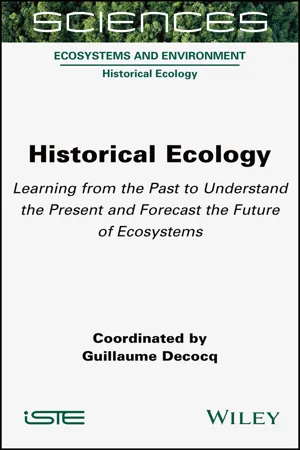
eBook - PDF
Historical Ecology
Learning from the Past to Understand the Present and Forecast the Future of Ecosystems
- 321 pages
- English
- PDF
- Available on iOS & Android
eBook - PDF
Historical Ecology
Learning from the Past to Understand the Present and Forecast the Future of Ecosystems
About this book
Information
Table of contents
- Cover
- Half-Title Page
- Title Page
- Copyright Page
- Contents
- Chapter 1. A General Introduction to Historical Ecology
- Chapter 2. Historical Resurveys Reveal Causes of Long-term Ecological Change
- Chapter 3. Getting the Right Answer Can Take a While: Long-term Ecological Field Studies as Historical Ecology
- Chapter 4. Gaps and Cracks in Land Cover Mapping for Historical Ecology
- Chapter 5. The Use of Repeat Photography in African Historical Ecology
- Chapter 6. Remote Sensing for Historical Ecology
- Chapter 7. Soil Archives: Where Soilscape History Meets Present-day Ecosystems
- Chapter 8. Continuous and Nested Time in Historical Ecology: Application to Soil Studies
- Chapter 9. The Analysis of Relic Charcoal Kilns for the Assessment of Forest Trajectories
- Chapter 10. Ancient Trees and Botanical Indicators as Evidence for Change and Continuity in Landscape Evolution
- Chapter 11. Towards a Methodological Framework for Investigating the Hidden History of Woodland Covers
- Chapter 12. The Gate to the Forest is in its History
- Chapter 13. Plant Assemblages and Ecosystem Functioning, a Legacy of Long-term Interactions with Large Herbivores
- Chapter 14. A Historical Ecology of the Compiègne Forest (N France)
- Chapter 15. The Chestnut Orchards in the Bolognese Apennines: A Vanishing Socio-ecological Habitat
- Chapter 16. Claudius’ Coin in the Forest – Niche Construction and Strategies by Early Colonizers of Boreal Inlands in Central Scandinavia
- Chapter 17. Recent History of Vegetation Changes in the Arctic
- Chapter 18. Reconstructing the Impact of Humans on Aotearoa New Zealand’s Biodiversity
- Chapter 19. Historical Ecology of the Coastal Aeolian Sedimentary Systems of the Canary Islands
- Chapter 20. Historical Forest Microclimates
- Chapter 21. Causes and Consequences of Extinction Debts: Perspectives for Historical Ecology and Biological Conservation
- Chapter 22. Historical Ecology for the Past and the Future: Organizing at Local and Regional Scales
- List of Authors
- Index
- EULA
Trusted by 375,005 students
Access to over 1.5 million titles for a fair monthly price.
Study more efficiently using our study tools.
Frequently asked questions
Yes, you can cancel anytime from the Subscription tab in your account settings on the Perlego website. Your subscription will stay active until the end of your current billing period. Learn how to cancel your subscription
No, books cannot be downloaded as external files, such as PDFs, for use outside of Perlego. However, you can download books within the Perlego app for offline reading on mobile or tablet. Learn how to download books offline
Perlego offers two plans: Essential and Complete
- Essential is ideal for learners and professionals who enjoy exploring a wide range of subjects. Access the Essential Library with 800,000+ trusted titles and best-sellers across business, personal growth, and the humanities. Includes unlimited reading time and Standard Read Aloud voice.
- Complete: Perfect for advanced learners and researchers needing full, unrestricted access. Unlock 1.5M+ books across hundreds of subjects, including academic and specialized titles. The Complete Plan also includes advanced features like Premium Read Aloud and Research Assistant.
We are an online textbook subscription service, where you can get access to an entire online library for less than the price of a single book per month. With over 1.5 million books across 990+ topics, we’ve got you covered! Learn about our mission
Look out for the read-aloud symbol on your next book to see if you can listen to it. The read-aloud tool reads text aloud for you, highlighting the text as it is being read. You can pause it, speed it up and slow it down. Learn more about Read Aloud
Yes! You can use the Perlego app on both iOS and Android devices to read anytime, anywhere — even offline. Perfect for commutes or when you’re on the go.
Please note we cannot support devices running on iOS 13 and Android 7 or earlier. Learn more about using the app
Please note we cannot support devices running on iOS 13 and Android 7 or earlier. Learn more about using the app
Yes, you can access Historical Ecology by Guillaume Decocq in PDF and/or ePUB format, as well as other popular books in Biological Sciences & World History. We have over 1.5 million books available in our catalogue for you to explore.