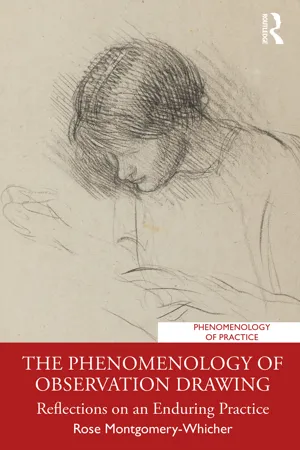
The Phenomenology of Observation Drawing
eBook - ePub

The Phenomenology of Observation Drawing

Reflections on an Enduring Practice

  1. 218 pages
  2. English
  3. ePUB (mobile friendly)
  4. Available on iOS & Android
eBook - ePub

The Phenomenology of Observation Drawing

Reflections on an Enduring Practice

About this book

Based on research, and grounded in experience, this book offers a view into the minds and hearts of people who draw. With technology at our fingertips that allows us to record and share what we see within moments, drawing seems a remarkably slow and difficult way to make an image. And yet, drawing from observation continues to be practiced by professional and amateur artists, a situation that invites the question: What does observation drawing mean in the lives of those who practice it?

The central chapters of the book explicate the structures of the lived experience of drawing, weaving phenomenological reflections into a narrative about the author drawing her sister on a train. With lively accounts of drawing from hobbyists, art students, contemporary and historical artists, Montgomery-Whicher considers how the act of drawing shapes place, time, the body and relationships with the world and with others. She addresses many facets of drawing, including the connection between drawing and thinking, the range of emotions felt when drawing a person and the experience of digital drawing. Montgomery-Whicher concludes that observation drawing warrants a place in general education as well as in the education of artists. She argues that drawing will continue to thrive because it is a human practice that deepens and enriches our humanity by giving us access to keener perception, greater understanding, empathy and wonder. This book will be of interest to anyone who has ever wondered about the appeal of drawing, including professional and amateur artists, philosophers, and educators.

Frequently asked questions

Yes, you can cancel anytime from the Subscription tab in your account settings on the Perlego website. Your subscription will stay active until the end of your current billing period. Learn how to cancel your subscription.
No, books cannot be downloaded as external files, such as PDFs, for use outside of Perlego. However, you can download books within the Perlego app for offline reading on mobile or tablet. Learn more here.
Perlego offers two plans: Essential and Complete
  • Essential is ideal for learners and professionals who enjoy exploring a wide range of subjects. Access the Essential Library with 800,000+ trusted titles and best-sellers across business, personal growth, and the humanities. Includes unlimited reading time and Standard Read Aloud voice.
  • Complete: Perfect for advanced learners and researchers needing full, unrestricted access. Unlock 1.4M+ books across hundreds of subjects, including academic and specialized titles. The Complete Plan also includes advanced features like Premium Read Aloud and Research Assistant.
Both plans are available with monthly, semester, or annual billing cycles.
We are an online textbook subscription service, where you can get access to an entire online library for less than the price of a single book per month. With over 1 million books across 1000+ topics, we’ve got you covered! Learn more here.
Look out for the read-aloud symbol on your next book to see if you can listen to it. The read-aloud tool reads text aloud for you, highlighting the text as it is being read. You can pause it, speed it up and slow it down. Learn more here.
Yes! You can use the Perlego app on both iOS or Android devices to read anytime, anywhere — even offline. Perfect for commutes or when you’re on the go.
Please note we cannot support devices running on iOS 13 and Android 7 or earlier. Learn more about using the app.
Yes, you can access The Phenomenology of Observation Drawing by Rose Montgomery-Whicher in PDF and/or ePUB format, as well as other popular books in Psychology & Social Science Research & Methodology. We have over one million books available in our catalogue for you to explore.

Table of contents

  1. Cover Page
  2. Endorsement Page
  3. Half Title page
  4. Series Page
  5. Title Page
  6. Copyright Page
  7. Dedication
  8. Contents
  9. List of figures
  10. Acknowledgments
  11. Preface
  12. Introduction: Practicing phenomenology and drawing
  13. 1 Everyone is a mark-maker
  14. 2 Places: The predictable and the unlikely
  15. 3 Time: Holding, losing, seeing
  16. 4 Finding time and making time
  17. 5 Drawn into the world
  18. 6 Drawn to others
  19. 7 Withdrawing from others
  20. 8 Drawing with others
  21. 9 The drawing body
  22. 10 The knowing hand
  23. 11 The body as drawn
  24. 12 The drawing as a body
  25. 13 Drawing disembodied
  26. 14 Reflections on practice
  27. 15 Living with drawing: The pleasures of work
  28. References
  29. Index