Originally published in 1959, this volume is a symposium from Official Government documents, Mikolajczyk's private files and other Polish sources is an indictment of Soviet policy towards Poland and of the Western Allies' leniency towards Stalin.-Print ed.
"This study of one of the most important and most neglected aspects of American foreign policy leading up to the concluding phases of the war and the peace settlements might have been called, in a spirit of bitterness, "The Betrayal of Poland."…It is a prime piece of documentation and analysis for all who would probe the brutal reality of Soviet policy, neither a riddle nor an enigma to those with eyes to see.
The story it tells is, of course, written to show the London Polish government's efforts to win and keep Polish freedom. Taken largely from the indicated Polish sources, set in their proper context, this work sketches the historical background and traces Soviet policy with great insight. But these sources...make available in a form not previously accessible to the student and scholar the twisting and turning of both British and American policy. This policy, taken up at the crucial points of 1939 and 1944 especially, was confronted by the dilemma of how to honor the British commitments to Poland without laying down a direct challenge to the declared intentions of the Soviet Union. These commitments included not only those given at the outbreak of the war in 1939 but the assurances given at the time of the invasion of Poland by the Soviet Union in 1941 that Britain would not recognize "any territorial changes which have been effected in Poland since Aug., 1939." The puppet "Lublin government" of handpicked and Communist-controlled figures was intended, as the Moscow broadcasts flatly declared, to assure that "the London clique will be wiped out." By being forced into a coalition with the Lublin government, the London government-in-exile was indeed wiped out, and Mikolajczyk barely escaped with his life."
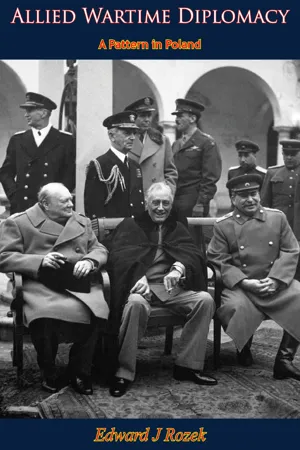
- 488 pages
- English
- ePUB (mobile friendly)
- Available on iOS & Android
eBook - ePub
About this book
Information
Subtopic
European HistoryIndex
HistoryTable of contents
- Title page
- TABLE OF CONTENTS
- DEDICATION
- Foreword
- Preface
- List of Maps and Charts
- 1 - Strategy and Tactics of Soviet Foreign Policy
- 2 - Historical Background of Soviet-Polish Relations From 1917 to September 1939
- 3 - The Fourth Partition of Poland
- 4 - The Precarious Alliance: August 1941 to April 1943
- 5 - From the Rupture of Diplomatic Relations to the Soviet Establishment of the Lublin Committee April 1943 to January 1944
- 6 - The Soviets Transform the Lublin Committee into the Provisional Government of Poland January 1944 to December 1944
- 7 - From the Soviet Establishment of the “Provisional Government” to the Allied Recognition of It as the “Provisional Government” of National Unity December 1944 to June 1945
- 8 - From the Potsdam Conference to the Elections July 17, 1945 to October 20, 1947
- Conclusion
- 1 - Appendix
- 2 - Appendix
- 3 - Appendix
- 4 - Appendix
- 5 - Appendix
- Bibliography
Trusted by 375,005 students
Access to over 1.5 million titles for a fair monthly price.
Study more efficiently using our study tools.
Frequently asked questions
Yes, you can cancel anytime from the Subscription tab in your account settings on the Perlego website. Your subscription will stay active until the end of your current billing period. Learn how to cancel your subscription
No, books cannot be downloaded as external files, such as PDFs, for use outside of Perlego. However, you can download books within the Perlego app for offline reading on mobile or tablet. Learn how to download books offline
Perlego offers two plans: Essential and Complete
- Essential is ideal for learners and professionals who enjoy exploring a wide range of subjects. Access the Essential Library with 800,000+ trusted titles and best-sellers across business, personal growth, and the humanities. Includes unlimited reading time and Standard Read Aloud voice.
- Complete: Perfect for advanced learners and researchers needing full, unrestricted access. Unlock 1.5M+ books across hundreds of subjects, including academic and specialized titles. The Complete Plan also includes advanced features like Premium Read Aloud and Research Assistant.
We are an online textbook subscription service, where you can get access to an entire online library for less than the price of a single book per month. With over 1.5 million books across 990+ topics, we’ve got you covered! Learn about our mission
Look out for the read-aloud symbol on your next book to see if you can listen to it. The read-aloud tool reads text aloud for you, highlighting the text as it is being read. You can pause it, speed it up and slow it down. Learn more about Read Aloud
Yes! You can use the Perlego app on both iOS and Android devices to read anytime, anywhere — even offline. Perfect for commutes or when you’re on the go.
Please note we cannot support devices running on iOS 13 and Android 7 or earlier. Learn more about using the app
Please note we cannot support devices running on iOS 13 and Android 7 or earlier. Learn more about using the app
Yes, you can access Allied Wartime Diplomacy by Edward J Rozek in PDF and/or ePUB format, as well as other popular books in History & European History. We have over 1.5 million books available in our catalogue for you to explore.