- 256 pages
- English
- PDF
- Available on iOS & Android
eBook - PDF
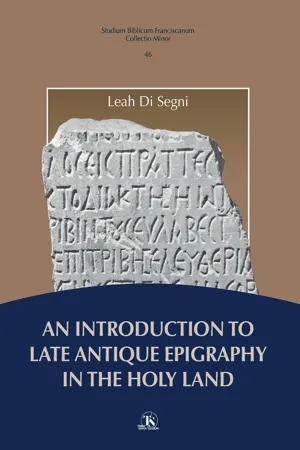
An Introduction to Late Antique Epigraphy in the Holy Land
About this book
The ethnic pluralism of the Holy Land is unparalleled elsewhere. Whatever period of history, or even of prehistory, one chooses to consider, the land, due to its geographical position, was always home to diverse ethne and cultures and a capturer of influences from nearby and faraway countries.
The same pluralism accounts for an unparalleled coexistence of languages and scripts. Greek and Latin, Hebrew, Jewish, Christian and Samaritan Aramaic, each with its own script, pre-Islamic Arabic in Nabataean and Old Arabic scripts, the occasional Syriac, Palmyrene, Armenian and Georgian inscriptions, Safaitic and Thamudic graffiti in the eastern and southern fringes: all are attested in late antique Holy Land, sometimes influencing one another in vocabulary and formulas. Still, Greek is the prevailing vehicle of written communication from its first appearance in the region in the fourth century BCE to the end of Late Antiquity in the late eighth or early ninth century, and it will draw most of the attention in these pages.
Information
Topic
Theology & ReligionSubtopic
Ancient ReligionTable of contents
- frontespizio
- PREFACE
- ACKNOWLEDGEMENTS
- ABBREVIATIONS AND SIGLA
- CHAPTER I: INTRODUCTION
- CHAPTER II: CHRONOLOGICAL SYSTEMSIN USE IN THE HOLY LAND
- CHAPTER III: ARAMAIC DIALECTS AND SCRIPTS
- CHAPTER IV: LATIN INSCRIPTIONS IN THE HOLY LANDIN LATE ANTIQUITY
- CHAPTER V: GREEK INSCRIPTIONS IN THE HOLY LANDIN LATE ANTIQUITY
- CHAPTER V: GREEK INSCRIPTIONS IN THE HOLY LANDIN LATE ANTIQUITY
- CHAPTER VI: TOOLS FOR THE STUDYOF LATE ANTIQUE EPIGRAPHYIN THE PROVINCES OF PALAESTINA AND ARABIA
- CHAPTER VII: PALAEOGRAPHY
- APPENDIX A: CIVIL AND MILITARY ADMINISTRATION
- APPENDIX B: CHURCH ADMINISTRATION
- BIBLIOGRAPHY
- TABLE OF CONTENTS
Trusted by 375,005 students
Access to over 1.5 million titles for a fair monthly price.
Study more efficiently using our study tools.
Frequently asked questions
Yes, you can cancel anytime from the Subscription tab in your account settings on the Perlego website. Your subscription will stay active until the end of your current billing period. Learn how to cancel your subscription
No, books cannot be downloaded as external files, such as PDFs, for use outside of Perlego. However, you can download books within the Perlego app for offline reading on mobile or tablet. Learn how to download books offline
Perlego offers two plans: Essential and Complete
- Essential is ideal for learners and professionals who enjoy exploring a wide range of subjects. Access the Essential Library with 800,000+ trusted titles and best-sellers across business, personal growth, and the humanities. Includes unlimited reading time and Standard Read Aloud voice.
- Complete: Perfect for advanced learners and researchers needing full, unrestricted access. Unlock 1.5M+ books across hundreds of subjects, including academic and specialized titles. The Complete Plan also includes advanced features like Premium Read Aloud and Research Assistant.
We are an online textbook subscription service, where you can get access to an entire online library for less than the price of a single book per month. With over 1.5 million books across 990+ topics, we’ve got you covered! Learn about our mission
Look out for the read-aloud symbol on your next book to see if you can listen to it. The read-aloud tool reads text aloud for you, highlighting the text as it is being read. You can pause it, speed it up and slow it down. Learn more about Read Aloud
Yes! You can use the Perlego app on both iOS and Android devices to read anytime, anywhere — even offline. Perfect for commutes or when you’re on the go.
Please note we cannot support devices running on iOS 13 and Android 7 or earlier. Learn more about using the app
Please note we cannot support devices running on iOS 13 and Android 7 or earlier. Learn more about using the app
Yes, you can access An Introduction to Late Antique Epigraphy in the Holy Land by Leah Di Segni in PDF and/or ePUB format, as well as other popular books in Theology & Religion & Ancient Religion. We have over 1.5 million books available in our catalogue for you to explore.