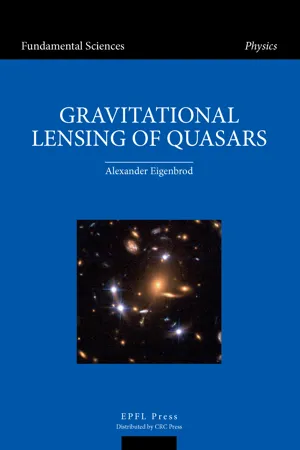
The universe, in all its richness, diversity and complexity, is populated by a myriad of intriguing celestial objects. Among the most exotic of them are gravitationally lensed quasars. A quasar is an extremely bright nucleus of a galaxy, and when such an object is gravitationally lensed, multiple images of the quasar are produced – this phenomenon of cosmic mirage can provide invaluable insights on burning questions, such as the nature of dark matter and dark energy. After presenting the basics of modern cosmology, the book describes active galactic nuclei, the theory of gravitational lensing, and presents a particular numerical technique to improve the resolution of astronomical data. The book then enters the heart of the subject with the description of important applications of gravitational lensing of quasars, such as the measurement of the famous Hubble constant, the determination of the dark matter distribution in galaxies, and the observation of the mysterious inner parts of quasars with much higher resolutions than those accessible with the largest telescopes. This book intends to give an overview of the current status of research in the field of gravitationally lensed quasars. It also gives some insights about the way this research is conducted in practice, and presents real data and results obtained with several high-technology instruments of the Very Large Telescope of the European Southern Observatory.
- 154 pages
- English
- PDF
- Available on iOS & Android
eBook - PDF
Gravitational Lensing of Quasars
About this book
Information
Topic
NaturwissenschaftenSubtopic
Astronomie & AstrophysikTable of contents
- FOREWORD
- CONTENTS
- 1 INTRODUCTION
- 2 BASICS OF MODERN COSMOLOGY
- 3 ACTIVE GALACTIC NUCLEI
- 4 GRAVITATIONAL LENSING
- 5 DECONVOLUTION
- 6 TIME DELAYS AND THE HUBBLE CONSTANT
- 7 REDSHIFT OF LENSING GALAXIES
- 8 MICROLENSING: A NATURAL TELESCOPE
- 9 DYNAMICS VERSUS GRAVITATIONAL LENSING
- 10 GENERAL CONCLUSIONS AND OUTLOOK
- BIBLIOGRAPHY
- INDEX
Trusted by 375,005 students
Access to over 1.5 million titles for a fair monthly price.
Study more efficiently using our study tools.
Frequently asked questions
Yes, you can cancel anytime from the Subscription tab in your account settings on the Perlego website. Your subscription will stay active until the end of your current billing period. Learn how to cancel your subscription
No, books cannot be downloaded as external files, such as PDFs, for use outside of Perlego. However, you can download books within the Perlego app for offline reading on mobile or tablet. Learn how to download books offline
Perlego offers two plans: Essential and Complete
- Essential is ideal for learners and professionals who enjoy exploring a wide range of subjects. Access the Essential Library with 800,000+ trusted titles and best-sellers across business, personal growth, and the humanities. Includes unlimited reading time and Standard Read Aloud voice.
- Complete: Perfect for advanced learners and researchers needing full, unrestricted access. Unlock 1.5M+ books across hundreds of subjects, including academic and specialized titles. The Complete Plan also includes advanced features like Premium Read Aloud and Research Assistant.
We are an online textbook subscription service, where you can get access to an entire online library for less than the price of a single book per month. With over 1.5 million books across 990+ topics, we’ve got you covered! Learn about our mission
Look out for the read-aloud symbol on your next book to see if you can listen to it. The read-aloud tool reads text aloud for you, highlighting the text as it is being read. You can pause it, speed it up and slow it down. Learn more about Read Aloud
Yes! You can use the Perlego app on both iOS and Android devices to read anytime, anywhere — even offline. Perfect for commutes or when you’re on the go.
Please note we cannot support devices running on iOS 13 and Android 7 or earlier. Learn more about using the app
Please note we cannot support devices running on iOS 13 and Android 7 or earlier. Learn more about using the app
Yes, you can access Gravitational Lensing of Quasars by Alexander Eigenbrod in PDF and/or ePUB format, as well as other popular books in Naturwissenschaften & Astronomie & Astrophysik. We have over 1.5 million books available in our catalogue for you to explore.