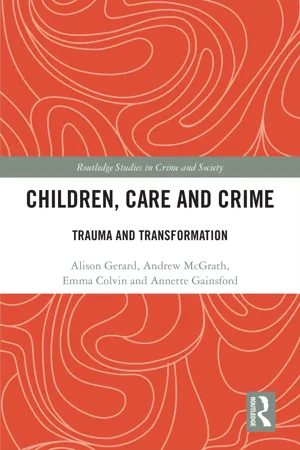
Children, Care and Crime
eBook - ePub

Children, Care and Crime

Trauma and Transformation

  1. 218 pages
  2. English
  3. ePUB (mobile friendly)
  4. Available on iOS & Android
eBook - ePub

Children, Care and Crime

Trauma and Transformation

About this book

The historical context of colonisation situates the analysis in Children, Care and Crime of the involvement of children with care experience in the criminal justice system in an Australian jurisdiction (New South Wales), focusing on residential care, policing, the provision of legal services and interactions in the Children's Court.

While the majority of children in care do not have contact with the criminal justice system, this book explores why those with care experience, and Indigenous children, are over-represented in this system. Drawing on findings from an innovative, mixed-method study – court observations, file reviews and qualitative interviews – the book investigates historical and contemporary processes of colonisation and criminalisation. The book outlines the impact of trauma and responses to trauma, including inter-generational trauma caused by policies of colonisation and criminalisation. It then follows a child's journey through the continuum of care to the criminal justice system, examining data at each stage including the residential care environment, interactions with police, the provision of legal services and experiences at the Children's Court. Drawing together an analysis of the gendered and racialised treatment of women and girls with care experience in the criminal justice system, the book particularly focuses on legacies of forced removal and apprenticeship which targeted Aboriginal and Torres Strait Islander women and girls. Through analysing what practices from England and Wales might offer the NSW context, our findings are enriched by further reflection on how decriminalisation pathways might be imagined. While there have been many policy initiatives developed to address criminalisation, in all parts of the study little evidence was found of implementation and impact. To conclude, the book examines the way that 'hope tropes' are regularly deployed in child protection and criminal justice to dangle the prospect of reform, and even to produce pockets of success, only to be whittled away by well-worn pathways to routine criminalisation. The conclusion also considers what a transformative agenda would look like and how monitoring and accountability mechanisms are key to new ways of operating. Finally, the book explores strengths-based approaches and how they might take shape in the child protection and criminal justice systems.

Children, Care and Crime is aimed at researchers, lawyers and criminal justice practitioners, police, Judges and Magistrates, policy-makers and those working in child protection, the criminal justice system or delivering services to children or adults with care experience. The research is multidisciplinary and therefore will be of broad appeal to the criminology, law, psychology, sociology and social work disciplines. The book is most suitable for undergraduate courses focusing on youth justice and policing, and postgraduates researching in this field.

Frequently asked questions

Yes, you can cancel anytime from the Subscription tab in your account settings on the Perlego website. Your subscription will stay active until the end of your current billing period. Learn how to cancel your subscription.
No, books cannot be downloaded as external files, such as PDFs, for use outside of Perlego. However, you can download books within the Perlego app for offline reading on mobile or tablet. Learn more here.
Perlego offers two plans: Essential and Complete
  • Essential is ideal for learners and professionals who enjoy exploring a wide range of subjects. Access the Essential Library with 800,000+ trusted titles and best-sellers across business, personal growth, and the humanities. Includes unlimited reading time and Standard Read Aloud voice.
  • Complete: Perfect for advanced learners and researchers needing full, unrestricted access. Unlock 1.4M+ books across hundreds of subjects, including academic and specialized titles. The Complete Plan also includes advanced features like Premium Read Aloud and Research Assistant.
Both plans are available with monthly, semester, or annual billing cycles.
We are an online textbook subscription service, where you can get access to an entire online library for less than the price of a single book per month. With over 1 million books across 1000+ topics, we’ve got you covered! Learn more here.
Look out for the read-aloud symbol on your next book to see if you can listen to it. The read-aloud tool reads text aloud for you, highlighting the text as it is being read. You can pause it, speed it up and slow it down. Learn more here.
Yes! You can use the Perlego app on both iOS or Android devices to read anytime, anywhere — even offline. Perfect for commutes or when you’re on the go.
Please note we cannot support devices running on iOS 13 and Android 7 or earlier. Learn more about using the app.
Yes, you can access Children, Care and Crime by Alison Gerard,Andrew McGrath,Emma Colvin,Annette Gainsford in PDF and/or ePUB format, as well as other popular books in Law & Criminology. We have over one million books available in our catalogue for you to explore.

Information

Publisher
Routledge
Year
2022
Print ISBN
9780367554033
eBook ISBN
9781000770551
Topic
Law
Subtopic
Criminology
Index
Law

Table of contents

  1. Cover
  2. Half Title
  3. Series Page
  4. Title Page
  5. Copyright Page
  6. Table of Contents
  7. Acknowledgements
  8. List of acronyms
  9. Introduction
  10. 1 Historical and contemporary contexts of out-of-home care
  11. 2 Care-experience, trauma, abuse and the criminal justice system
  12. 3 The residential care environment
  13. 4 Policing children with care experience
  14. 5 Lawyers, cultural competence and advising children with care experience
  15. 6 Care-experienced children in the NSW Children’s Court
  16. 7 Gender and criminalisation
  17. 8 Reducing criminalisation: innovations from England and Wales
  18. Conclusion: ‘hope tropes’ and routine criminalisation
  19. Index