eBook - ePub
Rembrandt
About this book
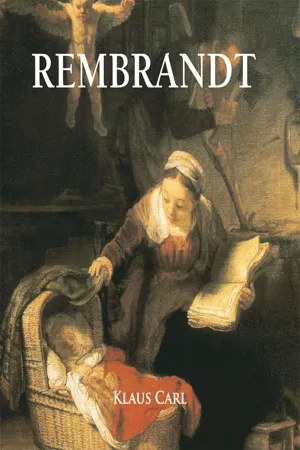
Rembrandt is completely mysterious in his spirit, his character, his life, his work and his method of painting. What we can divine of his essential nature comes through his painting and the trivial or tragic incidents of his unfortunate life; his penchant for ostentatious living forced him to declare bankruptcy. His misfortunes are not entirely explicable, and his oeuvre reflects disturbing notions and contradictory impulses emerging from the depths of his being, like the light and shade of his pictures. In spite of this, nothing perhaps in the history of art gives a more profound impression of unity than his paintings, composed though they are of such different elements, full of complex significations. One feels as if his intellect, that genial, great, free mind, bold and ignorant of all servitude and which led him to the loftiest meditations and the most sublime reveries, derived from the same source as his emotions. From this comes the tragic element he imprinted on everything he painted, irrespective of subject; there was inequality in his work as well as the sublime, which may be seen as the inevitable consequence of such a tumultuous existence.
It seems as though this singular, strange, attractive and almost enigmatic personality was slow in developing, or at least in attaining its complete expansion. Rembrandt showed talent and an original vision of the world early, as evidenced in his youthful etchings and his first self-portraits of about 1630. In painting, however, he did not immediately find the method he needed to express the still incomprehensible things he had to say, that audacious, broad and personal method which we admire in the masterpieces of his maturity and old age. In spite of its subtlety, it was adjudged brutal in his day and certainly contributed to alienate his public.
From the time of his beginnings and of his successes, however, lighting played a major part in his conception of painting and he made it the principal instrument of his investigations into the arcana of interior life. It already revealed to him the poetry of human physiognomy when he painted The Philosopher in Meditation or the Holy Family, so deliciously absorbed in its modest intimacy, or, for example, in The Angel Raphael leaving Tobias. Soon he asked for something more. The Night Watch marks at once the apotheosis of his reputation. He had a universal curiosity and he lived, meditated, dreamed and painted thrown back on himself. He thought of the great Venetians, borrowing their subjects and making of them an art out of the inner life of profound emotion. Mythological and religious subjects were treated as he treated his portraits. For all that he took from reality and even from the works of others, he transmuted it instantly into his own substance.
Information
Topic
ArtSubtopic
Art TechniquesTable of contents
- 1. Self-Portrait with Lace Collar, c. 1629.
- 2. The Anatomy Lesson by Dr. Tulp, 1632.
- 3. The Company of Frans Banning Cocq and Willem Van Ruytenburch also known as The Night Watch, 1642.
- 4. The Lazarus’ Resurrection, 1630-1631.
- 5. The Descent from the Cross, 1633.
- 6. Self-Portrait at the Age of Thirty-Four, 1639-1640.
- 7. Christ Driving the Money-Changers from the Temple, 1635.
- 8. Christ Driving the Money-Changers from the Temple, 1626.
- 9. Portrait of a Scholar, 1631.
- 10. The Adoration of the Magi, 1632.
- 11. The Adoration of the Magi, 1632.
- 12. John the Baptist Preaching, 1634-1635.
- 13. Portrait of Saskia with a Flower, 1641.
- 14. Portrait of a Boy.
- 15. The Portrait of a Young Woman with Flowers in Her Hair, 1634.
- 16. Young Man with a Lace Collar, 1634.
- 17. Rembrandt and Saskia, 1636.
- 18. Flora, 1634.
- 19. Saskia van Uylenburgh in Arcadian Costume, 1635.
- 20. The Incredulity of St Thomas, 1634.
- 21. Christ Revealing Himself to the Emmaüs’ Pilgrims, 1648.
- 22. The Descent from the Cross, 1634.
- 23. The Conspiracy of the Batavians under Claudius Civilis, c. 1666.
- 24. The Deposition, 1633.
- 25. Abraham’s Sacrifice, c. 1636.
- 26. Abraham’s Sacrifice, 1635.
- 27. The Parable of the Labourers in the Vineyard, 1637.
- 28. Herman Doomer (born about 1595, died 1650), 1640.
- 29. Portrait of Baertje Martens, c. 1640.
- 30. Return of the Prodigal Son.
- 31. David and Jonathan, 1642.
- 32. Old Woman with Glasses, 1643.
- 33. The Prophetess Anna (known as Rembrandt’s Mother), 1631.
- 34. Drawing from Raphael’s Portrait of Baldassare Castiglione.
- 35. Portrait of an Old Man.
- 36. Child in a Cradle, c. 1645.
- 37. The Holy Family, 1645.
- 38. Danae, 1636.
- 39. The Holy Family also known as The Carpenter’s Family (detail), 1640.
- 40. Old Man in an Armchair, 1652.
- 41. Portrait of an Old Lady, 1654.
- 42. Portrait of an Old Man in Red, 1652-1654.
- 43. Portrait of an Old Jew, 1654.
- 44. Old Lady Reading, 1655.
- 45. Portrait of an Old Lady, 1654.
- 46. Portrait of an Old Lady, 1654.
- 47. Portrait of Adriaen van Rijn, 1654.
- 48. Self-Portrait, 1652.
- 49. Saskia (?) in Front of a Mirror, c. 1630.
- 50. Young Lady Trying On Earrings, 1657.
- 51. Bathsheba at Her Bath, 1654.
- 52. Hendrickje Stoffels, c. 1652.
- 53. Christ and the Woman of Samaria, 1658.
- 54. Christ and the Woman of Samaria, 1659.
- 55. Haman, Esther and Ahasuerus, 1660.
- 56. Portrait of a Man, 1661.
- 57. Aristotle with a Bust of Homer, 1653.
- 58. The Return of the Prodigal Son, c. 1668.
- 59. Haman Recognizes His Fate, c. 1665.
- 60. Portrait of the Poet Jeremiah de Decker, 1666.
- 61. Sampling Officials of the Drapers’ Guild, 1662.
Trusted by 375,005 students
Access to over 1.5 million titles for a fair monthly price.
Study more efficiently using our study tools.
Frequently asked questions
Yes, you can cancel anytime from the Subscription tab in your account settings on the Perlego website. Your subscription will stay active until the end of your current billing period. Learn how to cancel your subscription
No, books cannot be downloaded as external files, such as PDFs, for use outside of Perlego. However, you can download books within the Perlego app for offline reading on mobile or tablet. Learn how to download books offline
Perlego offers two plans: Essential and Complete
- Essential is ideal for learners and professionals who enjoy exploring a wide range of subjects. Access the Essential Library with 800,000+ trusted titles and best-sellers across business, personal growth, and the humanities. Includes unlimited reading time and Standard Read Aloud voice.
- Complete: Perfect for advanced learners and researchers needing full, unrestricted access. Unlock 1.5M+ books across hundreds of subjects, including academic and specialized titles. The Complete Plan also includes advanced features like Premium Read Aloud and Research Assistant.
We are an online textbook subscription service, where you can get access to an entire online library for less than the price of a single book per month. With over 1.5 million books across 990+ topics, we’ve got you covered! Learn about our mission
Look out for the read-aloud symbol on your next book to see if you can listen to it. The read-aloud tool reads text aloud for you, highlighting the text as it is being read. You can pause it, speed it up and slow it down. Learn more about Read Aloud
Yes! You can use the Perlego app on both iOS and Android devices to read anytime, anywhere — even offline. Perfect for commutes or when you’re on the go.
Please note we cannot support devices running on iOS 13 and Android 7 or earlier. Learn more about using the app
Please note we cannot support devices running on iOS 13 and Android 7 or earlier. Learn more about using the app
Yes, you can access Rembrandt by Klaus Carl in PDF and/or ePUB format, as well as other popular books in Art & Art Techniques. We have over 1.5 million books available in our catalogue for you to explore.