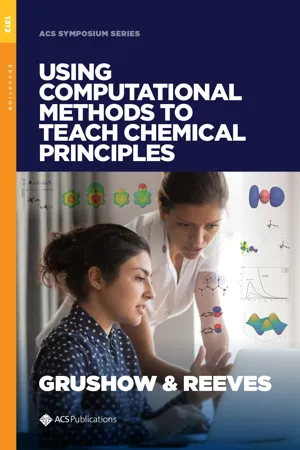
eBook - PDF
Using Computational Methods To Teach Chemical Principles
- 278 pages
- English
- PDF
- Available on iOS & Android
eBook - PDF
Using Computational Methods To Teach Chemical Principles
Information
Print ISBN
9780841234178
Table of contents
- Using Computational Methods To Teach Chemical Principles
- ACS Symposium Series1312
- Foreword
- Using Computational Methods To Teach Chemical Principles: Overview
- Molecular Dynamics Simulations in First-Semester General Chemistry: Visualizing Gas Particle Motion and Making Connections to Mathematical Gas Law Relationships
- Using Electronic Structure Calculations To Investigate the Kinetics of Gas-Phase Ammonia Synthesis
- Modeling Reaction Energies and Exploring Noble Gas Chemistry in the Physical Chemistry Laboratory
- How Can You Measure a Reaction Enthalpy without Going into the Lab?
- Process Oriented Guided Inquiry Learning Computational Chemistry Experiments: Revisions and Extensions Based on Lessons Learned from Implementation
- Chem Compute Science Gateway: An Online Computational Chemistry Tool
- Using Computational Chemistry to Extend the Acetylene Rovibrational Spectrum to C2T2
- Introducing Quantum Calculations into the Physical Chemistry Laboratory
- Learning by Computing: A First Year Honors Chemistry Curriculum
- Integrating Computational Chemistry into an Organic Chemistry Laboratory Curriculum Using WebMO
- Computational Narrative Activities: Combining Computing, Context, and Communication To Teach Chemical Concepts
- Computational Chemistry as a Course for Students Majoring in the Sciences
- Beyond the Analytical Solution: Using Mathematical Software To Enhance Understanding of Physical Chemistry
- A Lab Course in Computational Chemistry Is Not About Computers
- Discovery-Based Computational Activities in the Undergraduate Chemistry Curriculum
- Using the Hydrogen Bond as a Platform for the Enhancement of Integrative Learning
- Editors’ Biographies
- Indexes
- Author Index
- Subject Index
- Using Computational Methods To Teach Chemical Principles: Overview
- Molecular Dynamics Simulations in First-Semester General Chemistry: Visualizing Gas Particle Motion and Making Connections to Mathematical Gas Law Relationships
- Using Electronic Structure Calculations To Investigate the Kinetics of Gas-Phase Ammonia Synthesis
- Modeling Reaction Energies and Exploring Noble Gas Chemistry in the Physical Chemistry Laboratory
- How Can You Measure a Reaction Enthalpy without Going into the Lab?
- Process Oriented Guided Inquiry Learning Computational Chemistry Experiments: Revisions and Extensions Based on Lessons Learned from Implementation
- Chem Compute Science Gateway: An Online Computational Chemistry Tool
- Using Computational Chemistry to Extend the Acetylene Rovibrational Spectrum to C2T2
- Introducing Quantum Calculations into the Physical Chemistry Laboratory
- Learning by Computing: A First Year Honors Chemistry Curriculum
- Integrating Computational Chemistry into an Organic Chemistry Laboratory Curriculum Using WebMO
- Computational Narrative Activities: Combining Computing, Context, and Communication To Teach Chemical Concepts
- Computational Chemistry as a Course for Students Majoring in the Sciences
- Beyond the Analytical Solution: Using Mathematical Software To Enhance Understanding of Physical Chemistry
- A Lab Course in Computational Chemistry Is Not About Computers
- Discovery-Based Computational Activities in the Undergraduate Chemistry Curriculum
- Using the Hydrogen Bond as a Platform for the Enhancement of Integrative Learning
- Editors’ Biographies
- Indexes
- Author Index
- Subject Index
Trusted by 375,005 students
Access to over 1.5 million titles for a fair monthly price.
Study more efficiently using our study tools.