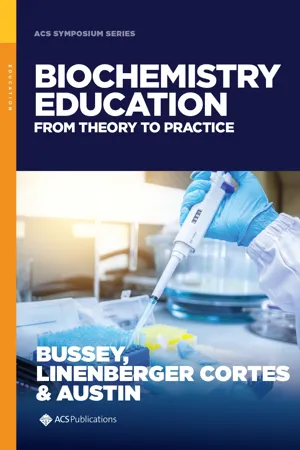
eBook - PDF
Biochemistry Education: From Theory to Practice
- 351 pages
- English
- PDF
- Available on iOS & Android
eBook - PDF
Biochemistry Education: From Theory to Practice
Information
Print ISBN
9780841236325
Table of contents
- Biochemistry Education: From Theory to Practice
- ACS Symposium Series1337
- Foreword
- Preface
- Visual Literacy
- Quantifying the Types of Representations Used in Common Biochemistry Textbooks
- Virtual Exploration of Biomolecular Structure and Function
- Physical Models Support Active Learning as Effective Thinking Tools
- Pedagogies and Practices
- Skills and Foundational Concepts for Biochemistry Students
- Implementing Guided Inquiry in Biochemistry: Challenges and Opportunities
- The Development and Use of Case Studies
- Development and Use of CUREs in Biochemistry
- Lab eNotebooks
- Formative Assessment to Improve Student Learning in Biochemistry
- Best Practices in Summative Assessment
- Implementation
- Don’t Go It Alone: The Importance of Community and Research in Implementing and Maintaining Innovative Pedagogy
- Vignette #1: Introducing Active Learning to Improve Student Performance on Threshold Concepts in Biochemistry
- Vignette #2: Making a Switch to In-Class Activities in the Biochemistry Classroom
- Vignette #3: Developing Student Proficiency in Reading Biochemical Literature
- Vignette #4: Implementation of POGIL-Inspired Experiments in the Biochemistry Laboratory
- Vignette #5: Incorporating Topic-Focused, Student-Derived Projects in the Biochemistry Laboratory Curriculum
- Editors’ Biographies
- Indexes
- Author Index
- Subject Index
- Preface
- Visual Literacy
- Quantifying the Types of Representations Used in Common Biochemistry Textbooks
- Virtual Exploration of Biomolecular Structure and Function
- Physical Models Support Active Learning as Effective Thinking Tools
- Pedagogies and Practices
- Skills and Foundational Concepts for Biochemistry Students
- Implementing Guided Inquiry in Biochemistry: Challenges and Opportunities
- The Development and Use of Case Studies
- Development and Use of CUREs in Biochemistry
- Lab eNotebooks
- Formative Assessment to Improve Student Learning in Biochemistry
- Best Practices in Summative Assessment
- Implementation
- Don’t Go It Alone: The Importance of Community and Research in Implementing and Maintaining Innovative Pedagogy
- Vignette #1: Introducing Active Learning to Improve Student Performance on Threshold Concepts in Biochemistry
- Vignette #2: Making a Switch to In-Class Activities in the Biochemistry Classroom
- Vignette #3: Developing Student Proficiency in Reading Biochemical Literature
- Vignette #4: Implementation of POGIL-Inspired Experiments in the Biochemistry Laboratory
- Vignette #5: Incorporating Topic-Focused, Student-Derived Projects in the Biochemistry Laboratory Curriculum
- Editors’ Biographies
- Indexes
- Author Index
- Subject Index
Trusted by 375,005 students
Access to over 1.5 million titles for a fair monthly price.
Study more efficiently using our study tools.