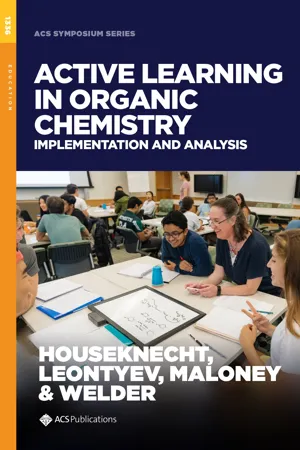
eBook - PDF
Active Learning in Organic Chemistry: Implementation and Analysis
- 261 pages
- English
- PDF
- Available on iOS & Android
eBook - PDF
Active Learning in Organic Chemistry: Implementation and Analysis
Information
Print ISBN
9780841237537
Table of contents
- Active Learning in Organic Chemistry: Implementation and Analysis
- ACS Symposium Series1336
- Foreword
- On the Cover
- Introduction to Active Learning in Organic Chemistry and Essential Terms
- Just-in-Time Teaching
- Using Just-in-Time Teaching To Engage Rural Students in Small Enrollment Organic Chemistry Classes
- Finding Time for Active Learning with Just-in-Time Teaching
- Using Technology to Engage Students
- Clickers in Small Undergraduate Organic Chemistry Courses: Increasing Student Engagement while Improving Perception
- Collaborative Problem Solving: Using Clickers and Cloud Folders To Enhance Student Learning in Organic Chemistry
- Student Use of Classroom Response Systems To Promote Active Learning
- The Mechanisms App and Platform:
- The Flipped Classroom
- An All-In Approach to Flipping the Organic Chemistry Classroom Using Elements of Peer-Led Team Learning with Undergraduate Learning Assistants
- Flipping an Allied Health Survey Course of Organic and Biological Chemistry
- Benefits of a Partially Flipped Organic Chemistry Course to Student Perceptions and Learning
- Effective Implementations of a Partially Flipped Classroom for Large-Enrollment Organic Chemistry Courses
- Collaborative Learning with POGIL
- Cooperative Learning in Large Sections of Organic Chemistry: Transitioning to POGIL
- Combining POGIL and a Flipped Classroom Methodology in Organic Chemistry
- Editors’ Biographies
- Indexes
- Author Index
- Subject Index
- On the Cover
- Introduction to Active Learning in Organic Chemistry and Essential Terms
- Just-in-Time Teaching
- Using Just-in-Time Teaching To Engage Rural Students in Small Enrollment Organic Chemistry Classes
- Finding Time for Active Learning with Just-in-Time Teaching
- Using Technology to Engage Students
- Clickers in Small Undergraduate Organic Chemistry Courses: Increasing Student Engagement while Improving Perception
- Collaborative Problem Solving: Using Clickers and Cloud Folders To Enhance Student Learning in Organic Chemistry
- Student Use of Classroom Response Systems To Promote Active Learning
- The Mechanisms App and Platform:
- The Flipped Classroom
- An All-In Approach to Flipping the Organic Chemistry Classroom Using Elements of Peer-Led Team Learning with Undergraduate Learning Assistants
- Flipping an Allied Health Survey Course of Organic and Biological Chemistry
- Benefits of a Partially Flipped Organic Chemistry Course to Student Perceptions and Learning
- Effective Implementations of a Partially Flipped Classroom for Large-Enrollment Organic Chemistry Courses
- Collaborative Learning with POGIL
- Cooperative Learning in Large Sections of Organic Chemistry: Transitioning to POGIL
- Combining POGIL and a Flipped Classroom Methodology in Organic Chemistry
- Editors’ Biographies
- Indexes
- Author Index
- Subject Index
Trusted by 375,005 students
Access to over 1.5 million titles for a fair monthly price.
Study more efficiently using our study tools.