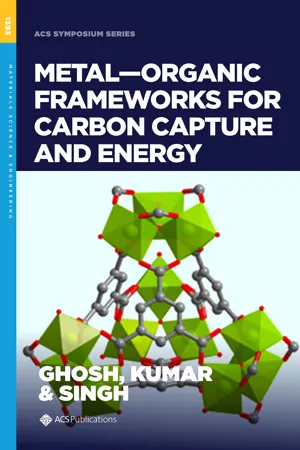
eBook - PDF
Metal−Organic Frameworks for Carbon Capture and Energy
- 536 pages
- English
- PDF
- Available on iOS & Android
eBook - PDF
Metal−Organic Frameworks for Carbon Capture and Energy
Information
Print ISBN
9780841298071
Table of contents
- Metal−Organic Frameworks for Carbon Capture and Energy
- ACS Symposium Series1393
- Foreword
- Preface
- Structure and Functional Characteristics of MOFs
- Bimetallic Metal−Organic Frameworks (BMOFs) and Their Potential Applications
- Additively Manufacturing Metal−Organic Frameworks and Derivatives: Methods, Functional Objects, and Applications
- Bismuth-Based Metal–Organic Frameworks Derived from Multi-Carboxylate Organic Linkers
- Postsynthetic Modification (PSM) in Metal−Organic Frameworks (MOFs): Icing on the Cake
- MOFs for Biomass Conversion
- Metal−Organic Frameworks as Catalysts for the Conversion of Lignin to Value-Added Products
- MOF-Based Catalysts for the Production of Value-Added Fine Chemicals
- MOFs for Carbon Capture
- MOF-Based Catalysts for Production of Value-Added Fine Chemicals from Carbon Dioxide
- Metal−Organic Frameworks for Photoreduction of CO2
- Metal−Organic Frameworks for Carbon Dioxide Capture
- MOF-Based Chemical Fixation of Carbon Dioxide into Value-Added Fine Chemicals
- Modification of Metal−Organic Frameworks for CO2 Capture
- Metal−Organic Framework Based Single-Atom Catalysts for Electrochemical CO2 Sequestration
- MOF: A Heterogeneous Platform for CO2 Capture and Catalysis
- Metal−Organic Frameworks for Capturing Carbon Dioxide from Flue Gas
- MOFs for Energy Applications
- Electrochemical Applications of Metal−Organic Frameworks: Overview, Challenges, and Perspectives
- Chemistry of Metal−Organic Frameworks for Li-Ion Storage and Conversion
- Metal−Organic Frameworks as Photocatalysts for Hydrogen Evolution
- Editors’ Biographies
- Indexes
- Author Index
- Subject Index
- Preface
- Structure and Functional Characteristics of MOFs
- Bimetallic Metal−Organic Frameworks (BMOFs) and Their Potential Applications
- Additively Manufacturing Metal−Organic Frameworks and Derivatives: Methods, Functional Objects, and Applications
- Bismuth-Based Metal–Organic Frameworks Derived from Multi-Carboxylate Organic Linkers
- Postsynthetic Modification (PSM) in Metal−Organic Frameworks (MOFs): Icing on the Cake
- MOFs for Biomass Conversion
- Metal−Organic Frameworks as Catalysts for the Conversion of Lignin to Value-Added Products
- MOF-Based Catalysts for the Production of Value-Added Fine Chemicals
- MOFs for Carbon Capture
- MOF-Based Catalysts for Production of Value-Added Fine Chemicals from Carbon Dioxide
- Metal−Organic Frameworks for Photoreduction of CO2
- Metal−Organic Frameworks for Carbon Dioxide Capture
- MOF-Based Chemical Fixation of Carbon Dioxide into Value-Added Fine Chemicals
- Modification of Metal−Organic Frameworks for CO2 Capture
- Metal−Organic Framework Based Single-Atom Catalysts for Electrochemical CO2 Sequestration
- MOF: A Heterogeneous Platform for CO2 Capture and Catalysis
- Metal−Organic Frameworks for Capturing Carbon Dioxide from Flue Gas
- MOFs for Energy Applications
- Electrochemical Applications of Metal−Organic Frameworks: Overview, Challenges, and Perspectives
- Chemistry of Metal−Organic Frameworks for Li-Ion Storage and Conversion
- Metal−Organic Frameworks as Photocatalysts for Hydrogen Evolution
- Editors’ Biographies
- Indexes
- Author Index
- Subject Index
Trusted by 375,005 students
Access to over 1.5 million titles for a fair monthly price.
Study more efficiently using our study tools.