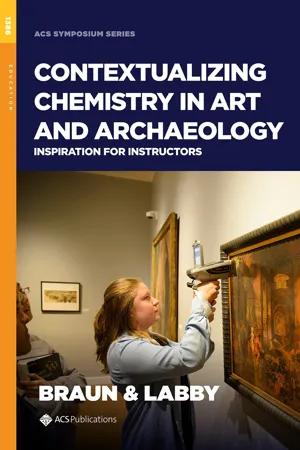
eBook - PDF
Contextualizing Chemistry in Art and Archaeology: Inspiration for Instructors
- 487 pages
- English
- PDF
- Available on iOS & Android
eBook - PDF
Contextualizing Chemistry in Art and Archaeology: Inspiration for Instructors
Information
Print ISBN
9780841298323
Table of contents
- Contextualizing Chemistry in Art and Archaeology: Inspiration for Instructors
- ACS Symposium Series1386
- Foreword
- Preface–Chemistry’s Diverse Applications in Art and Archaeology
- General Chemistry
- Incorporating Conservation Science into the General Education Curriculum
- Archaeological and Historical Pigments: A Unifying Framework for Delivering Relevant Chemical Content Utilizing an Interdisciplinary Approach
- Connecting Chemistry and Cultural Heritage: Presenting the Physical Sciences to Non-science Majors and First-Year Students through the Investigation of Works of Art and Archaeological Artifacts
- Using Examples from Art and Archaeology to Demonstrate the Chemistry of Materials in a General Education Course
- Using the History of Technology to Connect Art and Chemistry in a Science of Art Course for Nonscience Majors
- Making Light Work: A First-Year Writing Course on Art, Colors, and Chemistry
- Instrumentation
- The Chemistry of Art and Artifacts: A Sophomore-Level, Thematic Chemical Instrumentation Course
- X-ray Fluorescence Spectroscopy in Painting Analyses: Undergraduate Classroom, Teaching Laboratory, and Research
- Multispectral and Hyperspectral Reflectance Imaging Spectrometry (VIS, VNIR, SWIR) in Painting Analyses: Undergraduate Teaching and Interfacial Undergraduate Research at the Nexus of Chemistry and Art
- Mixing Chemistry and Pigments: X-ray Fluorescence Spectroscopy as a Nondestructive Technique for Analysis of Pigments in a Painted Japanese Handscroll
- Study Abroad
- Development and Implementation of Molecular Modernism, a “Chemistry and Art” Course with Travel Components in France or the United States
- Exploring London through the World of Art and Chemistry: The Properties and Uses of Metals in Sculpture
- Interdisciplinary or Multiple Levels
- Dry Laboratory Forgery Investigation of a Purported Giorgio de Chirico Painting for a “Chemistry in Art” Course
- Teaching Undergraduate Chemistry through Fibers and Dyes
- Integrating Archaeology and Interdisciplinary Collaborations with Museums into the Chemistry Curriculum
- An Introduction to Ceramic Glaze Color Chemistry
- The Heterogeneity Problem: Intermolecular Forces as They Relate to Solubility and Chromatography
- Editors’ Biographies
- Indexes
- Author Index
- Subject Index
- Preface–Chemistry’s Diverse Applications in Art and Archaeology
- General Chemistry
- Incorporating Conservation Science into the General Education Curriculum
- Archaeological and Historical Pigments: A Unifying Framework for Delivering Relevant Chemical Content Utilizing an Interdisciplinary Approach
- Connecting Chemistry and Cultural Heritage: Presenting the Physical Sciences to Non-science Majors and First-Year Students through the Investigation of Works of Art and Archaeological Artifacts
- Using Examples from Art and Archaeology to Demonstrate the Chemistry of Materials in a General Education Course
- Using the History of Technology to Connect Art and Chemistry in a Science of Art Course for Nonscience Majors
- Making Light Work: A First-Year Writing Course on Art, Colors, and Chemistry
- Instrumentation
- The Chemistry of Art and Artifacts: A Sophomore-Level, Thematic Chemical Instrumentation Course
- X-ray Fluorescence Spectroscopy in Painting Analyses: Undergraduate Classroom, Teaching Laboratory, and Research
- Multispectral and Hyperspectral Reflectance Imaging Spectrometry (VIS, VNIR, SWIR) in Painting Analyses: Undergraduate Teaching and Interfacial Undergraduate Research at the Nexus of Chemistry and Art
- Mixing Chemistry and Pigments: X-ray Fluorescence Spectroscopy as a Nondestructive Technique for Analysis of Pigments in a Painted Japanese Handscroll
- Study Abroad
- Development and Implementation of Molecular Modernism, a “Chemistry and Art” Course with Travel Components in France or the United States
- Exploring London through the World of Art and Chemistry: The Properties and Uses of Metals in Sculpture
- Interdisciplinary or Multiple Levels
- Dry Laboratory Forgery Investigation of a Purported Giorgio de Chirico Painting for a “Chemistry in Art” Course
- Teaching Undergraduate Chemistry through Fibers and Dyes
- Integrating Archaeology and Interdisciplinary Collaborations with Museums into the Chemistry Curriculum
- An Introduction to Ceramic Glaze Color Chemistry
- The Heterogeneity Problem: Intermolecular Forces as They Relate to Solubility and Chromatography
- Editors’ Biographies
- Indexes
- Author Index
- Subject Index
Trusted by 375,005 students
Access to over 1.5 million titles for a fair monthly price.
Study more efficiently using our study tools.