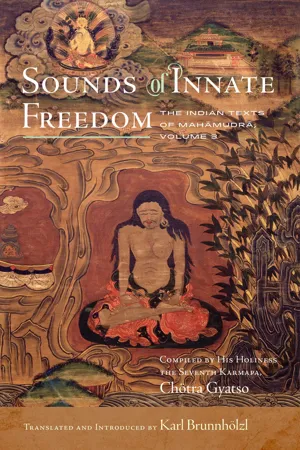
The third volume in a historic six-volume series containing many of the first English translations of the classic mahamudra literature compiled by the Seventh Karmapa.
Sounds of Innate Freedom: The Indian Texts of Mahamudra are historic volumes containing many of the first English translations of the classic mahamudra literature. The texts and songs in these volumes constitute the large compendium called The Indian Texts of the Mahamudra of Definitive Meaning, compiled by the Seventh Karmapa Chötra Gyatso (1456–1539). Translated, introduced, and annotated by Karl Brunnhölzl, acclaimed senior teacher at the Nalandabodhi community of Dzogchen Ponlop Rinpoche, the collection offers a brilliant window into the richness of the vast ocean of Indian mahamudra texts cherished in all Tibetan lineages, particularly in the Kagyu tradition, giving us a clear view of the sources of one of the world’s great contemplative traditions.
This third volume contains twenty-four texts, the bulk of which are dohas by Saraha and commentaries on them, as well as works by other renowned Indian Buddhist mahasiddhas such as Naropa, Krsna, and Sakyasribhadra. The extensive commentaries brilliantly unravel enigmas and bring clarity to the songs they comment on as well as to many other songs of realization in the series. These expressive songs of the inexpressible offer readers a feast of profound and powerful pith instructions uttered by numerous male and female mahasiddhas, yogis, and dakinis, often in the context of ritual ganacakras and initially kept in their secret treasury. Displaying a vast range of themes, styles, and metaphors, they all point to the single true nature of the mind—mahamudra—in inspiring ways and from different angles, using a dazzling array of skillful means to penetrate the sole vital point of buddhahood being found nowhere but within our own mind. Reading and singing these songs of mystical wonder, bliss, and ecstatic freedom and contemplating their meaning will open doors to spiritual experience for us today just as it has for countless practitioners in the past.
- 1,080 pages
- English
- ePUB (mobile friendly)
- Available on iOS & Android
eBook - ePub
About this book
Information
Topic
Theology & ReligionSubtopic
Eastern PhilosophyTable of contents
- Cover Page
- Title Page
- Contents
- Foreword by Dzogchen Ponlop Rinpoche
- Preface
- Abbreviations
- Introduction
- (46) A Commentary on “Ten Stanzas on True Reality”
- (47) Vajra Words
- (48) Six Stanzas on the Progressive Stages of Meditation
- (49) Jewel Light
- (50) Nine Syllables of Precious Instructions
- (51) Stanzas upon Arriving in the Sky
- (52) The Seven Branches of Awakening That Arose from the Roar of the Water-Bearers
- (53) The Body Treasure, A Vajra Song of Immortality
- (54) The Speech Treasure, A Vajra Song of Mellifluousness
- (55) The Mind Treasure, A Vajra Song of the Unborn
- (56) The Mental Nonengagement of Body, Speech, and Mind
- (57) Mahāmudrā Pith Instructions at the Verge of Dying
- (58) A Mahāmudrā Pith Instruction Called “A Dohā Treasure”
- (59) An Elucidation of Śrī Saraha’s “Twelve Stanzas”
- (60) An Alphabet Dohā
- (61) A Commentary on “An Alphabet Dohā”
- (62) The Pinnacle of the Pith Instructions on True Reality Called “A Dohā Song”
- (63) A Dohā Treasure
- (64) A Commentary on the “Dohā Treasure” Composed by Śrīmat Kṛṣṇavajrapāda, Written by Paṇḍita Amṛtavajra
- (65) A Conduct Song Called “A Dohā Treasure”
- (66) A Critical Commentary on “A Dohā Treasure”
- (67) A Critical Commentary on “A Dohā Treasure”
- (68) A Song That Is a Completely Filled Dohā Treasure Store
- (69) The Vajra Lines of the Aural Lineage
- Appendix 1: A Paracanonical Version of Kṛṣṇācārya’s Dohā Treasure (text 63)
- Appendix 2: A Commentary on Kṛṣṇācārya’s “Dohā Treasure” (Tibetan versions of text 64)
- Appendix 3: Saraha’s Dohā Treasure Called “A Song of Pith Instructions” (“Queen Dohā”)
- Appendix 4: *Ajamahāsukha’s Commentary on “A Song on Essential Reality That Is a Dohā Treasure”
- Appendix 5: *Ajamahāsukha’s Commentary on “A Conduct Song Called ‘Doha Treasure,’” Named “A Lamp for the Meaning”
- Appendix 6: Comparison of the Four Canonical Commentaries on Saraha’s “People Dohā”
- Appendix 7: Excerpts from Vajrapāṇi’s Commentary on the Heart Sūtra
- Notes
- Bibliography
- About the Translator
- Copyright
Trusted by 375,005 students
Access to over 1.5 million titles for a fair monthly price.
Study more efficiently using our study tools.
Frequently asked questions
Yes, you can cancel anytime from the Subscription tab in your account settings on the Perlego website. Your subscription will stay active until the end of your current billing period. Learn how to cancel your subscription
No, books cannot be downloaded as external files, such as PDFs, for use outside of Perlego. However, you can download books within the Perlego app for offline reading on mobile or tablet. Learn how to download books offline
Perlego offers two plans: Essential and Complete
- Essential is ideal for learners and professionals who enjoy exploring a wide range of subjects. Access the Essential Library with 800,000+ trusted titles and best-sellers across business, personal growth, and the humanities. Includes unlimited reading time and Standard Read Aloud voice.
- Complete: Perfect for advanced learners and researchers needing full, unrestricted access. Unlock 1.5M+ books across hundreds of subjects, including academic and specialized titles. The Complete Plan also includes advanced features like Premium Read Aloud and Research Assistant.
We are an online textbook subscription service, where you can get access to an entire online library for less than the price of a single book per month. With over 1.5 million books across 990+ topics, we’ve got you covered! Learn about our mission
Look out for the read-aloud symbol on your next book to see if you can listen to it. The read-aloud tool reads text aloud for you, highlighting the text as it is being read. You can pause it, speed it up and slow it down. Learn more about Read Aloud
Yes! You can use the Perlego app on both iOS and Android devices to read anytime, anywhere — even offline. Perfect for commutes or when you’re on the go.
Please note we cannot support devices running on iOS 13 and Android 7 or earlier. Learn more about using the app
Please note we cannot support devices running on iOS 13 and Android 7 or earlier. Learn more about using the app
Yes, you can access Sounds of Innate Freedom by Karl Brunnhölzl in PDF and/or ePUB format, as well as other popular books in Theology & Religion & Eastern Philosophy. We have over 1.5 million books available in our catalogue for you to explore.