An up-to-date reference book on phylogenetic methods and applications for evolutionary biologists
The increasingly widespread availability of genomic data is transforming how biologists estimate evolutionary relationships among organisms and broadening the range of questions that researchers can test in a phylogenetic framework. Species Tree Inference brings together many of today’s leading scholars in the field to provide an incisive guide to the latest practices for analyzing multilocus sequence data.
This wide-ranging and authoritative book gives detailed explanations of emerging new approaches and assesses their strengths and challenges, offering an invaluable context for gauging which procedure to apply given the types of genomic data and processes that contribute to differences in the patterns of inheritance across loci. It demonstrates how to apply these approaches using empirical studies that span a range of taxa, timeframes of diversification, and processes that cause the evolutionary history of genes across genomes to differ.
By fully embracing this genomic heterogeneity, Species Tree Inference illustrates how to address questions beyond the goal of estimating phylogenetic relationships of organisms, enabling students and researchers to pursue their own research in statistically sophisticated ways while charting new directions of scientific discovery.
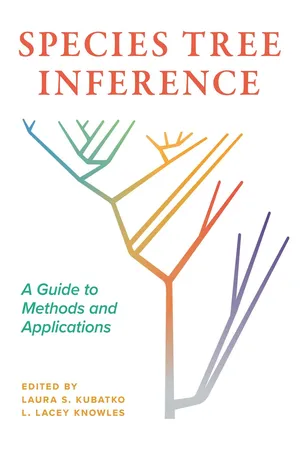
eBook - ePub
Species Tree Inference
A Guide to Methods and Applications
- 408 pages
- English
- ePUB (mobile friendly)
- Available on iOS & Android
eBook - ePub
Species Tree Inference
A Guide to Methods and Applications
About this book
Information
Publisher
Princeton University PressYear
2023Print ISBN
9780691207605
9780691207599
eBook ISBN
9780691245157
Topic
Ciencias biológicasSubtopic
EcologíaTable of contents
- Cover
- Title Page
- Copyright
- Dedication
- Short Contents
- Contents
- Preface
- Acknowledgments
- List of Contributors
- Chapter 1. Introduction to Species Tree Inference
- Part I. Analytical and Methodological Developments
- Part II. Empirical Inference
- Part III. Beyond the Species Tree
- Bibliography
- Index
Trusted by 375,005 students
Access to over 1.5 million titles for a fair monthly price.
Study more efficiently using our study tools.
Frequently asked questions
Yes, you can cancel anytime from the Subscription tab in your account settings on the Perlego website. Your subscription will stay active until the end of your current billing period. Learn how to cancel your subscription
No, books cannot be downloaded as external files, such as PDFs, for use outside of Perlego. However, you can download books within the Perlego app for offline reading on mobile or tablet. Learn how to download books offline
Perlego offers two plans: Essential and Complete
- Essential is ideal for learners and professionals who enjoy exploring a wide range of subjects. Access the Essential Library with 800,000+ trusted titles and best-sellers across business, personal growth, and the humanities. Includes unlimited reading time and Standard Read Aloud voice.
- Complete: Perfect for advanced learners and researchers needing full, unrestricted access. Unlock 1.5M+ books across hundreds of subjects, including academic and specialized titles. The Complete Plan also includes advanced features like Premium Read Aloud and Research Assistant.
We are an online textbook subscription service, where you can get access to an entire online library for less than the price of a single book per month. With over 1.5 million books across 990+ topics, we’ve got you covered! Learn about our mission
Look out for the read-aloud symbol on your next book to see if you can listen to it. The read-aloud tool reads text aloud for you, highlighting the text as it is being read. You can pause it, speed it up and slow it down. Learn more about Read Aloud
Yes! You can use the Perlego app on both iOS and Android devices to read anytime, anywhere — even offline. Perfect for commutes or when you’re on the go.
Please note we cannot support devices running on iOS 13 and Android 7 or earlier. Learn more about using the app
Please note we cannot support devices running on iOS 13 and Android 7 or earlier. Learn more about using the app
Yes, you can access Species Tree Inference by Laura Kubatko, L. Lacey Knowles, Laura Kubatko,L. Lacey Knowles in PDF and/or ePUB format, as well as other popular books in Ciencias biológicas & Ecología. We have over 1.5 million books available in our catalogue for you to explore.