The concept of a "smart city" is used widely in general; however, it is hard to explain because of the complexity and multidimensionality of this notion. However, the essential qualification for being a smart city is to achieve "sustainable social, environmental, and economic development" and boost the living standards of society based on Information and Communication Technology (ICT) and Artificial intelligence (AI). AI in smart cities has become an important aspect for cities that face great challenges to make smart decisions for social well-being, particularly cybersecurity and corporate sustainability. In this context, we aim to contribute literature with a value-added approach where various AI applications of smart cities are discussed from a different perspective. First, we start by discussing the conceptual design, modeling, and determination of components for the sustainability of a smart city structure. Since smart cities operate on spatial-based data, it is important to design, operate, and manage smart city elements using Geographical Information Systems (GIS) technologies. Second, we define the structure, type, unit, and functionality of the layers to be placed on the GIS to achieve best practices based on Industry 4.0 components. Transportation is one of the key indicators of smart cities, so it is critical to make transportation in smart cities accessible for different disabled groups by using AI technologies. Third, we demonstrate what kinds of technologies should be used for which disabled groups in different transportation vehicles with specific examples. Finally, we create a discussion platform for processes and sub-processes such as waste management, emergency management, risk management, and data management for establishing smart cities including the financial and ethical aspects.
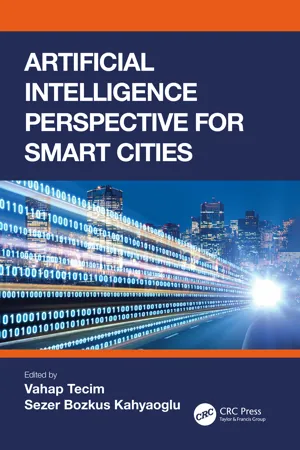
eBook - ePub
Artificial Intelligence Perspective for Smart Cities
- 280 pages
- English
- ePUB (mobile friendly)
- Available on iOS & Android
eBook - ePub
Artificial Intelligence Perspective for Smart Cities
About this book
Information
Table of contents
- Cover Page
- Half Title page
- Title Page
- Copyright Page
- Contents
- Abbreviations
- Foreword
- Editors
- Contributors
- Chapter 1 AI perspective for smart cities
- Chapter 2 Conceptual design: Components of smart cities
- Chapter 3 From digital to sustainable urban systems
- Chapter 4 GIS-based management
- Chapter 5 Industry 4.0 for smart cities
- Chapter 6 Smart transportation for disabilities
- Chapter 7 Waste management for smart cities
- Chapter 8 Emergency management in smart cities
- Chapter 9 Sustainable financing of smart cities
- Chapter 10 Risk management
- Chapter 11 Ethical rules: Protection of personal data
- Chapter 12 Data security
- Index
Trusted by 375,005 students
Access to over 1.5 million titles for a fair monthly price.
Study more efficiently using our study tools.
Frequently asked questions
Yes, you can cancel anytime from the Subscription tab in your account settings on the Perlego website. Your subscription will stay active until the end of your current billing period. Learn how to cancel your subscription
No, books cannot be downloaded as external files, such as PDFs, for use outside of Perlego. However, you can download books within the Perlego app for offline reading on mobile or tablet. Learn how to download books offline
Perlego offers two plans: Essential and Complete
- Essential is ideal for learners and professionals who enjoy exploring a wide range of subjects. Access the Essential Library with 800,000+ trusted titles and best-sellers across business, personal growth, and the humanities. Includes unlimited reading time and Standard Read Aloud voice.
- Complete: Perfect for advanced learners and researchers needing full, unrestricted access. Unlock 1.5M+ books across hundreds of subjects, including academic and specialized titles. The Complete Plan also includes advanced features like Premium Read Aloud and Research Assistant.
We are an online textbook subscription service, where you can get access to an entire online library for less than the price of a single book per month. With over 1.5 million books across 990+ topics, we’ve got you covered! Learn about our mission
Look out for the read-aloud symbol on your next book to see if you can listen to it. The read-aloud tool reads text aloud for you, highlighting the text as it is being read. You can pause it, speed it up and slow it down. Learn more about Read Aloud
Yes! You can use the Perlego app on both iOS and Android devices to read anytime, anywhere — even offline. Perfect for commutes or when you’re on the go.
Please note we cannot support devices running on iOS 13 and Android 7 or earlier. Learn more about using the app
Please note we cannot support devices running on iOS 13 and Android 7 or earlier. Learn more about using the app
Yes, you can access Artificial Intelligence Perspective for Smart Cities by Vahap Tecim, Sezer Bozkus Kahyaoglu, Vahap Tecim,Sezer Bozkus Kahyaoglu in PDF and/or ePUB format, as well as other popular books in Architecture & Urban Planning & Landscaping. We have over 1.5 million books available in our catalogue for you to explore.