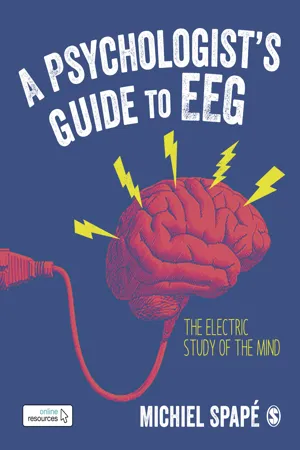
Do you want to learn to read people?s minds?In this student-friendly, practice-focussed textbook on EEG and biosignal analysis, you will learn how to: Implement your experiment in E-Prime or OpenSesame;Run your study in the psychophysiological laboratory;Analyse data in MATLAB by following simple steps.This textbook follows a unique approach by guiding you through a single EEG study, each part introducing the relevant core knowledge and commonly available software. Practical exercises help you master the skills to independently implement every aspect of an experiment, from setting up the lab to analysing the data. Suitable for developing both basic levels of skill for undergraduates as well as advancing towards a stronger command of analysis and understanding at postgraduate level.Michiel Spapé is a Lecturer and Researcher in Psychology at the University of Helsinki.
- 328 pages
- English
- ePUB (mobile friendly)
- Available on iOS & Android
eBook - ePub
About this book
Information
Table of contents
- Cover
- Half Title
- Publisher Note
- Title Page
- Copyright Page
- Contents
- You, me, and the EEG: A preface
- Acknowledgements
- Online resources
- 1 EEG in theory
- 2 Design your experiment
- 3 Develop your experiment in E-Prime
- 4 Develop your experiment in OpenSesame
- 5 Lab life: EEG equipment, hardware and software
- 6 Lab life: EEG equipment and dealing with people
- 7 Preprocessing EEG: Importing, referencing, filtering
- 8 Further processing of EEG: Artefact rejection and correction
- 9 Looking at brainwaves: Data visualisation
- 10 Great brains think alike: Grand average analysis
- 11 Inferential statistics and reporting results
- 12 Concluding and discussing research
- Epilogue: So you want to be a cognitive neuroscientist?
- References
- Index
Trusted by 375,005 students
Access to over 1.5 million titles for a fair monthly price.
Study more efficiently using our study tools.
Frequently asked questions
Yes, you can cancel anytime from the Subscription tab in your account settings on the Perlego website. Your subscription will stay active until the end of your current billing period. Learn how to cancel your subscription
No, books cannot be downloaded as external files, such as PDFs, for use outside of Perlego. However, you can download books within the Perlego app for offline reading on mobile or tablet. Learn how to download books offline
Perlego offers two plans: Essential and Complete
- Essential is ideal for learners and professionals who enjoy exploring a wide range of subjects. Access the Essential Library with 800,000+ trusted titles and best-sellers across business, personal growth, and the humanities. Includes unlimited reading time and Standard Read Aloud voice.
- Complete: Perfect for advanced learners and researchers needing full, unrestricted access. Unlock 1.5M+ books across hundreds of subjects, including academic and specialized titles. The Complete Plan also includes advanced features like Premium Read Aloud and Research Assistant.
We are an online textbook subscription service, where you can get access to an entire online library for less than the price of a single book per month. With over 1.5 million books across 990+ topics, we’ve got you covered! Learn about our mission
Look out for the read-aloud symbol on your next book to see if you can listen to it. The read-aloud tool reads text aloud for you, highlighting the text as it is being read. You can pause it, speed it up and slow it down. Learn more about Read Aloud
Yes! You can use the Perlego app on both iOS and Android devices to read anytime, anywhere — even offline. Perfect for commutes or when you’re on the go.
Please note we cannot support devices running on iOS 13 and Android 7 or earlier. Learn more about using the app
Please note we cannot support devices running on iOS 13 and Android 7 or earlier. Learn more about using the app
Yes, you can access A Psychologist's guide to EEG by Michiel Spape in PDF and/or ePUB format, as well as other popular books in Psychology & Cognitive Neuroscience & Neuropsychology. We have over 1.5 million books available in our catalogue for you to explore.