This work summarizes the state-of-the-art development of inertial electrostatic confinement (IEC) thruster, which can be divided into two parallel lines of development: the IEC plasma source and the corresponding electromagnetic nozzle (EMN). Both developing lines start from the establishment of the theory and modeling and evolve to the design implementation and experimental verification. The IEC discharge model highlights a novel perspective on the IEC discharge physics and the impacts of the respective critical parameters, which layouts the design for the IEC plasma source. Experimental verification for the theory is demonstrated via the optical emission spectroscopy and collision radiative model. The results provide conclusive evidence of forming a spherical double layer within the IEC plasma source, which is the key to establishing the proposed IEC discharge theory in this work. This work presents a comprehensive study on the magnetohydrodynamic theory for assessing the plasma acceleration in the magnetic nozzle. Nevertheless, the result shows a performance limitation of the magnetic nozzle. An innovative invention is proposed to overcome the limitation known as the EMN. Thorough descriptions of EMN and its working principle are summarized in this work, including its effects on plasma confinement, acceleration, and detachment. Investigation of the plasma plume properties by miscellaneous plasma diagnostics tools further demonstrates EMN functionality and constitutes the first IECT prototype with proof-of-concept in literature.
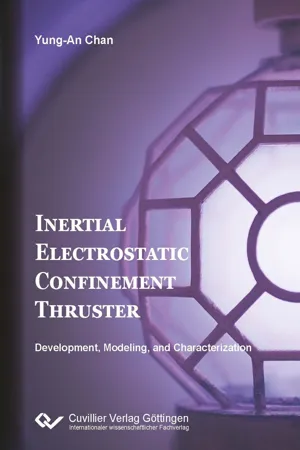
- 273 pages
- English
- PDF
- Available on iOS & Android
eBook - PDF
About this book
Information
Print ISBN
9783736976771
Edition
1Table of contents
- Acknowledgment
- Abstract
- Zusammenfassung
- Contents
- Nomenclature
- Chapter 1 Introduction
- 1.1 Background of Inertial Electrostatic Confinement
- 1.2 Magnetic Nozzle for IEC Plasma Acceleration
- 1.3 Potential Applications
- 1.4 Motivation and Difficulties
- 1.5 Thesis Structure
- Chapter 2 Fundamentals of DC Discharge and IEC Theory
- 2.1 Fundamentals of DC Plasma Discharge
- 2.2 The New Perspective of the IEC Working Principle
- 2.3 Implementation of the IEC-SDL Model
- 2.4 Summary of IEC Discharge Theory
- Chapter 3 Plasma Acceleration in Magnetic Nozzle
- 3.1 Summary of the Plasma Transportation and MHD Flow Theory
- 3.2 Plasma Acceleration in a Divergent B-field
- 3.3 Plasma Detachment Mechanism
- 3.4 Design Criteria of MN for IEC Plasma Source
- Chapter 4 IECT Design and Test Facility
- 4.1 The Design Concept and Considerations of IECT
- 4.2 Phase I: IEC Discharge Experiment
- 4.3 Phase II: IECT Experiment
- 4.4 IECT Test Facility
- Chapter 5 Plasma Diagnostics for IEC Plasma Sphere
- 5.1 Narrow Spectral-bandwidth Imaging
- 5.2 Optical Emission Spectroscopy
- 5.3 Collisional Radiative Model
- Chapter 6 Plasma Diagnostics for IECT Plume
- 6.1 Principle of the Electrostatic Probe
- 6.2 Probe Design and Experimental Setup
- Chapter 7 Discharge Evaluation of IEC Plasma Source
- 7.1 Discharge Behavior of IEC Plasma Source
- 7.2 SDL Characteristics
- 7.3 Conclusions of IEC Discharge Experiment
- Chapter 8 EMN Discharge and Plume Characteristics
- 8.1 EMN Discharge Characteristics
- 8.2 IECT Plume Properties
- 8.3 Summary of EMN Discharge Characteristics and Plume Properties
- Chapter 9 Conclusion
- 9.1 Discharge of IEC and SDL Theory
- 9.2 Plasma Confinement and Acceleration by EMN
- Bibliography
- Appendix
Trusted by 375,005 students
Access to over 1.5 million titles for a fair monthly price.
Study more efficiently using our study tools.