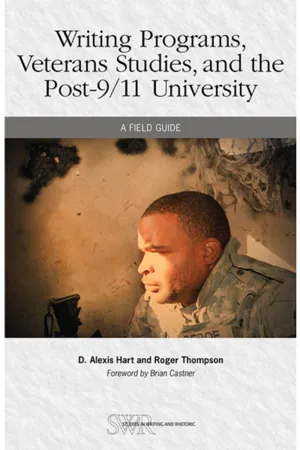
Writing Programs, Veterans Studies, and the Post-9/11 University
eBook - ePub

Writing Programs, Veterans Studies, and the Post-9/11 University

A Field Guide

  1. 178 pages
  2. English
  3. ePUB (mobile friendly)
  4. Available on iOS & Android
eBook - ePub

Writing Programs, Veterans Studies, and the Post-9/11 University

A Field Guide

About this book

D. Alexis Hart and Roger Thompson offer rich academic inquiry into the idea of “the veteran” as well as into ways that veteran culture has been fostered or challenged in writing classrooms, in writing centers, and in college communities more generally.

For good reasons, the rise of veterans studies has occurred within the discipline of writing studies, with its interdisciplinary approach to scholarship, pedagogy, and community outreach. Writing faculty are often a point of first contact with veteran students, and writing classrooms are by their nature the site of disclosures, providing opportunities to make connections and hear narratives that debunk the myth of the stereotypical combat veteran of popular culture. 

Presenting a more nuanced approach to understanding “the veteran” leads not only to more useful research, but also to more wide-ranging and significant scholarship and community engagement. Such an approach recognizes veterans as assets to the college campus, encourages institutions to customize their veterans programs and courses, and leads to more thoughtful engagement with veterans in the writing classroom.

About the CCCC Studies in Writing & Rhetoric (SWR) Series
In this series, the methods of studies vary from the critical to historical to linguistic to ethnographic, and their authors draw on work in various fields that inform composition—including rhetoric, communication, education, discourse analysis, psychology, cultural studies, and literature. Their focuses are similarly diverse—ranging from individual writers and teachers, to classrooms and communities and curricula, to analyses of the social, political, and material contexts of writing and its teaching.

Frequently asked questions

Yes, you can cancel anytime from the Subscription tab in your account settings on the Perlego website. Your subscription will stay active until the end of your current billing period. Learn how to cancel your subscription.
No, books cannot be downloaded as external files, such as PDFs, for use outside of Perlego. However, you can download books within the Perlego app for offline reading on mobile or tablet. Learn more here.
Perlego offers two plans: Essential and Complete
  • Essential is ideal for learners and professionals who enjoy exploring a wide range of subjects. Access the Essential Library with 800,000+ trusted titles and best-sellers across business, personal growth, and the humanities. Includes unlimited reading time and Standard Read Aloud voice.
  • Complete: Perfect for advanced learners and researchers needing full, unrestricted access. Unlock 1.4M+ books across hundreds of subjects, including academic and specialized titles. The Complete Plan also includes advanced features like Premium Read Aloud and Research Assistant.
Both plans are available with monthly, semester, or annual billing cycles.
We are an online textbook subscription service, where you can get access to an entire online library for less than the price of a single book per month. With over 1 million books across 1000+ topics, we’ve got you covered! Learn more here.
Look out for the read-aloud symbol on your next book to see if you can listen to it. The read-aloud tool reads text aloud for you, highlighting the text as it is being read. You can pause it, speed it up and slow it down. Learn more here.
Yes! You can use the Perlego app on both iOS or Android devices to read anytime, anywhere — even offline. Perfect for commutes or when you’re on the go.
Please note we cannot support devices running on iOS 13 and Android 7 or earlier. Learn more about using the app.
Yes, you can access Writing Programs, Veterans Studies, and the Post-9/11 University by D. Alexis Hart,Roger Thompson in PDF and/or ePUB format. We have over one million books available in our catalogue for you to explore.

Table of contents

  1. COVER
  2. TITLE PAGE
  3. COPYRIGHT
  4. CONTENTS
  5. Foreword
  6. Acknowledgments
  7. Introduction: Theorizing the Post-9/11 Veteran
  8. 1. Writing (Veterans) Studies
  9. 2. The Rhetoric of the GI Bill: Defining Veteran Education
  10. Writing/Practices 1: Student Voices/Writing Genres
  11. 3. Transferring Veteran Knowledge
  12. 4. Developing Veteran-Informed Classrooms
  13. 5. Engaging Veteran Trauma
  14. Writing/Practices 2: Pedagogy and Programs
  15. Conclusion: Assets and Avenues
  16. Notes
  17. Works Cited
  18. Index
  19. Authors