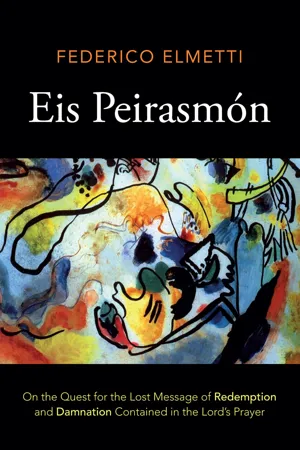
eBook - ePub
Eis Peirasmón
On the Quest for the Lost Message of Redemption and Damnation Contained in the Lord’s Prayer
- 408 pages
- English
- ePUB (mobile friendly)
- Available on iOS & Android
eBook - ePub
Eis Peirasmón
On the Quest for the Lost Message of Redemption and Damnation Contained in the Lord’s Prayer
About this book
For the past two thousand years, theologians and biblical scholars have been furiously debating the correct interpretation of the sixth petition of the Lord's Prayer ("and lead us not into temptation"). Despite all the hypotheses proposed, no convincing solution has been found to date. In fact, every single attempt has crashed against insurmountable difficulties. Even within the church, the debate on this topic is far from settled. Recently, both France and Italy approved new translations that deviate substantially from the two-thousand-year-old traditional Latin version. Since God cannot be the one leading us into temptation (Satan is), it becomes necessary to reformulate the petition by hiding God's responsibility under convoluted permissive constructs. But can any of these interpretations have any exegetical justification? This book is an ambitious and reckless attempt--from the point of view of an outsider, of a theoretical physicist--to rethink the Lord's Prayer from the beginning, and with it, to come closer, if possible, to the authentic message of Christ. As a result of a rigorous, deductive, scientific approach that minimizes any hermeneutical bias, the meaning of the sixth petition will spontaneously emerge and appear to the reader in its simplicity and elegance.
Information
Topic
Theology & ReligionSubtopic
Christian TheologyTable of contents
- Title Page
- Preface
- Abbreviations
- Introduction
- Chapter 1: God Does Not Lead Us into Temptation
- Chapter 2: The Sermon on the Mount
- Chapter 3: Eisphérō
- Chapter 4: To Lead or to Allow to Go?
- Chapter 5: The Lord’s Prayer in Different Idioms
- Chapter 6: Causative vs. Permissive
- Chapter 7: The Permissive Construct in Biblical Greek
- Chapter 8: Can God Lead Man Astray?
- Chapter 9: The Permissive Sensitivity in the Old Testament
- Chapter 10: The Causative Form of “to Enter” in the Old Testament
- Chapter 11: The Theory of the Divine “Cardiodynamic”
- Chapter 12: Divine Justice and Free Will: the Choice between Good and Evil
- Chapter 13: God and the Necessary Evil: the Examples of Noah and Lot
- Chapter 14: The Relationship between God and Satan: the Example of Job
- Chapter 15: Critique of the Church Fathers
- Chapter 16: The Concept of Temptation in the Old Testament
- Chapter 17: The Concept of Temptation According to the Evangelists
- Chapter 18: The Big Misunderstanding
- Chapter 19: Lead Us Not into Peirasmós
- Chapter 20: But Deliver Us from Evil
- Chapter 21: Is It Ponērós or Ponērón?
- Chapter 22: The Dead Sea Scrolls and the Extra-Biblical Tradition
- Chapter 23: The Active Interpretation
- Chapter 24: The Eschatological Interpretation and the Unsolved Problem
- Chapter 25: The Lord’s Prayer in the Gethsēmaní and the Problem of Trivialization
- Chapter 26: Agnus Dei
- Chapter 27: The Meaning of Peirasmós in the Sixth Petition
- Chapter 28: The Meaning of the Sixth Petition
- Chapter 29: The Secretary of Divine Mercy
- Chapter 30: The Lord’s Prayer, Corrected
- Appendix
- Bibliography
Trusted by 375,005 students
Access to over 1.5 million titles for a fair monthly price.
Study more efficiently using our study tools.
Frequently asked questions
Yes, you can cancel anytime from the Subscription tab in your account settings on the Perlego website. Your subscription will stay active until the end of your current billing period. Learn how to cancel your subscription
No, books cannot be downloaded as external files, such as PDFs, for use outside of Perlego. However, you can download books within the Perlego app for offline reading on mobile or tablet. Learn how to download books offline
Perlego offers two plans: Essential and Complete
- Essential is ideal for learners and professionals who enjoy exploring a wide range of subjects. Access the Essential Library with 800,000+ trusted titles and best-sellers across business, personal growth, and the humanities. Includes unlimited reading time and Standard Read Aloud voice.
- Complete: Perfect for advanced learners and researchers needing full, unrestricted access. Unlock 1.5M+ books across hundreds of subjects, including academic and specialized titles. The Complete Plan also includes advanced features like Premium Read Aloud and Research Assistant.
We are an online textbook subscription service, where you can get access to an entire online library for less than the price of a single book per month. With over 1.5 million books across 990+ topics, we’ve got you covered! Learn about our mission
Look out for the read-aloud symbol on your next book to see if you can listen to it. The read-aloud tool reads text aloud for you, highlighting the text as it is being read. You can pause it, speed it up and slow it down. Learn more about Read Aloud
Yes! You can use the Perlego app on both iOS and Android devices to read anytime, anywhere — even offline. Perfect for commutes or when you’re on the go.
Please note we cannot support devices running on iOS 13 and Android 7 or earlier. Learn more about using the app
Please note we cannot support devices running on iOS 13 and Android 7 or earlier. Learn more about using the app
Yes, you can access Eis Peirasmón by Federico Elmetti in PDF and/or ePUB format, as well as other popular books in Theology & Religion & Christian Theology. We have over 1.5 million books available in our catalogue for you to explore.