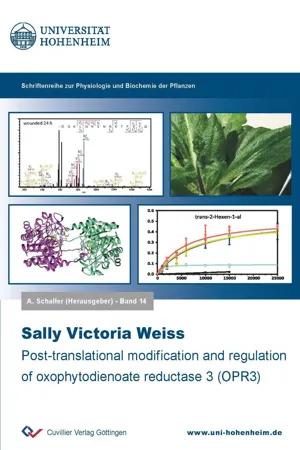
Oxophytodienoic acid reductases (OPRs) are flavoenzymes closely related to Old Yellow Enzyme (OYE) from Saccharomyces. The physiological role of plant OPRs could only be clarified for OPR3: OPR3 from tomato and Arabidopsis reduce the double bond of the ?, ?-unsaturated carbonyl group of (9S, 13S)-oxophytodienoic acid (OPDA), the precursor of the phytohormone jasmonic acid (JA). OPR3 is therefore an important step for JA biosynthesis and the following JA-triggered defensive and developmental adaptations of the plant. Since the production of phytohormones, including JA, is regulated in an extremely time- and tissue specific manner, the regulatory step of JA-biosynthesis was sought. The conversion of OPDA by OPR3 was proposed as the rate-limiting step in biosynthesis as OPR3 turned out to form a self-inhibiting dimer when crystallized. In the OPR3 crystal, the L6-loop from each protomer reaches into the active site cavity of the other protomer. The dimerization-dependent block of the active site provides a hypothetical mechanism for the regulation of OPR3 activity. Interestingly, two sulfate ions were enclosed in the interacting site of the protomers, suggesting that the dimer might be stabilized in vivo by reversible sulfation or phosphorylation of the tyrosine 364(SlOPR3) or 365 (AtOPR3), respectively. The role of this hypothesized sulfation/phosphorylation was subject of this study.Neither sulfation nor phosphorylation of Y365 could be detected by mass spectrometry. Hence, studies were continued with an in vitro approach where OPR3 was expressed with sulfotyrosine incorporated co-translationally at position 365 (Y365SY). Biochemical characterization led to contradictory results: On the one hand, interaction strength of Y365SY was unaltered in comparison to wild-type OPR3, while on the other hand, activity of Y365SY was reduced. Closer examination indicated that substrate binding or product release was reduced in Y365SY. These changes could be traced back to the additional charge of the SO42--ion, which leads to a narrowing of the entrance to the active site cavity. With this finding, the proposed regulating mechanism by sulfation/phosphorylation is still valid, but independent from dimerization.In order to link this potential regulatory mechanism with a post-translational modification in vivo, an untargeted screen was performed, in which OPR3 was expressed as a fusion protein with a promiscous biotin ligase (BioID2). With this method, potentially interacting proteins were biotinylated in vivo and subsequently isolated and analyzed by MS/MS. Many candidate proteins were identified for OPR3, including kinases and phosphatases. Additionally, OPR1, OPR2 and OPR4 from Arabidopsis were also expressed as BioID2 fusion proteins in order to clarify their physiological role. The most promising results were obtained for OPR4, which was found to be association with stress granule and P-body proteins.
eBook - PDF
Post-translational modification and regulation of oxophytodienoate reductase 3 (OPR3)
- 265 pages
- English
- PDF
- Available on iOS & Android
eBook - PDF
Post-translational modification and regulation of oxophytodienoate reductase 3 (OPR3)
About this book
Information
Print ISBN
9783736976870
Edition
1Table of contents
- Contents
- Figures
- Tables
- Abbreviations
- Summary
- Zusammenfassung
- 1. Introduction
- 1.1. Jasmonic acid and its role in growth and defense
- 1.2. Biosynthesis and perception of jasmonates
- 1.3. Regulation of OPR3 activity by dimerization
- 1.4. Post-translational modification as key regulator of JA-Biosynthesis?
- 1.5. Non-OPDA reducing OPRs
- 1.6. Objectives of this work
- 2. Material and Methods
- 2.1. Chemicals, enzymes and kits
- 2.2. Antibodies
- 2.3. Oligonucleotides
- 2.4. Plasmids
- 2.5. Constructs
- 2.5.1. AtOPR3-constructs for complementation of Arabidopsis thaliana
- 2.5.2. Constructs in pET21a for heterologous expression of proteins in E. coli
- 2.5.3. Constructs for proximity-dependent biotin identification 2 (BioID2)
- 2.6. Organisms
- 2.6.1. Bacteria
- 2.6.2. Plants
- 2.7. Plant methods
- 2.7.1. Growth of Arabidopsis thaliana on soil
- 2.7.2. Growth of Arabidopsis thaliana in hydroponic culture
- 2.7.3. Growth of Arabidopsis thaliana under sterile conditions
- 2.7.4. Growth of Nicotiana benthamiana
- 2.7.5. Stable transformation of Arabidopsis thaliana
- 2.7.6. Transient expression of proteins in Nicotiana benthamiana
- 2.8. Bacterial methods
- 2.8.1. Heterologous protein expression in E. coli
- 2.8.2. Cell lysis and Ni+-NTA purification of heterologously expressed 6xHistaggedproteins
- 2.9. Biochemical Methods
- 2.9.1. Ion exchange chromatography
- 2.9.2. Monitoring protein quality via Tycho NT.6
- 2.9.3. Enzyme activity assay
- 2.9.4. Extraction of reaction products
- 2.9.5. Sulfotyrosine synthesis
- 2.9.6. Affinity purification by GFP®-Trap
- 2.9.7. Affinity purification by streptavidin sepharose
- 2.10. Sample preparation for Mass Spectrometry
- 2.10.1. On-beads proteolytic digestion
- 2.10.2. In-gel proteolytic digestion
- 2.10.3. On-beads chemical cleavage
- 2.10.4. Desalting of mass spectrometry samples by stop-and-go-extractiontips (StageTips)
- 2.10.5. Electrospray-Ionization Mass Spectrometry (ESI-MS)
- 2.10.6. Analysis and statistics of mass spectrometric data
- 2.10.7. QTRAP-Mass spectrometry (metabolome-analysis)
- 2.10.8. Micro scale thermophoresis
- 2.10.9. Analytical ultracentrifugation (AUC)
- 2.11. Basic biochemical techniques
- 2.11.1. Protein isolation from leaves
- 2.11.2. Determination of protein concentration by Bradford assay
- 2.11.3. Determination of flavoprotein concentration by measuring FMN cofactor
- 2.11.4. Separation of Proteins by denaturing SDS-polyacrylamide gel electrophoresis(SDS-PAGE)
- 2.11.5. Coomassie Stain
- 2.11.6. Western Blot
- 2.11.7. Ponceau Stain
- 2.11.8. Isolation of plasmid DNA
- 2.11.9. Isolation of genomic DNA from plant material
- 2.11.10. Polymerase chain reaction (PCR)
- 2.11.11. Agarose gel electrophoresis
- 2.11.12. Elution of DNA from Agarose
- 2.11.13. Topo-cloning
- 2.11.14. Restriction digest and dephosphorylation
- 2.11.15. Ligation
- 2.11.16. Transformation of bacteria
- 2.11.17. DNA sequencing
- 3. Results
- 3.1. Characterization of tyrosine-sulfated OPR3
- 3.1.1. Preparation of tyrosine-sulfated OPR3
- 3.1.2. OPR3 and its mutants form dimers during Micro Scale Thermophoresis
- 3.1.3. Thermal unfolding profile of AtOPR3 and its mutants
- 3.1.4. OPR3 forms a dimer during analytical ultracentrifugation
- 3.1.5. Enzymatic activity of OPR3 and its mutants
- 3.1.6. Conversion of racemic OPDA by OPR3 and Y365SY
- 3.1.7. Summary of biochemical characterization
- 3.2. Is OPR3 posttranslationally modified in vivo?
- 3.2.1. Expressing OPR3-YFP under its native promotor
- 3.2.2. Is tyrosine 365 modified in vivo in response to wounding?
- 3.2.3. Is tyrosine 365 modified in vivo in specialized tissues?
- 3.2.4. Post-translational modifications of other amino acids
- 3.2.5. Chemical cleavage with formic acid
- 3.2.6. Summary of mass spectrometric analysis
- 3.3. Identification of interacting proteins by in vivo proximity labeling
- 3.3.1. Selection of candidate proteins and expression
- 3.3.2. Biotin supplementation and expression levels in A. thaliana
- 3.3.3. BioID2 screen
- 3.3.4. Verification of feasibility
- 3.3.5. Results for OPR3
- 3.3.6. BioID2-results for cytosolic OPR1, OPR2 and OPR4
- 3.3.6.1. Proximal proteins of OPR4-BioID2
- 3.3.6.2. Proteins in proximity of OPR2-BioID2
- 3.3.6.3. Proteins in proximity of OPR1-BioID2
- 3.3.7. Summary for BioID2 screen
- 4. Discussion
- 4.1. Does sulfation at position Y365 promote dimerization of OPR3?
- 4.2. Is OPR3 posttranslationally modified in vivo?
- 4.3. On which level is JA-Biosynthesis regulated?
- 4.4. Proximity labeling of OPR interactors by BioID2
- 4.4.1. Objective of BioID2
- 4.4.2. BioID2-candidates for OPR3-interaction
- 4.4.3. Comparison of BioID2- and BIFC-Screen
- 4.4.4. Interacting proteins of other OPRs
- 4.4.4.1. OPR4
- 4.4.4.2. OPR1 and OPR2
- 4.4.5. Prospect and limitation of BioID2
- 5. References
- 6. Appendices
- 6.1. Comparison of AtOPR3 and SlOPR3
- 6.2. NMR-spectra of synthesized sulfotyrosine
- 6.3. Dimerization potential of SlOPR3 in different buffers
- 6.4. Monomer-/Dimer percentage calculated from peak area analyzedwith Analytical Ultracentrifugation
- 6.5. Catalytic properties obtained with enzyme assays
- 6.6. Comparison of catalytic efficiency
- 6.7. Mass spectrometric analyses of OPDA and OPC-8:0
- 6.8. MS/MS of OPDA and converted OPDA
- 6.9. Hypothetical double digest with GluC and AspN of OPR3-YFP
- 6.10. Overlay of SlOPR3 and AtOPR3 crystals
- 6.11. Fragmentation spectra of standard peptides.
- 6.12. Percentage of localization in BioID2-screen
- 6.13. Perseus/Top30/Unique precipitated proteins
- Danksagung
- Eidesstattliche Erklärung
- Lebenslauf
Trusted by 375,005 students
Access to over 1.5 million titles for a fair monthly price.
Study more efficiently using our study tools.