Louis-Auguste Blanqui (1805-1881) was one of the most important and controversial figures in nineteenth-century French revolutionary politics, and he played a major role in all of the great upheavals that punctuated his life - the insurrections of 1830, 1848 and 1870-71. Adamant that a just and egalitarian society can only be established by revolutionary means, he recognised that no revolution can succeed if it fails to overcome the coercive resources of the state, and no revolutionary government can endure if it betrays the principles that alone earn and deserve mass support.
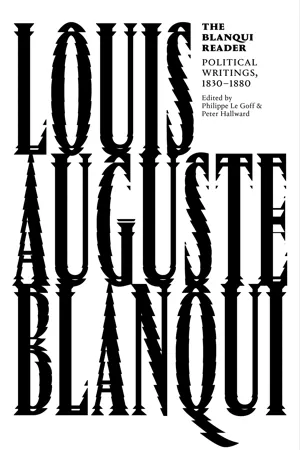
At odds with followers of Proudhon on the one hand and of Marx on the other, while Blanqui commanded unrivalled authority in French revolutionary circles during parts of his own lifetime he was quickly forgotten (if not derided) after his death. This is the first collection of Blanqui's political writings ever published in English, and it includes new and complete translations of his best known texts: Instructions for an Armed Uprising, and Eternity by the Stars. With material drawn from all his main publications and speeches, as well as from the full sweep of his voluminous manuscripts and correspondence, this wide-ranging anthology will enable anglophone readers and political activists to arrive at their own critical assessment of Blanqui's thought and legacy for the first time.
- 384 pages
- English
- ePUB (mobile friendly)
- Available on iOS & Android
eBook - ePub
The Blanqui Reader
About this book
Information
Table of contents
- Cover Page
- Halftitle Page
- Title Page
- Copyright Page
- Contents
- Abbreviations
- Chronology
- Editors’ Note and Acknowledgements
- Preface: Blanqui Our Contemporary?
- Introduction
- Part I: 1830–1834: The July Revolution and its Aftermath
- Part II: 1835–1847: Secret Societies
- Part III: 1848: Year of Revolution
- Part IV: 1849–1852: Learning from Defeat
- Part V: 1830–1880: Philosophical and Political Fragments
- Part VI: 1866–1869: Writings from Exile
- Part VII: 1870–1872: From the Siege of Paris to the Astronomical Hypothesis
- Notes
- Selected Bibliography
- Index
Trusted by 375,005 students
Access to over 1.5 million titles for a fair monthly price.
Study more efficiently using our study tools.
Frequently asked questions
Yes, you can cancel anytime from the Subscription tab in your account settings on the Perlego website. Your subscription will stay active until the end of your current billing period. Learn how to cancel your subscription
No, books cannot be downloaded as external files, such as PDFs, for use outside of Perlego. However, you can download books within the Perlego app for offline reading on mobile or tablet. Learn how to download books offline
Perlego offers two plans: Essential and Complete
- Essential is ideal for learners and professionals who enjoy exploring a wide range of subjects. Access the Essential Library with 800,000+ trusted titles and best-sellers across business, personal growth, and the humanities. Includes unlimited reading time and Standard Read Aloud voice.
- Complete: Perfect for advanced learners and researchers needing full, unrestricted access. Unlock 1.5M+ books across hundreds of subjects, including academic and specialized titles. The Complete Plan also includes advanced features like Premium Read Aloud and Research Assistant.
We are an online textbook subscription service, where you can get access to an entire online library for less than the price of a single book per month. With over 1.5 million books across 990+ topics, we’ve got you covered! Learn about our mission
Look out for the read-aloud symbol on your next book to see if you can listen to it. The read-aloud tool reads text aloud for you, highlighting the text as it is being read. You can pause it, speed it up and slow it down. Learn more about Read Aloud
Yes! You can use the Perlego app on both iOS and Android devices to read anytime, anywhere — even offline. Perfect for commutes or when you’re on the go.
Please note we cannot support devices running on iOS 13 and Android 7 or earlier. Learn more about using the app
Please note we cannot support devices running on iOS 13 and Android 7 or earlier. Learn more about using the app
Yes, you can access The Blanqui Reader by Louis Auguste Blanqui, Peter Hallward,Philippe Le Goff in PDF and/or ePUB format, as well as other popular books in Politics & International Relations & Essays in Politics & International Relations. We have over 1.5 million books available in our catalogue for you to explore.