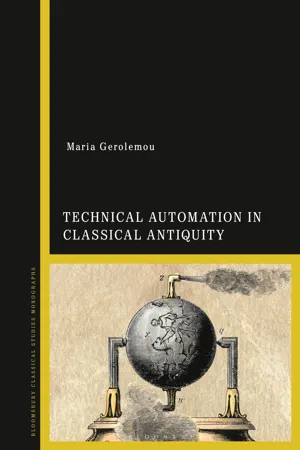
Technical automation – the ability of man-made (or god-made) objects to move and act autonomously – is not just the province of engineering or science fiction. In this book, Maria Gerolemou, by taking as her starting point the close semantic and linguistic relevance of technical automation to natural automatism, demonstrates how ancient literature, performance and engineering were often concerned with the way nature and artifice interacted. Moving across epic, didactic, tragedy, comedy, philosophy and ancient science, this is a brilliant assembly of evidence for the power of 'automatic theatre' in ancient literature.
Gerolemou starts with the earliest Greek literature of Homer and Hesiod, where Hephaestus' self-moving artefacts in the Iliad reflect natural forces of motion and the manufactured Pandora becomes an autonomous woman. Her second chapter looks at Greek drama, where technical automation is used to augment and undermine nature not only through staging and costume but also in plot devices where statues come to life and humans behave as automatic devices. In the third chapter, Gerolemou considers how the philosophers of the 4th century BCE and the engineers of the Hellenistic period with their mechanical devices contributed to a growing dialogue around technical automation and how it could help its audience glance and marvel at the hidden mechanisms of self-motion. Finally, the book explores the ways technical automation is employed as an ekphrastic technique in late antiquity and early Byzantium.
- 200 pages
- English
- ePUB (mobile friendly)
- Available on iOS & Android
eBook - ePub
Technical Automation in Classical Antiquity
About this book
Information
Table of contents
- Cover
- Half-Title Page
- Series Page
- Title Page
- Contents
- Acknowledgements
- Introduction
- 1 Natural Automation
- 2 Dramatic Automation
- 3 Mechanical Automation
- Conclusions
- Notes
- Bibliography
- Index
- Copyright
Trusted by 375,005 students
Access to over 1.5 million titles for a fair monthly price.
Study more efficiently using our study tools.
Frequently asked questions
Yes, you can cancel anytime from the Subscription tab in your account settings on the Perlego website. Your subscription will stay active until the end of your current billing period. Learn how to cancel your subscription
No, books cannot be downloaded as external files, such as PDFs, for use outside of Perlego. However, you can download books within the Perlego app for offline reading on mobile or tablet. Learn how to download books offline
Perlego offers two plans: Essential and Complete
- Essential is ideal for learners and professionals who enjoy exploring a wide range of subjects. Access the Essential Library with 800,000+ trusted titles and best-sellers across business, personal growth, and the humanities. Includes unlimited reading time and Standard Read Aloud voice.
- Complete: Perfect for advanced learners and researchers needing full, unrestricted access. Unlock 1.5M+ books across hundreds of subjects, including academic and specialized titles. The Complete Plan also includes advanced features like Premium Read Aloud and Research Assistant.
We are an online textbook subscription service, where you can get access to an entire online library for less than the price of a single book per month. With over 1.5 million books across 990+ topics, we’ve got you covered! Learn about our mission
Look out for the read-aloud symbol on your next book to see if you can listen to it. The read-aloud tool reads text aloud for you, highlighting the text as it is being read. You can pause it, speed it up and slow it down. Learn more about Read Aloud
Yes! You can use the Perlego app on both iOS and Android devices to read anytime, anywhere — even offline. Perfect for commutes or when you’re on the go.
Please note we cannot support devices running on iOS 13 and Android 7 or earlier. Learn more about using the app
Please note we cannot support devices running on iOS 13 and Android 7 or earlier. Learn more about using the app
Yes, you can access Technical Automation in Classical Antiquity by Maria Gerolemou in PDF and/or ePUB format, as well as other popular books in Literature & Ancient & Classical Drama. We have over 1.5 million books available in our catalogue for you to explore.