eBook - ePub
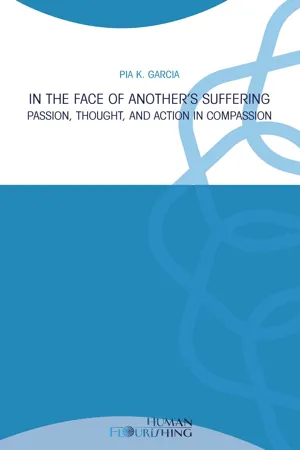
In the Face of Another's Suffering
Passion, Thought, and Action in Compassion
- 493 pages
- English
- ePUB (mobile friendly)
- Available on iOS & Android
eBook - ePub
About this book
This book sets out to philosophically explore the following questions: What is compassion? What does it tell us about the relationship between the rational and irrational in man? What role does it have in the flourishing life? To answer, it begins by discussing Aristotle's account of compassion, followed by Thomas Aquinas, Martha Nussbaum, Kristján Kristjánsson, and Diana Fritz Cates. The wide range of authors and the focus on emotion and virtue allows one to build a solid picture of compassion as perfective of the human person, as the good response to suffering, and as certainly key in human flourishing.
The presentation of each author features a thorough discussion of each one's notion of emotion and virtue, highlighting similarities, differences, strengths and weaknesses vis-à-vis the others. Each philosophical anthropological framework is in turn used to understand each author's take on compassion and the ethical potential envisioned for it. The choice of classical and contemporary accounts allows one to grasp the shift from compassion as a noteworthy "good emotion" (as per the original Aristotelian account) to compassion as an important virtue for relational moral excellence. Choosing to be compassionate disposes us to help other individuals flourish in a truly human way, and also enables us to take steps towards a society and culture where all—even the weakest—can flourish. This book will be of interest to academics from both philosophy and psychology, compassion researchers and trainers, and character educators.
Pia K. Garcia is a Philosophy professor at the University of Asia and the Pacific, Pasig City, Philippines. Born in Manila, she graduated AB Interdisciplinary Studies (minor in Literature) from the Ateneo de Manila University (2010). She worked for a year at Punlaan School—where she taught computer—and for three at PAREF Southcrest School, Inc., where she taught English, Literature, Religion and Philosophy across year levels. She then went on to do her postgraduate studies in Rome, and earned her Ph.D. in Philosophy from the Pontifical University of the Holy Cross (2021). In general, her research explores the relationships between reason, desires, emotions and virtues: specifically, she has written about compassion as a virtuous response to human suffering and key to the good life. Her interest in human flourishing goes beyond the theoretical: she has always been involved in the personal mentoring programs, service projects and outreach activities of the institutions she has worked in.
Information
Topic
PhilosophySubtopic
Ethics & Moral PhilosophyTable of contents
- The Human Flourishing Series
- Table of abbreviations
- Introduction
- PART I: Aristotle
- Chapter 1: Emotion and virtue in Aristotle
- Chapter 2: Compassion in Aristotle
- PART II: AQUINAS
- Chapter 3: Emotion and virtue in Aquinas
- Chapter 4: Compassion in Aquinas
- PART III: PERSPECTIVES FROM CONTEMPORARY VIRTUE ETHICS
- Chapter 5: Martha Nussbaum
- Chapter 6: Reconstructing the classics
- Conclusions
- Selected references
- Index of names
- Subject index
Trusted by 375,005 students
Access to over 1.5 million titles for a fair monthly price.
Study more efficiently using our study tools.
Frequently asked questions
Yes, you can cancel anytime from the Subscription tab in your account settings on the Perlego website. Your subscription will stay active until the end of your current billing period. Learn how to cancel your subscription
No, books cannot be downloaded as external files, such as PDFs, for use outside of Perlego. However, you can download books within the Perlego app for offline reading on mobile or tablet. Learn how to download books offline
Perlego offers two plans: Essential and Complete
- Essential is ideal for learners and professionals who enjoy exploring a wide range of subjects. Access the Essential Library with 800,000+ trusted titles and best-sellers across business, personal growth, and the humanities. Includes unlimited reading time and Standard Read Aloud voice.
- Complete: Perfect for advanced learners and researchers needing full, unrestricted access. Unlock 1.5M+ books across hundreds of subjects, including academic and specialized titles. The Complete Plan also includes advanced features like Premium Read Aloud and Research Assistant.
We are an online textbook subscription service, where you can get access to an entire online library for less than the price of a single book per month. With over 1.5 million books across 990+ topics, we’ve got you covered! Learn about our mission
Look out for the read-aloud symbol on your next book to see if you can listen to it. The read-aloud tool reads text aloud for you, highlighting the text as it is being read. You can pause it, speed it up and slow it down. Learn more about Read Aloud
Yes! You can use the Perlego app on both iOS and Android devices to read anytime, anywhere — even offline. Perfect for commutes or when you’re on the go.
Please note we cannot support devices running on iOS 13 and Android 7 or earlier. Learn more about using the app
Please note we cannot support devices running on iOS 13 and Android 7 or earlier. Learn more about using the app
Yes, you can access In the Face of Another's Suffering by Pia K. Garcia in PDF and/or ePUB format, as well as other popular books in Philosophy & Ethics & Moral Philosophy. We have over 1.5 million books available in our catalogue for you to explore.