What roles do imaginary games have in story-telling? Why do fiction authors outline the rules of a game that the audience will never play? Combining perspectives from philosophy, literary theory and game studies, this book provides the first in-depth investigation into the significance of fictional games within fictional worlds.
Drawing from contemporary cinema and literature, from The Hunger Games to the science fiction of Iain M. Banks, Stefano Gualeni and Riccardo Fassone introduce five key functions that different types of imaginary games have in worldbuilding. First, fictional games can emphasize the dominant values and ideologies of the fictional society they belong to. Second, some imaginary games function in fictional worlds as critical, utopian tools, inspiring shifts in the thinking and political orientation of the fictional characters. Third, a few fictional games are conducive to the transcendence of a particular form of being, such as the overcoming of human corporeality. Fourth, imaginary games within works of fiction can deceptively blur the boundaries between the contingency of play and the irrevocable seriousness of "real life", either camouflaging life as a game or disguising a game as something with more permanent consequences. And fifth, they can function as meta-reflexive tools, suggesting critical and/or satirical perspectives on how actual games are designed, played, sold, manipulated, experienced, understood and utilized as part of our culture.
With illustrations in every chapter bringing the imaginary games to life, Gualeni and Fassone creatively inspire us to consider fictional games anew: not as moments of playful reprieve in a storyline, but as significant and multi-layered expressive devices.
eBook - ePub
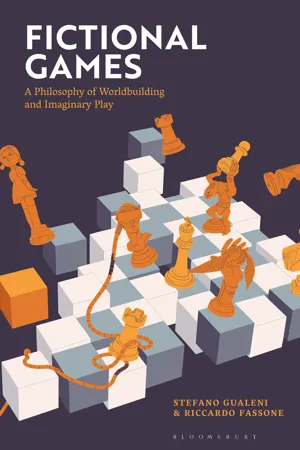
Fictional Games
A Philosophy of Worldbuilding and Imaginary Play
- 216 pages
- English
- ePUB (mobile friendly)
- Available on iOS & Android
eBook - ePub
About this book
Information
Table of contents
- Cover
- Half-Title Page
- Series Page
- Title Page
- Contents
- List of Figures
- Foreword
- Acknowledgements
- Introduction
- 1 On Fictional Games
- 2 Fictional Games and Ideology
- 3 Fictional Games as Utopian Devices
- 4 Fictional Games as Deceptions and Hallucinations
- 5 Fictional Games and Transcendence
- 6 Concluding Thoughts
- Appendix: A Compendium of Fictional Games Cited in the Book
- Index
- Copyright
Trusted by 375,005 students
Access to over 1.5 million titles for a fair monthly price.
Study more efficiently using our study tools.
Frequently asked questions
Yes, you can cancel anytime from the Subscription tab in your account settings on the Perlego website. Your subscription will stay active until the end of your current billing period. Learn how to cancel your subscription
No, books cannot be downloaded as external files, such as PDFs, for use outside of Perlego. However, you can download books within the Perlego app for offline reading on mobile or tablet. Learn how to download books offline
Perlego offers two plans: Essential and Complete
- Essential is ideal for learners and professionals who enjoy exploring a wide range of subjects. Access the Essential Library with 800,000+ trusted titles and best-sellers across business, personal growth, and the humanities. Includes unlimited reading time and Standard Read Aloud voice.
- Complete: Perfect for advanced learners and researchers needing full, unrestricted access. Unlock 1.5M+ books across hundreds of subjects, including academic and specialized titles. The Complete Plan also includes advanced features like Premium Read Aloud and Research Assistant.
We are an online textbook subscription service, where you can get access to an entire online library for less than the price of a single book per month. With over 1.5 million books across 990+ topics, we’ve got you covered! Learn about our mission
Look out for the read-aloud symbol on your next book to see if you can listen to it. The read-aloud tool reads text aloud for you, highlighting the text as it is being read. You can pause it, speed it up and slow it down. Learn more about Read Aloud
Yes! You can use the Perlego app on both iOS and Android devices to read anytime, anywhere — even offline. Perfect for commutes or when you’re on the go.
Please note we cannot support devices running on iOS 13 and Android 7 or earlier. Learn more about using the app
Please note we cannot support devices running on iOS 13 and Android 7 or earlier. Learn more about using the app
Yes, you can access Fictional Games by Stefano Gualeni,Riccardo Fassone in PDF and/or ePUB format, as well as other popular books in Philosophy & Literary Criticism in Science Fiction. We have over 1.5 million books available in our catalogue for you to explore.