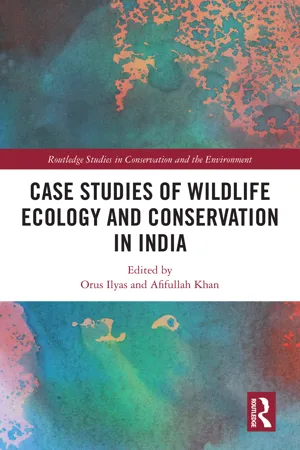
Case Studies of Wildlife Ecology and Conservation in India
eBook - ePub

Case Studies of Wildlife Ecology and Conservation in India

  1. 248 pages
  2. English
  3. ePUB (mobile friendly)
  4. Available on iOS & Android
eBook - ePub

Case Studies of Wildlife Ecology and Conservation in India

About this book

This volume brings together a collection of case studies examining wildlife ecology and conservation across India.

The book explores and examines a wide range of fauna across different terrains and habitats in India, revealing key issues and concerns for biodiversity conservation, with a particular emphasis on the impact of humans and climate change. Case-studies are as wide-ranging as tigers, leopards, sloth bears, pheasants, insects, and birds, across a diverse range of landscapes, including forests, wetlands, and nature reserves, and even a university campus. Split into three parts, Part I focuses on how the distribution of animals is influenced by the availability of resources such as food, water, and space. Chapters examine key determinants, such as diet and prey and habitat preferences, with habitat loss also being an important factor. In Part II, chapters examine human-wildlife interactions, dealing with issues such as the impact of urbanisation, the establishment of nature reserves, and competition for resources. The book concludes with an examination of landscape ecology and conservation, with chapters in Part III focusing on habitat degradation, changes in land-use patterns, and ecosystem management. Overall, the volume not only reflects the great breadth and depth of biodiversity in India but offers important insights into the challenges facing biodiversity conservation not only in this region but worldwide.

This volume will be of great interest to students and scholars of wildlife ecology, conservation biology, biodiversity conservation, and the environmental sciences more broadly.

Frequently asked questions

Yes, you can cancel anytime from the Subscription tab in your account settings on the Perlego website. Your subscription will stay active until the end of your current billing period. Learn how to cancel your subscription.
No, books cannot be downloaded as external files, such as PDFs, for use outside of Perlego. However, you can download books within the Perlego app for offline reading on mobile or tablet. Learn more here.
Perlego offers two plans: Essential and Complete
  • Essential is ideal for learners and professionals who enjoy exploring a wide range of subjects. Access the Essential Library with 800,000+ trusted titles and best-sellers across business, personal growth, and the humanities. Includes unlimited reading time and Standard Read Aloud voice.
  • Complete: Perfect for advanced learners and researchers needing full, unrestricted access. Unlock 1.4M+ books across hundreds of subjects, including academic and specialized titles. The Complete Plan also includes advanced features like Premium Read Aloud and Research Assistant.
Both plans are available with monthly, semester, or annual billing cycles.
We are an online textbook subscription service, where you can get access to an entire online library for less than the price of a single book per month. With over 1 million books across 1000+ topics, we’ve got you covered! Learn more here.
Look out for the read-aloud symbol on your next book to see if you can listen to it. The read-aloud tool reads text aloud for you, highlighting the text as it is being read. You can pause it, speed it up and slow it down. Learn more here.
Yes! You can use the Perlego app on both iOS or Android devices to read anytime, anywhere — even offline. Perfect for commutes or when you’re on the go.
Please note we cannot support devices running on iOS 13 and Android 7 or earlier. Learn more about using the app.
Yes, you can access Case Studies of Wildlife Ecology and Conservation in India by Orus Ilyas, Afifullah Khan, Orus Ilyas,Afifullah Khan in PDF and/or ePUB format, as well as other popular books in Biological Sciences & Ecology. We have over one million books available in our catalogue for you to explore.

Information

Table of contents

  1. Cover
  2. Half-Title
  3. Series
  4. Title
  5. Copyright
  6. Contents
  7. List of Figures
  8. List of Tables
  9. List of Contributors
  10. Preface
  11. Acknowledgments
  12. 1 Introduction
  13. PART I Resource selection in Protected and Non-Protected areas
  14. PART II Human-Wildlife Interaction
  15. PART III Landscape Ecology and Conservation
  16. Index