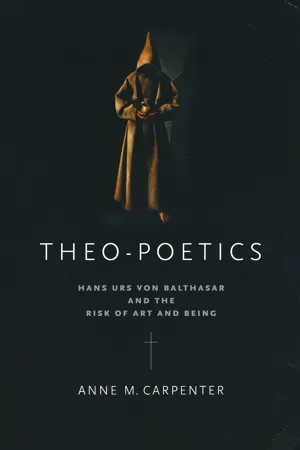
Theo-Poetics
eBook - PDF

Theo-Poetics

Hans Urs von Balthasar and the Risk of Art and Being

  1. English
  2. PDF
  3. Available on iOS & Android
eBook - PDF

Theo-Poetics

Hans Urs von Balthasar and the Risk of Art and Being

About this book

Swiss theologian Hans Urs von Balthasar (1905–1988) originated much of twentieth- and twenty-first-century theology's renewed interest in aesthetics. Von Balthasar's theology is both poetic and philosophical, and while this combination is often recognized, it calls for an explanation. In Theo-Poetics: Hans Urs von Balthasar and the Risk of Art and Being, Anne M. Carpenter explores von Balthasar's use of poetry and poetic language, and she offers a detailed analysis of his philosophical presuppositions. Carpenter argues that von Balthasar uses poets and poetic language to make theological arguments because this poetic way of speaking expresses metaphysical truth without reducing one to the other.

Carpenter begins with von Balthasar's very early interests in music, literature, and philosophy, in particular his work, Apocalypse of the German Soul. She explores Glory of the Lord and the trilogy, moving through his despair over the possibility of reconciling art and theology. She uncovers the major characteristics of von Balthasar's metaphysical thinking, discussing his interactions with Thomas Aquinas, Karl Barth, and Martin Heidegger to firmly link Christology, metaphysics, and the expressiveness of language. The book concludes by marshaling its themes into a focused evaluation of von Balthasar's "redeemed" theo-poetic as it comes to expression in the poetry of G. M. Hopkins. Carpenter resituates and reevaluates Hopkins's poetry in a new context, placing him in the school of Aquinas rather than Scotus, and shows us how metaphysics is necessary for a vigorous understanding of language.

Frequently asked questions

Yes, you can cancel anytime from the Subscription tab in your account settings on the Perlego website. Your subscription will stay active until the end of your current billing period. Learn how to cancel your subscription.
No, books cannot be downloaded as external files, such as PDFs, for use outside of Perlego. However, you can download books within the Perlego app for offline reading on mobile or tablet. Learn more here.
Perlego offers two plans: Essential and Complete
  • Essential is ideal for learners and professionals who enjoy exploring a wide range of subjects. Access the Essential Library with 800,000+ trusted titles and best-sellers across business, personal growth, and the humanities. Includes unlimited reading time and Standard Read Aloud voice.
  • Complete: Perfect for advanced learners and researchers needing full, unrestricted access. Unlock 1.4M+ books across hundreds of subjects, including academic and specialized titles. The Complete Plan also includes advanced features like Premium Read Aloud and Research Assistant.
Both plans are available with monthly, semester, or annual billing cycles.
We are an online textbook subscription service, where you can get access to an entire online library for less than the price of a single book per month. With over 1 million books across 1000+ topics, we’ve got you covered! Learn more here.
Look out for the read-aloud symbol on your next book to see if you can listen to it. The read-aloud tool reads text aloud for you, highlighting the text as it is being read. You can pause it, speed it up and slow it down. Learn more here.
Yes! You can use the Perlego app on both iOS or Android devices to read anytime, anywhere — even offline. Perfect for commutes or when you’re on the go.
Please note we cannot support devices running on iOS 13 and Android 7 or earlier. Learn more about using the app.
Yes, you can access Theo-Poetics by Anne M. Carpenter in PDF and/or ePUB format, as well as other popular books in Theology & Religion & Aesthetics in Philosophy. We have over one million books available in our catalogue for you to explore.

Table of contents

  1. Cover
  2. Half title
  3. Title page
  4. Copyright
  5. Dedication
  6. CONTENTS
  7. FOREWORD
  8. ABBREVIATIONS
  9. Introduction
  10. Chapter One: Beauty and Risk
  11. Chapter Two: The Redemption of Beauty
  12. Chapter Three: Measuring Metaphysics
  13. Chapter Four: A Theological Poetic
  14. Chapter Five: Art, Metaphysics, and the Sacraments
  15. Conclusion
  16. NOTES
  17. BIBLIOGRAPHY
  18. INDEX