Organizing Women
eBook - PDF

Organizing Women

Home, Work, and the Institutional Infrastructure of Print in Twentieth-Century America

  1. English
  2. PDF
  3. Available on iOS & Android
eBook - PDF

Organizing Women

Home, Work, and the Institutional Infrastructure of Print in Twentieth-Century America

About this book

In the first decades of the twentieth century, print-centered organizations spread rapidly across the United States, providing more women than ever before with opportunities to participate in public life. While most organizations at the time were run by and for white men, women—both Black and white—were able to reshape their lives and their social worlds through their participation in these institutions.

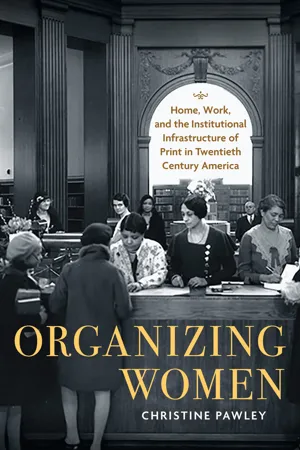
Organizing Women traces the histories of middle-class women—rural and urban, white and Black, married and unmarried—who used public and private institutions of print to tell their stories, expand their horizons, and further their ambitions. Drawing from a diverse range of examples, Christine Pawley introduces readers to women who ran branch libraries and library schools in Chicago and Madison, built radio empires from their midwestern farms, formed reading clubs, and published newsletters. In the process, we learn about the organizations themselves, from libraries and universities to the USDA extension service and the YWCA, and the ways in which women confronted gender discrimination and racial segregation in the course of their work.

Frequently asked questions

Yes, you can cancel anytime from the Subscription tab in your account settings on the Perlego website. Your subscription will stay active until the end of your current billing period. Learn how to cancel your subscription.
No, books cannot be downloaded as external files, such as PDFs, for use outside of Perlego. However, you can download books within the Perlego app for offline reading on mobile or tablet. Learn more here.
Perlego offers two plans: Essential and Complete
  • Essential is ideal for learners and professionals who enjoy exploring a wide range of subjects. Access the Essential Library with 800,000+ trusted titles and best-sellers across business, personal growth, and the humanities. Includes unlimited reading time and Standard Read Aloud voice.
  • Complete: Perfect for advanced learners and researchers needing full, unrestricted access. Unlock 1.4M+ books across hundreds of subjects, including academic and specialized titles. The Complete Plan also includes advanced features like Premium Read Aloud and Research Assistant.
Both plans are available with monthly, semester, or annual billing cycles.
We are an online textbook subscription service, where you can get access to an entire online library for less than the price of a single book per month. With over 1 million books across 1000+ topics, we’ve got you covered! Learn more here.
Look out for the read-aloud symbol on your next book to see if you can listen to it. The read-aloud tool reads text aloud for you, highlighting the text as it is being read. You can pause it, speed it up and slow it down. Learn more here.
Yes! You can use the Perlego app on both iOS or Android devices to read anytime, anywhere — even offline. Perfect for commutes or when you’re on the go.
Please note we cannot support devices running on iOS 13 and Android 7 or earlier. Learn more about using the app.
Yes, you can access Organizing Women by Christine Pawley in PDF and/or ePUB format, as well as other popular books in History & North American History. We have over one million books available in our catalogue for you to explore.

Table of contents

  1. Cover
  2. Title Page
  3. Copyright Page
  4. Dedication
  5. Contents
  6. Acknowledgments
  7. Introduction
  8. Chapter One: “Hilda’s Helps in Home-Making”: Print, Domesticity, and Collaboration in the Golden Age of Agriculture
  9. Chapter Two: Letters from Leanna: Kitchen-Klatter and the Radio Homemakers
  10. Chapter Three: “What message does it have?”: Race, Reading, and the Book Lovers Club
  11. Chapter Four: A “Terror” and a “Legend”: Lutie Eugenia Stearns and the State Library Organizations of Wisconsin
  12. Chapter Five: Maintaining a Mesh of Mutual Assistance: Mary Emogene Hazeltine and the Wisconsin Library School
  13. Chapter Six: Books for Bronzeville: Vivian Gordon Harsh, the “Special Negro Collection,” and the Chicago Public Library
  14. Acknowledgments
  15. Conclusion
  16. Notes
  17. Index
  18. Back Cover