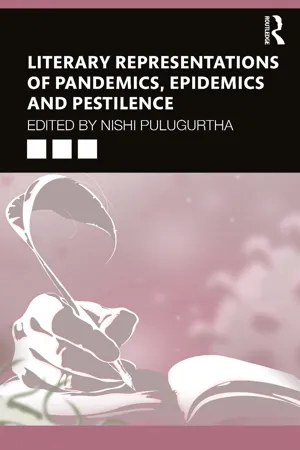
Literary Representations of Pandemics, Epidemics and Pestilence
eBook - ePub

Literary Representations of Pandemics, Epidemics and Pestilence

  1. 192 pages
  2. English
  3. ePUB (mobile friendly)
  4. Available on iOS & Android
eBook - ePub

Literary Representations of Pandemics, Epidemics and Pestilence

About this book

Disease, pestilence and contagion have been an integral component of human lives and stories. This book explores the articulations and representations of the vulnerability of life or the trauma of death in literature about epidemics both from India and around the world.

This book critically engages with stories and narratives that have dealt with pandemics or epidemics in the past and in contemporary times to see how these texts present human life coming to terms with upheaval, fear and uncertainty. Set in various places and times, the literature examined in this book explores the themes of human suffering and resilience, inequality, corruption, the ruin of civilizations and the rituals of grief and remembrance. The chapters in this volume cover a wide spatio-temporal trajectory analysing the writings of Fakir Mohan Senapati and Suryakant Tripathi Nirala, Jack London, Albert Camus, Margaret Atwood, Sarat Chand, Pandita Ramabai and Christina Sweeney-Baird, among others. It gives readers a glimpse into both grounded and fantastical realities where disease and death clash with human psychology and where philosophy, politics and social values are critiqued and problematized.

This book will be of interest to students of English literature, social science, gender studies, cultural studies, psychology, society, politics and philosophy. General readers too will find this exciting as it covers authors from across the world.

Frequently asked questions

Yes, you can cancel anytime from the Subscription tab in your account settings on the Perlego website. Your subscription will stay active until the end of your current billing period. Learn how to cancel your subscription.
No, books cannot be downloaded as external files, such as PDFs, for use outside of Perlego. However, you can download books within the Perlego app for offline reading on mobile or tablet. Learn more here.
Perlego offers two plans: Essential and Complete
  • Essential is ideal for learners and professionals who enjoy exploring a wide range of subjects. Access the Essential Library with 800,000+ trusted titles and best-sellers across business, personal growth, and the humanities. Includes unlimited reading time and Standard Read Aloud voice.
  • Complete: Perfect for advanced learners and researchers needing full, unrestricted access. Unlock 1.4M+ books across hundreds of subjects, including academic and specialized titles. The Complete Plan also includes advanced features like Premium Read Aloud and Research Assistant.
Both plans are available with monthly, semester, or annual billing cycles.
We are an online textbook subscription service, where you can get access to an entire online library for less than the price of a single book per month. With over 1 million books across 1000+ topics, we’ve got you covered! Learn more here.
Look out for the read-aloud symbol on your next book to see if you can listen to it. The read-aloud tool reads text aloud for you, highlighting the text as it is being read. You can pause it, speed it up and slow it down. Learn more here.
Yes! You can use the Perlego app on both iOS or Android devices to read anytime, anywhere — even offline. Perfect for commutes or when you’re on the go.
Please note we cannot support devices running on iOS 13 and Android 7 or earlier. Learn more about using the app.
Yes, you can access Literary Representations of Pandemics, Epidemics and Pestilence by Nishi Pulugurtha in PDF and/or ePUB format, as well as other popular books in Literature & Gender Studies. We have over one million books available in our catalogue for you to explore.

Information

Year
2022
Print ISBN
9781032535647
eBook ISBN
9781000810806
Edition
1

Table of contents

  1. Cover
  2. Half Title
  3. Title
  4. Copyright
  5. Contents
  6. List of Contributors
  7. Introduction
  8. I Memory and Contagion
  9. II Uncanny Dilemmas
  10. III Moving Between Language and Media
  11. IV Fear, Disaster and Dystopia
  12. V COVID-19, Public Health and Social Justice
  13. Index