"Fred Schaaf is one of the most experienced astronomical observers of our time. For more than two decades, his view of the sky--what will be visible, when it will be visible, and what it will look like--has encouraged tens of thousands of people to turn their eyes skyward."
--David H. Levy, Science Editor, Parade magazine, discoverer of twenty-one comets, and author of Starry Night and Cosmic Discoveries"Fred Schaaf is a poet of the stars. He brings the sky into people's lives in a way that is compelling, and his descriptions have all the impact of witnessing the stars on a crystal clear dark night."
--William Sheehan, coauthor of Mars: The Lure of the Red Planet and The Transits of VenusThe night sky holds endless fascination for anyone who chooses simply to look up and observe, but with so much to see, it can be difficult to know where to start. This remarkable book introduces you to the fifty best sights in astronomy and tells you exactly how to see them. In no time at all, you will learn how to find and appreciate the Orion group of constellations; the Summer Triangle; Venus, Jupiter, and Mars; the best meteor showers; man-made satellites; star clusters; novae; variable stars; and more.The sights are presented according to the field of view necessary to see them. Your eyes and a clear night sky are all you need to view the sights in the first part of the book, before moving on to those that can be observed through binoculars and, finally, a telescope. Concise descriptions and explanations of these spectacular visual wonders will deepen your appreciation of them and spur further exploration. You will also find the essential basic information on astronomical observation you need to get started, including observing conditions, techniques, telescopes, and astronomical measurements.Once you start gazing, you'll see that the sky really is the limit--and discovering its amazing treasures will become your lifetime passion.
eBook - ePub
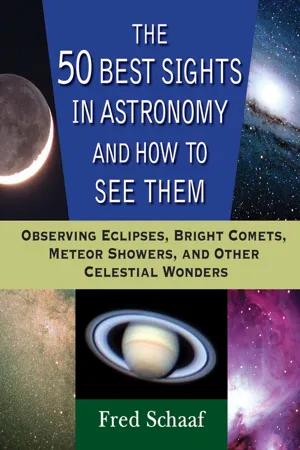
The 50 Best Sights in Astronomy and How to See Them
Observing Eclipses, Bright Comets, Meteor Showers, and Other Celestial Wonders
- 256 pages
- English
- ePUB (mobile friendly)
- Available on iOS & Android
eBook - ePub
The 50 Best Sights in Astronomy and How to See Them
Observing Eclipses, Bright Comets, Meteor Showers, and Other Celestial Wonders
About this book
Information
Table of contents
- Cover
- Title Page
- Dedication
- Copyright Page
- Contents
- Acknowledgments
- Introduction
- Basic Information for Astronomical Observers
- Field of View: 180° (the Whole Sky) to 100° (Naked-Eye Scan)
- Field of View: 100° to 50° (the Widest Fixed Naked-Eye Field)
- Field of View: 50° to 15° (Moderately Wide Naked-Eye Field)
- Field of View: 15° to 1° (Narrow Naked-Eye Field, Binoculars Field, and Wide-Telescopic Field)
- Field of View: 1° to 0.1° or Less (Medium to Narrow Telescopic Field)
- Appendix A: Total Solar Eclipses, 2008–2024
- Appendix B: Major Meteor Showers
- Appendix C: Total and Partial Lunar Eclipses, 2007–2017
- Appendix D: The Brightest Stars
- Appendix E: Transits of Venus and Mercury
- Glossary
- Sources
- Photo Credits
- Index
Trusted by 375,005 students
Access to over 1.5 million titles for a fair monthly price.
Study more efficiently using our study tools.
Frequently asked questions
Yes, you can cancel anytime from the Subscription tab in your account settings on the Perlego website. Your subscription will stay active until the end of your current billing period. Learn how to cancel your subscription
No, books cannot be downloaded as external files, such as PDFs, for use outside of Perlego. However, you can download books within the Perlego app for offline reading on mobile or tablet. Learn how to download books offline
Perlego offers two plans: Essential and Complete
- Essential is ideal for learners and professionals who enjoy exploring a wide range of subjects. Access the Essential Library with 800,000+ trusted titles and best-sellers across business, personal growth, and the humanities. Includes unlimited reading time and Standard Read Aloud voice.
- Complete: Perfect for advanced learners and researchers needing full, unrestricted access. Unlock 1.5M+ books across hundreds of subjects, including academic and specialized titles. The Complete Plan also includes advanced features like Premium Read Aloud and Research Assistant.
We are an online textbook subscription service, where you can get access to an entire online library for less than the price of a single book per month. With over 1.5 million books across 990+ topics, we’ve got you covered! Learn about our mission
Look out for the read-aloud symbol on your next book to see if you can listen to it. The read-aloud tool reads text aloud for you, highlighting the text as it is being read. You can pause it, speed it up and slow it down. Learn more about Read Aloud
Yes! You can use the Perlego app on both iOS and Android devices to read anytime, anywhere — even offline. Perfect for commutes or when you’re on the go.
Please note we cannot support devices running on iOS 13 and Android 7 or earlier. Learn more about using the app
Please note we cannot support devices running on iOS 13 and Android 7 or earlier. Learn more about using the app
Yes, you can access The 50 Best Sights in Astronomy and How to See Them by Fred Schaaf in PDF and/or ePUB format, as well as other popular books in Physical Sciences & Astronomy & Astrophysics. We have over 1.5 million books available in our catalogue for you to explore.