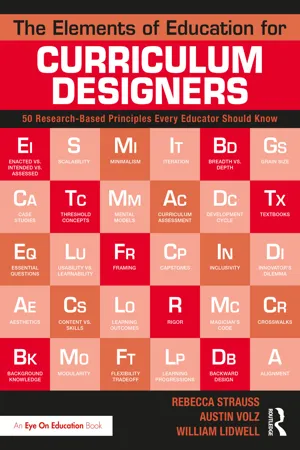
The Elements of Education for Curriculum Designers
eBook - ePub

The Elements of Education for Curriculum Designers

50 Research-Based Principles Every Educator Should Know

  1. 104 pages
  2. English
  3. ePUB (mobile friendly)
  4. Available on iOS & Android
eBook - ePub

The Elements of Education for Curriculum Designers

50 Research-Based Principles Every Educator Should Know

About this book

How should curriculum designers translate abstract learning outcomes into engaging learning experiences that get results? What is the right balance between depth and breadth or between content and skills? What methods should be used to continuously improve a curriculum over time? To answer these kinds of questions, the authors combined research from cutting-edge fields with their own first-hand experience to carefully curate fifty essential elements that demystify the work of curriculum design.

Written for utility, clarity, and practical value, this book provides indispensable professional development for educators working in a wide range of fields—from teachers and school leaders to educational publishers and instructional designers. The elements included are applicable across primary, secondary, and higher education as well as for workforce development programs. The Elements of Education for Curriculum Designers is an invaluable resource for anyone aiming to help others learn more effectively.

Frequently asked questions

Yes, you can cancel anytime from the Subscription tab in your account settings on the Perlego website. Your subscription will stay active until the end of your current billing period. Learn how to cancel your subscription.
No, books cannot be downloaded as external files, such as PDFs, for use outside of Perlego. However, you can download books within the Perlego app for offline reading on mobile or tablet. Learn more here.
Perlego offers two plans: Essential and Complete
  • Essential is ideal for learners and professionals who enjoy exploring a wide range of subjects. Access the Essential Library with 800,000+ trusted titles and best-sellers across business, personal growth, and the humanities. Includes unlimited reading time and Standard Read Aloud voice.
  • Complete: Perfect for advanced learners and researchers needing full, unrestricted access. Unlock 1.4M+ books across hundreds of subjects, including academic and specialized titles. The Complete Plan also includes advanced features like Premium Read Aloud and Research Assistant.
Both plans are available with monthly, semester, or annual billing cycles.
We are an online textbook subscription service, where you can get access to an entire online library for less than the price of a single book per month. With over 1 million books across 1000+ topics, we’ve got you covered! Learn more here.
Look out for the read-aloud symbol on your next book to see if you can listen to it. The read-aloud tool reads text aloud for you, highlighting the text as it is being read. You can pause it, speed it up and slow it down. Learn more here.
Yes! You can use the Perlego app on both iOS or Android devices to read anytime, anywhere — even offline. Perfect for commutes or when you’re on the go.
Please note we cannot support devices running on iOS 13 and Android 7 or earlier. Learn more about using the app.
Yes, you can access The Elements of Education for Curriculum Designers by Rebecca Strauss,Austin Volz,William Lidwell in PDF and/or ePUB format, as well as other popular books in Education & Education Curricula. We have over one million books available in our catalogue for you to explore.

Information

Publisher
Routledge
Year
2022
Print ISBN
9780367336950
eBook ISBN
9781000806151
Edition
1

Table of contents

  1. Cover
  2. Half Title
  3. Series
  4. Title
  5. Copyright
  6. Dedication
  7. Contents
  8. Acknowledgments
  9. Introduction
  10. 1 Advance Organizers
  11. 2 Aesthetics
  12. 3 Alignment
  13. 4 Background Knowledge
  14. 5 Backward Design
  15. 6 Breadth vs. Depth
  16. 7 Capstones
  17. 8 Case Studies
  18. 9 Content vs. Skills
  19. 10 Course Guides
  20. 11 Crosswalks
  21. 12 Curriculum Assessment
  22. 13 Curriculum Maps
  23. 14 Curriculum vs. Program
  24. 15 Development Cycle
  25. 16 Enacted vs. Intended vs. Assessed
  26. 17 Essential Questions
  27. 18 Five Hat Racks
  28. 19 Flexibility Tradeoff
  29. 20 Framing
  30. 21 Grain Size
  31. 22 Inclusivity
  32. 23 Innovator’s Dilemma
  33. 24 Interdisciplinarity
  34. 25 Iteration
  35. 26 Labeling Systems
  36. 27 Learning Objectives
  37. 28 Learning Outcomes
  38. 29 Learning Progressions
  39. 30 Learning Tasks
  40. 31 Levels
  41. 32 Magician’s Code
  42. 33 Mental Models
  43. 34 Minimalism
  44. 35 Modularity
  45. 36 Propositional Density
  46. 37 Proximity
  47. 38 Rigor
  48. 39 Scalability
  49. 40 Specialization
  50. 41 Spiral Curriculum
  51. 42 Stakeholder Assets
  52. 43 Storytelling
  53. 44 Student-Facing vs. Teacher-Facing
  54. 45 Student Work Samples
  55. 46 Subject-Matter Experts
  56. 47 Templates
  57. 48 Textbooks
  58. 49 Threshold Concepts
  59. 50 Usability vs. Learnability