Although muskets delivered devastating projectiles at comparatively long ranges, their slow rate of fire left the soldier very vulnerable while reloading, and early muskets were useless for close-quarter fighting.
The development of the flintlock musket produced a much less cumbersome and faster-firing firearm, which could be used for close combat with a short knife stuck into its muzzle. However, the musket could not be loaded or fired while the plug bayonet was in place. The socket bayonet solved this problem and the musket/bayonet combination became the universal infantry weapon from c.1700 to c.1870.
The perfection of the small-bore magazine rifle in the 1890s saw the bayonet lose its tactical importance, a trend that continued in the world wars. Its potential usefulness continued to be recognized from the 1950s, but its blade was often combined with an item with some additional function, most notably a wire-cutter.
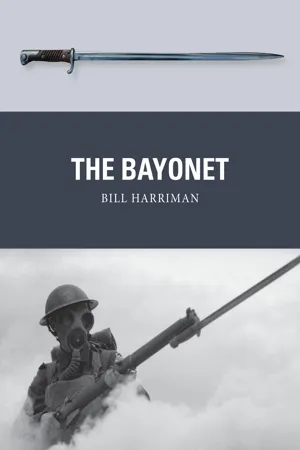
Ultimately, for all its fearsome reputation as a visceral, close-quarter fighting weapon, the bayonet's greatest impact was actually as a psychological weapon. Featuring full-colour artwork as well as archive and close-up photographs, this is the absorbing story of the complementary weapon to every soldier's firearm from the army of Louis XIV to modern-day forces in all global theatres of conflict.
- 81 pages
- English
- PDF
- Available on iOS & Android
eBook - PDF
The Bayonet
About this book
Information
Table of contents
- Cover
- Contents
- Introduction
- Development: Blades for firearms
- Use: The bayonet goes to war
- Impact: The bayonet’s reach
- Conclusion
- Glossary
- Bibliography
- Index
- Imprint
Trusted by 375,005 students
Access to over 1.5 million titles for a fair monthly price.
Study more efficiently using our study tools.
Frequently asked questions
Yes, you can cancel anytime from the Subscription tab in your account settings on the Perlego website. Your subscription will stay active until the end of your current billing period. Learn how to cancel your subscription
No, books cannot be downloaded as external files, such as PDFs, for use outside of Perlego. However, you can download books within the Perlego app for offline reading on mobile or tablet. Learn how to download books offline
Perlego offers two plans: Essential and Complete
- Essential is ideal for learners and professionals who enjoy exploring a wide range of subjects. Access the Essential Library with 800,000+ trusted titles and best-sellers across business, personal growth, and the humanities. Includes unlimited reading time and Standard Read Aloud voice.
- Complete: Perfect for advanced learners and researchers needing full, unrestricted access. Unlock 1.5M+ books across hundreds of subjects, including academic and specialized titles. The Complete Plan also includes advanced features like Premium Read Aloud and Research Assistant.
We are an online textbook subscription service, where you can get access to an entire online library for less than the price of a single book per month. With over 1.5 million books across 990+ topics, we’ve got you covered! Learn about our mission
Look out for the read-aloud symbol on your next book to see if you can listen to it. The read-aloud tool reads text aloud for you, highlighting the text as it is being read. You can pause it, speed it up and slow it down. Learn more about Read Aloud
Yes! You can use the Perlego app on both iOS and Android devices to read anytime, anywhere — even offline. Perfect for commutes or when you’re on the go.
Please note we cannot support devices running on iOS 13 and Android 7 or earlier. Learn more about using the app
Please note we cannot support devices running on iOS 13 and Android 7 or earlier. Learn more about using the app
Yes, you can access The Bayonet by Bill Harriman,Adam Hook,Alan Gilliland in PDF and/or ePUB format, as well as other popular books in History & Military & Maritime History. We have over 1.5 million books available in our catalogue for you to explore.