This illustrated study explores, in detail, the climactic events of the Battle of the Atlantic, and how air power proved to be the Allies' most important submarine-killer in one of the most bitterly fought naval campaigns of World War II.
As 1942 opened, both Nazi Germany and the Allies were ready for the climactic battles of the Atlantic to begin. Germany had 91 operational U-boats, and over 150 in training or trials. Production for 1942–44 was planned to exceed 200 boats annually. Karl Dönitz, running the Kriegsmarine's U-boat arm, would finally have the numbers needed to run the tonnage war he wanted against the Allies.
Meanwhile, the British had, at last, assembled the solution to the U-boat peril. Its weapons and detection systems had improved to the stage that maritime patrol aircraft could launch deadly attacks on U-boats day and night. Airborne radar, Leigh lights, Magnetic Anomaly Detection (MAD) and the Fido homing torpedo all turned the anti-submarine warfare (ASW) aircraft into a submarine-killer, while shore and ship-based technologies such as high-frequency direction finding and signals intelligence could now help aircraft find enemy U-boats. Following its entry into the war in 1941, the United States had also thrown its industrial muscle behind the campaign, supplying VLR Liberator bombers to the RAF and escort carriers to the Royal Navy. The US Navy also operated anti-submarine patrol blimps and VLR aircraft in the southern and western Atlantic, and sent its own escort carriers to guard convoys.
This book, the second of two volumes, explores the climactic events of the Battle of the Atlantic, and reveals how air power – both maritime patrol aircraft and carrier aircraft – ultimately proved to be the Allies' most important weapon in one of the most bitterly fought naval campaigns of World War II.
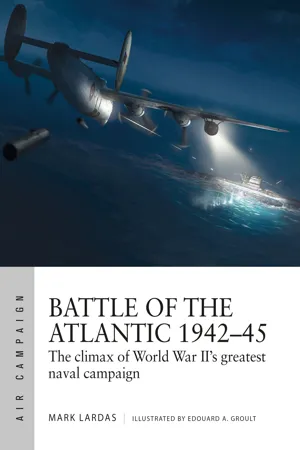
eBook - ePub
Battle of the Atlantic 1942–45
The climax of World War II’s greatest naval campaign
- 96 pages
- English
- ePUB (mobile friendly)
- Available on iOS & Android
eBook - ePub
Battle of the Atlantic 1942–45
The climax of World War II’s greatest naval campaign
About this book
Information
Table of contents
- Cover
- Title Page
- Table of Contents
- Introduction
- Chronology
- Attackerߣs Capabilities
- Defenderߣs Capabilities
- Campaign Objectives
- The Campaign
- Aftermath and Analysis
- Further Reading
- eCopyright
Trusted by 375,005 students
Access to over 1.5 million titles for a fair monthly price.
Study more efficiently using our study tools.
Frequently asked questions
Yes, you can cancel anytime from the Subscription tab in your account settings on the Perlego website. Your subscription will stay active until the end of your current billing period. Learn how to cancel your subscription
No, books cannot be downloaded as external files, such as PDFs, for use outside of Perlego. However, you can download books within the Perlego app for offline reading on mobile or tablet. Learn how to download books offline
Perlego offers two plans: Essential and Complete
- Essential is ideal for learners and professionals who enjoy exploring a wide range of subjects. Access the Essential Library with 800,000+ trusted titles and best-sellers across business, personal growth, and the humanities. Includes unlimited reading time and Standard Read Aloud voice.
- Complete: Perfect for advanced learners and researchers needing full, unrestricted access. Unlock 1.5M+ books across hundreds of subjects, including academic and specialized titles. The Complete Plan also includes advanced features like Premium Read Aloud and Research Assistant.
We are an online textbook subscription service, where you can get access to an entire online library for less than the price of a single book per month. With over 1.5 million books across 990+ topics, we’ve got you covered! Learn about our mission
Look out for the read-aloud symbol on your next book to see if you can listen to it. The read-aloud tool reads text aloud for you, highlighting the text as it is being read. You can pause it, speed it up and slow it down. Learn more about Read Aloud
Yes! You can use the Perlego app on both iOS and Android devices to read anytime, anywhere — even offline. Perfect for commutes or when you’re on the go.
Please note we cannot support devices running on iOS 13 and Android 7 or earlier. Learn more about using the app
Please note we cannot support devices running on iOS 13 and Android 7 or earlier. Learn more about using the app
Yes, you can access Battle of the Atlantic 1942–45 by Mark Lardas,Edouard A. Groult in PDF and/or ePUB format, as well as other popular books in History & Military & Maritime History. We have over 1.5 million books available in our catalogue for you to explore.