Caesar's governorship of Cisalpine Gaul gave him the opportunity to demonstrate the greatness of his character to the people of Rome through the subjugation of those outside Rome's borders.
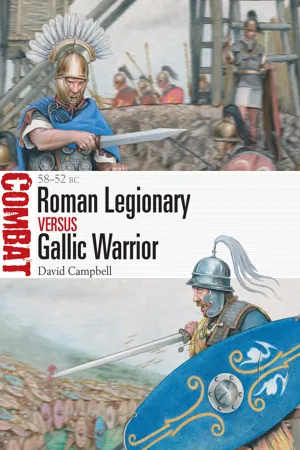
Well-armed and armoured, the Roman Army of the late Republic was trained to operate within self-supporting legions, with auxiliaries employed in roles the legions lacked such as light troops or cavalry. The Roman legions were in many ways a modern force, with formations designed around tactical goals and held together by discipline, training and common purpose.
The armies fielded by the tribes of Gaul were for the most part lightly armed and armoured, with fine cavalry and a well-deserved reputation for ferocity. As might be expected from a region made up of different tribes with a range of needs and interests, there was no consensus on how to make war – battle was an opportunity to prove their personal courage and skill, raising their status in the eyes of friends and foes alike.
Fully illustrated, this study investigates the Roman and Gallic forces pitched into combat in three battles: Bibracte (58 BC), Sabis (57 BC) and Gergovia/Alesia (52 BC). Although charismatic Gallic leaders did rise up – notably Dumnorix of the Aedui and later Vercingetorix of the Arverni – and proved to be men capable of bringing together forces that had the prospect of checking Caesar's ambitions in the bloodiest of ways, it would not be enough. For Caesar his war against the Gauls provided him with enormous power and the springboard he needed to make Rome his own, though his many domestic enemies would ensure that he did not long enjoy his success.
- 80 pages
- English
- ePUB (mobile friendly)
- Available on iOS & Android
eBook - ePub
About this book
Information
Table of contents
- Cover
- Title Page
- Table of Contents
- Introduction
- The Opposing Sides
- Bibracte
- The Sabis
- Alesia
- Analysis
- Aftermath
- Bibliography
- eCopyright
Trusted by 375,005 students
Access to over 1.5 million titles for a fair monthly price.
Study more efficiently using our study tools.
Frequently asked questions
Yes, you can cancel anytime from the Subscription tab in your account settings on the Perlego website. Your subscription will stay active until the end of your current billing period. Learn how to cancel your subscription
No, books cannot be downloaded as external files, such as PDFs, for use outside of Perlego. However, you can download books within the Perlego app for offline reading on mobile or tablet. Learn how to download books offline
Perlego offers two plans: Essential and Complete
- Essential is ideal for learners and professionals who enjoy exploring a wide range of subjects. Access the Essential Library with 800,000+ trusted titles and best-sellers across business, personal growth, and the humanities. Includes unlimited reading time and Standard Read Aloud voice.
- Complete: Perfect for advanced learners and researchers needing full, unrestricted access. Unlock 1.5M+ books across hundreds of subjects, including academic and specialized titles. The Complete Plan also includes advanced features like Premium Read Aloud and Research Assistant.
We are an online textbook subscription service, where you can get access to an entire online library for less than the price of a single book per month. With over 1.5 million books across 990+ topics, we’ve got you covered! Learn about our mission
Look out for the read-aloud symbol on your next book to see if you can listen to it. The read-aloud tool reads text aloud for you, highlighting the text as it is being read. You can pause it, speed it up and slow it down. Learn more about Read Aloud
Yes! You can use the Perlego app on both iOS and Android devices to read anytime, anywhere — even offline. Perfect for commutes or when you’re on the go.
Please note we cannot support devices running on iOS 13 and Android 7 or earlier. Learn more about using the app
Please note we cannot support devices running on iOS 13 and Android 7 or earlier. Learn more about using the app
Yes, you can access Roman Legionary vs Gallic Warrior by David Campbell,Raffaele Ruggeri in PDF and/or ePUB format, as well as other popular books in History & Military & Maritime History. We have over 1.5 million books available in our catalogue for you to explore.