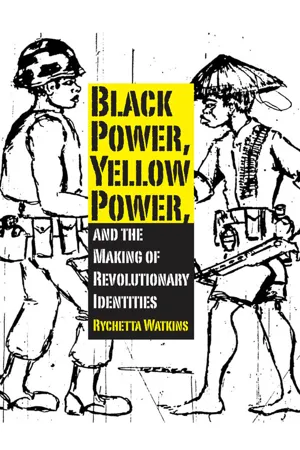
Images of upraised fists, afros, and dashikis have long dominated the collective memory of Black Power and its proponents. The "guerilla" figure—taking the form of the black-leather-clad revolutionary within the Black Panther Party—has become an iconic trope in American popular culture. That politically radical figure, however, has been shaped as much by Asian American cultural discourse as by African American political ideology. From the Asian-African Conference held in April of 1955 in Bandung, Indonesia, onward to the present, Afro-Asian political collaboration has been active and influential. In Black Power, Yellow Power, and the Making of Revolutionary Identities, author Rychetta Watkins uses the guerilla figure as a point of departure and shows how the trope's rhetoric animates discourses of representation and identity in African American and Asian American literature and culture. In doing so, she examines the notion of "Power, " in terms of ethnic political identity, and explores collaborating—and sometimes competing—ethnic interests that have drawn ideas from the concept. The project brings together a range of texts—editorial cartoons, newspaper articles, novels, visual propaganda, and essays—that illustrate the emergence of this subjectivity in Asian American and African American cultural productions during the Power period, roughly 1966 through 1981. After a case study of the cultural politics of academic anthologies and the cooperation between Frank Chin and Ishmael Reed, the volume culminates with analyses of this trope in Sam Greenlee's The Spook Who Sat by the Door, Alice Walker's Meridian, and John Okada's No No Boy.
- 199 pages
- English
- PDF
- Available on iOS & Android
eBook - PDF
Black Power, Yellow Power, and the Making of Revolutionary Identities
About this book
Information
Publisher
University Press of MississippiYear
2012Print ISBN
9781617039485
9781617031618
eBook ISBN
9781617031625
Table of contents
- Cover
- Contents
- Acknowledgments
- Introduction: Developing a Critical Perspective on Power in Literature
- Chapter One: Translating Fanon: Black and Yellow Power as American Anticolonialisms
- Chapter Two: From Gorilla to Guerilla: Defining Revolutionary Identity
- Chapter Three: Power and the Ivory Tower: Academics as Intellectual Guerillas
- Chapter Four: Reading Resistance: The Guerilla in Literature
- Chapter Five: Promise vs. Praxis: The Legacies of Power
- Notes
- Bibliography
- Index
Trusted by 375,005 students
Access to over 1.5 million titles for a fair monthly price.
Study more efficiently using our study tools.
Frequently asked questions
Yes, you can cancel anytime from the Subscription tab in your account settings on the Perlego website. Your subscription will stay active until the end of your current billing period. Learn how to cancel your subscription
No, books cannot be downloaded as external files, such as PDFs, for use outside of Perlego. However, you can download books within the Perlego app for offline reading on mobile or tablet. Learn how to download books offline
Perlego offers two plans: Essential and Complete
- Essential is ideal for learners and professionals who enjoy exploring a wide range of subjects. Access the Essential Library with 800,000+ trusted titles and best-sellers across business, personal growth, and the humanities. Includes unlimited reading time and Standard Read Aloud voice.
- Complete: Perfect for advanced learners and researchers needing full, unrestricted access. Unlock 1.5M+ books across hundreds of subjects, including academic and specialized titles. The Complete Plan also includes advanced features like Premium Read Aloud and Research Assistant.
We are an online textbook subscription service, where you can get access to an entire online library for less than the price of a single book per month. With over 1.5 million books across 990+ topics, we’ve got you covered! Learn about our mission
Look out for the read-aloud symbol on your next book to see if you can listen to it. The read-aloud tool reads text aloud for you, highlighting the text as it is being read. You can pause it, speed it up and slow it down. Learn more about Read Aloud
Yes! You can use the Perlego app on both iOS and Android devices to read anytime, anywhere — even offline. Perfect for commutes or when you’re on the go.
Please note we cannot support devices running on iOS 13 and Android 7 or earlier. Learn more about using the app
Please note we cannot support devices running on iOS 13 and Android 7 or earlier. Learn more about using the app
Yes, you can access Black Power, Yellow Power, and the Making of Revolutionary Identities by Rychetta Watkins in PDF and/or ePUB format, as well as other popular books in Social Sciences & Civil Rights in Politics. We have over 1.5 million books available in our catalogue for you to explore.